
Related Articles

 -Editorial
On February 10, daily life along the border quietly changed. The familiar crossing on First Street in Calexico ceased operations, replaced—temporarily—by a new port of entry facility on Heffernan Avenue, now serving as the primary access into Mexicali and the entry point back into the United States.
For decades, the brown, fortress-like structure on First Street stood as a defining landmark of cross-border movement. Opened in 1974 when Jimmy Carter was in national political prominence and funded during the administration of Richard Nixon, the facility shaped generations of daily crossings. Now silent, the building awaits demolition, marking the end of an era for the community that grew around it.
In a turn rich with historical symmetry, the shift to Heffernan Avenue returns the crossing to where earlier generations once passed between nations. For approximately the next two years, residents and visitors will traverse the border much as their grandparents did—on foot, through a route that echoes the region’s earliest modern crossings.
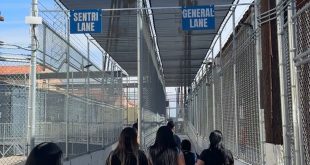
The experience itself is notably different. Travelers heading into Mexico proceed straight past the historic structure on Heffernan, then veer left into an extended pedestrian path that gradually guides them toward the area once anchored by the soon-to-be-demolished First Street facility. Entry into Mexicali comes after a final approach alongside Mexican vehicle inspection lanes, offering a new physical rhythm to a deeply familiar journey.
The temporary route reshapes not only logistics but also perspective. Where there was once a compact crossing defined by mid-20th-century infrastructure, there is now a longer, more deliberate transition—one that visually connects past and present in a single walk.
Border crossings have linked Calexico and Mexicali since the late 19th century, expanding after irrigation transformed the Imperial Valley following the 1906 breach of the Colorado River tied to the California Development Company. George Chaffey and the Imperial Land Company later organized regional towns. The 1933 facility on Heffernan Avenue remains in federal use after its 1992 listing on the U.S. National Register of Historic Places.