


Imperial County Gives Final Farewell for Those Who Had No One to Say Goodbye
Share your love
 -Editorial
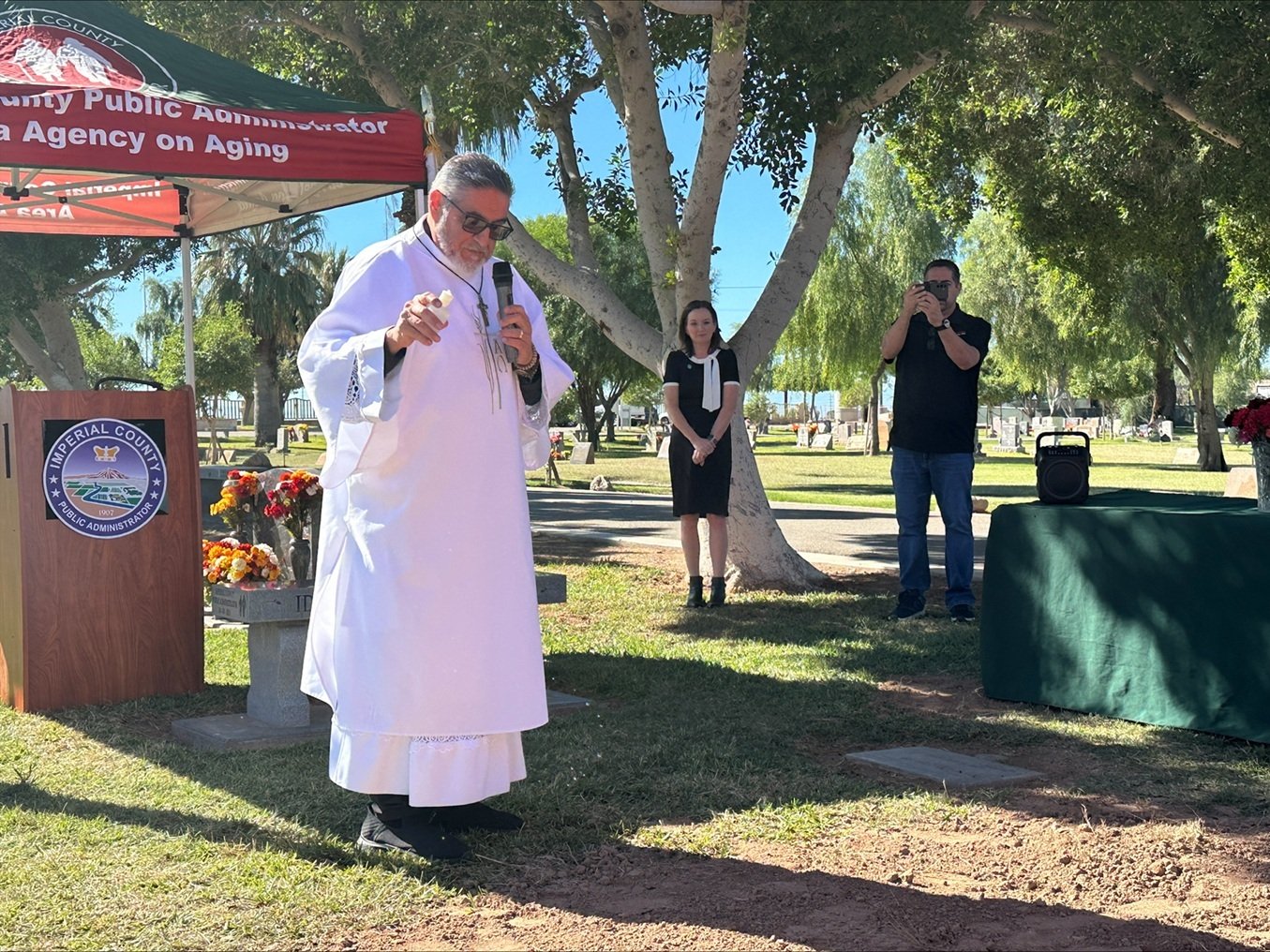
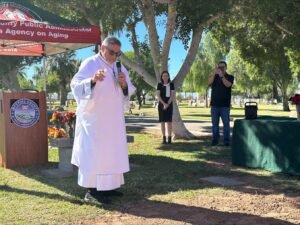
Imperial County officials, religious leaders, veterans, and community members gathered, Nov. 5, at Terrace Park Cemetery in Holtville for the annual Indigent Burial Ceremony, honoring sixty-three individuals who died without the financial resources or family support necessary to arrange their final resting places.
Organized through the Imperial County Public Administrator’s Office, the ceremony provided a formal farewell for individuals whose identities remain unknown, those without surviving relatives, and families unable to afford funeral expenses.
Sarah Enz, Imperial County public administrator, said the program ensures that individuals receive a dignified burial regardless of their circumstances.
“Our ceremony is for those who are unidentified, and it’s also geared towards families who cannot afford to pay for the final disposition of their loved ones, and for those that don’t have family,” Enz said. “We are here to give them a final send-off as we lay them to rest in their final resting place.”
Enz explained that the county’s indigent burial program began years ago, initially providing burials in a designated cemetery area where graves were identified only by numbered bricks.
“It was just very impersonal, just a dirt lot and a brick with a number,” Enz said.
Over time, county administrators developed a more personalized approach. The program previously included scattering cremated remains at sea before transitioning to its current arrangement at Terrace Park Cemetery, where two burial plots were purchased several years ago using donated funds.
Enz said the number of individuals requiring indigent burial services has remained relatively consistent, ranging between sixty and seventy annually over the past three years.
Many of those served through the program were experiencing homelessness or living without stable shelter at the time of their deaths. Cases are typically referred to the Public Administrator’s Office through the Imperial County Coroner’s Office.
Among the sixty-three individuals honored were approximately ten unidentified people whose remains were recovered in Imperial County. They believe some may have been migrants who died while attempting to cross the U.S.-Mexico border. Approximately six were recovered from the All-American Canal, while four others were discovered in remote desert areas.
Deacon Marcos Lopez of St. Margaret Mary Catholic Church in Brawley, who has participated in previous ceremonies, offered a religious blessing and emphasized the importance of providing a proper farewell.
“These are our brothers and sisters, and part of our vocation as deacons and priests is to bury the dead,” Lopez said. “That’s one of the corporal works of mercy, and that’s what we’re here to do.”
Lopez said the ceremony holds particular significance for individuals who died without family members or loved ones present.
“Those that we call the forgotten dead are truly forgotten by the world,” Lopez said. “But we have to remember that God doesn’t forget His children. God never forgets every one of us.”
A special military tribute was also included for two veterans among those laid to rest. Enz said the county handled the remains of twelve veterans during the reporting period, with ten previously transported to national cemeteries for burial.
The two veterans honored in Holtville received a final military salute, marking the first time the annual ceremony incorporated a special veterans’ tribute.
Jacinto Cruz Jiménez, a veteran who supported U.S. military operations during the Vietnam War, attended the ceremony and expressed appreciation to Imperial County for recognizing veterans who died without family members or others to honor their service.
“I am extremely grateful to Imperial County for recognizing these veterans who have not been acknowledged,” Jiménez said. “It is important that every individual be recognized by our heavenly Father for the service they provided to the government of the United States of America.”
Jiménez also addressed the challenges facing veterans experiencing homelessness and poverty, calling for greater community involvement in finding solutions.
“We all have a responsibility to work together in our communities to find a solution to this problem,” Jiménez said, noting that veteran homelessness affects communities throughout California, including San Francisco, Sacramento, Los Angeles and Imperial Valley.
He said some veterans die without stable housing or family support, making public recognition of their military service particularly meaningful.