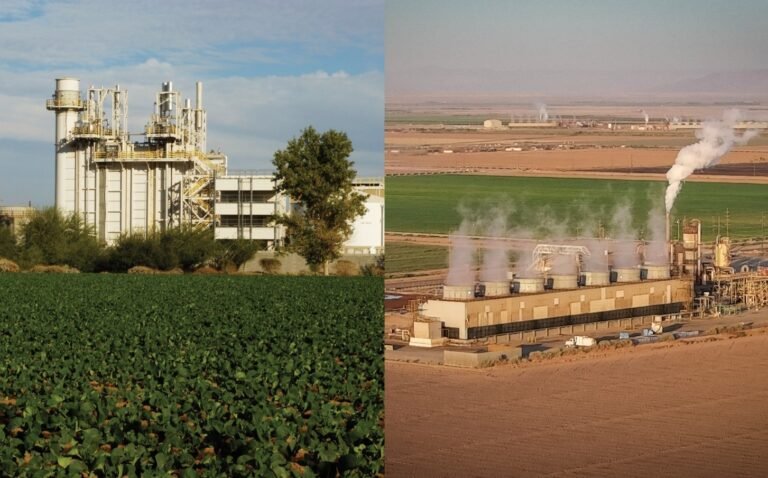




Appeals Court Orders Imperial County to Rework Environmental Review of Hell’s Kitchen Project
Share your love

-Editorial
A California appeals court has told Imperial County it must fix major problems in its review of a big geothermal and lithium project near the Salton Sea.
The court said the county’s environmental study for Controlled Thermal Resources’ Hell’s Kitchen project did not properly show that enough water would be available for the next 50 years. The project is expected to use about 6,500 acre-feet of water every year from the Imperial Irrigation District.
The judges also found that the study did not adequately examine what would happen if Colorado River water supplies drop in the future, or how taking water that might otherwise support farms could reduce flows into the Salton Sea. Less water reaching the sea can leave more dry lakebed exposed, which can kick up more dust and worsen air quality for nearby communities.
The court did uphold the county’s work on consulting with local tribes about cultural sites.
Hell’s Kitchen would build a geothermal power plant and facilities to pull lithium and other minerals from underground hot brine. The used brine would be pumped back underground. It is one of several lithium projects being looked at in the Imperial Valley, an area with large lithium deposits under the Salton Sea region.
Community groups Comite Civico del Valle and Earthworks challenged the county’s approval, saying the environmental review fell short of state law. A lower court had sided with the county, but the appeals court reversed parts of that ruling and sent the case back with orders to correct the problems.
“This decision is not against lithium development,” said Luis Olmedo, CCV’s Executive Director. “It is about getting lithium development right. Imperial Valley can lead the clean energy transition, while also protecting our water resources, public health, and communities.”
Olmedo further added that “Today’s decision reinforces a simple principle. Projects of this scale must be supported by credible evidence, not assumptions, about long-term water availability, enforceable mitigation, and impacts to surrounding communities. The transition to clean energy should never come at the expense of our local environment and the health of Imperial Valley families.”
CTR proposes to use direct lithium extraction (DLE). While some forms of DLE have operated commercially for years, many of the newer DLE technologies proposed for large-scale projects remain in the early stages of commercial deployment, making careful environmental review and independent evaluation essential.
“When companies come into a community to make a profit, they need to respect the people who live there,” said Jared Naimark, western mining senior manager at Earthworks, an international environmental justice organization. “One way to show that respect is to follow the law from the start instead of cutting corners.”
The ruling does not kill the project. It requires the county to strengthen the environmental analysis, especially on long-term water supplies and effects on the Salton Sea and air quality, before the project can move forward under the previous approval.
In a statement to Beyond Borders Gazette, Eddie Lopez, deputy CEO of communications for Imperial County, said the county is reviewing the recent appellate court decision involving Controlled Thermal Resources’ Hell’s Kitchen project and consulting with legal counsel to evaluate the ruling and potential next steps.
“The County remains committed to supporting responsible lithium and geothermal development that protects our environment, creates high-quality local jobs and delivers lasting economic benefits for Imperial County residents,” Lopez said.
Because the matter remains under active legal review, the county will not comment further on its future direction at this time, Lopez said.