


The American Society of Mexico Receives Business Merit Medal
Share your love
 -Editorial
The American Society of Mexico (AmSoc) was awarded the Medal of Business Merit by the Mexico City Congress in recognition of its contributions to business ethics, corporate culture, and binational economic engagement, organization leaders said Tuesday.
The honor, granted in the category of Business Culture and Ethics, recognizes institutions and individuals that promote transparency, integrity, and social responsibility in the private sector. AmSoc leaders described the award as a formal acknowledgment of the organization’s role in fostering dialogue between Mexican and U.S. business communities.
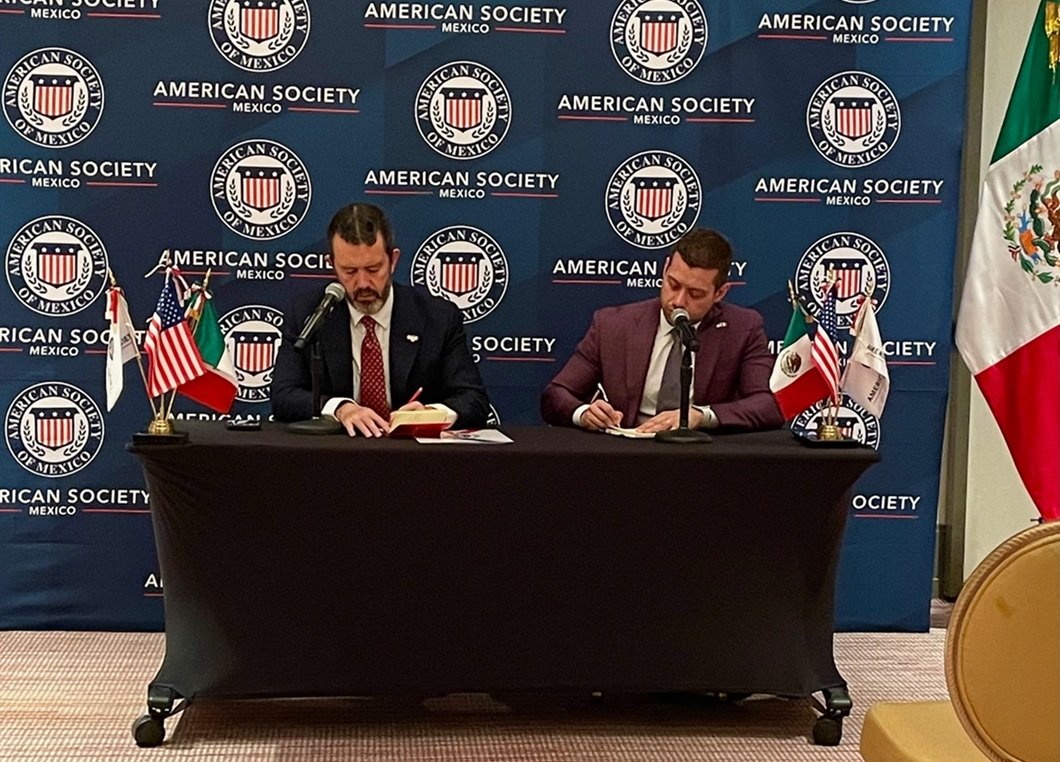
Larry Rubin, president of AmSoc, and Enrique Huesca, the organization’s chief executive officer, received the recognition during a public ceremony and later discussed its significance during a press briefing in Mexico City.
Rubin said the distinction reinforces AmSoc’s mission of promoting ethical business practices while strengthening the economic relationship between Mexico and the United States.
“This medal confirms that real competitiveness is built with integrity, compliance, and a long-term vision that benefits both societies,” Rubin said. “It also reflects the importance of institutions that can serve as bridges between our two countries.”
Beyond the award, Rubin used the occasion to urge a broader approach to the Mexico–U.S. relationship, saying it should not be limited to trade and tariff discussions but understood as a long-term strategic alliance.
He pointed to the United States-Mexico-Canada Agreement (USMCA) as the foundational framework for regional integration but argued that North America’s economic future depends on expanding cooperation into areas such as energy, infrastructure, security, and regulatory alignment.
“The USMCA is the axis of our integration, but the future of the region depends on advancing a broader strategic agenda that ensures sustained and shared growth,” Rubin said. “We must move toward a vision that includes energy security, infrastructure development, legal certainty, and coordinated security policies.”
The USMCA, which replaced the North American Free Trade Agreement (NAFTA), governs trade and investment across the three countries and is scheduled for a joint review process in the coming years. Business groups and policymakers on both sides of the border have increasingly debated how the agreement could evolve in response to supply chain shifts, energy transition policies, and geopolitical competition.
Huesca emphasized that the geographic proximity of Mexico and the United States requires deeper cooperation not only in economic matters but also in security.
“Mexico and the United States, as neighboring countries, not only share commercial privileges but also unavoidable responsibilities in security matters,” Huesca said. “This relationship demands a strategic vision and coordinated action to build lasting solutions.”
He said current economic and security challenges in the region make cross-border coordination more important than ever, particularly in sectors such as energy, logistics, and industrial supply chains.
According to Huesca, strengthening North American competitiveness will require sustained collaboration between governments and private sector institutions.
“Only through greater regional cooperation can we strengthen North America’s competitiveness and fully take advantage of the opportunities we have as a bloc,” he said.
During the briefing, Rubin also highlighted what he described as constructive engagement from senior Mexican officials in recent bilateral discussions.
He specifically cited Energy Secretary Luz Elena González Escobar, Economy Secretary Marcelo Ebrard, and Deputy Foreign Minister Roberto Velasco, saying each has played a role in maintaining dialogue on key aspects of the Mexico–U.S. relationship.
Rubin said González Escobar has been involved in energy coordination discussions central to regional integration, while Ebrard has led economic and trade policy efforts tied to the USMCA framework. He also credited Velasco with strengthening diplomatic channels and institutional communication between the two countries.
He said AmSoc has found these channels useful in advancing what he described as a more structured and results-oriented bilateral agenda.
Rubin announced that both he and Huesca will travel to Houston, Texas, in the coming weeks to participate in meetings focused on energy cooperation between Mexico and the United States.
He said the discussions will bring together industry representatives and policy stakeholders to continue technical dialogue on cross-border energy infrastructure, investment, and regulatory coordination.
The Houston meetings, he said, are intended to build on ongoing conversations about regional energy integration, particularly as both countries navigate transitions in energy production, demand, and sustainability policy.
The remarks come as Mexico and the United States continue to deepen economic ties under the USMCA framework, even as both countries face domestic political pressures related to trade policy, energy regulation, and industrial competitiveness.
Mexico has become one of the United States’ largest trading partners, with deeply integrated manufacturing and supply chains spanning automotive, electronics, agriculture, and energy sectors. At the same time, debates over energy policy and investment rules have periodically tested bilateral relations.
Business organizations such as AmSoc have positioned themselves as intermediaries advocating for predictability, regulatory stability, and long-term planning across borders.
They characterized the current moment as an opportunity to strengthen North America’s position in global markets through coordinated economic strategy and deeper institutional cooperation.