


Mexico Cites Stronger Peso, Wage Increase, and Tourism Growth at the Start of 2026
Share your love
 -Editorial
President Claudia Sheinbaum said that Mexico entered 2026 with signs of economic momentum, citing a strengthening peso, rising wages, solid stock market performance, and continued growth in international tourism.
Speaking during her daily news conference, Sheinbaum highlighted what she described as five positive economic indicators: low unemployment, gains by the peso against the U.S. dollar, record performance by Mexico’s stock exchanges, an increase in international visitors, and a rise in the minimum wage.
She said the peso posted its strongest annual gain against the dollar since 1991, according to financial media reports, while the Mexican Stock Exchange recorded its best year since 2009. The Institutional Stock Exchange, which began operations in 2018, also posted its strongest annual performance.
As of Jan. 1, Mexico’s minimum wage increased by 13%, continuing a multiyear trend of wage hikes aimed at improving household income and purchasing power. Sheinbaum also said Mexico ranks among countries with the lowest unemployment rates globally, citing government data.
Tourism Secretary Josefina Rodríguez said tourism continues to play a central role in the Mexican economy, supported by rising international and domestic travel. From January through October 2025, Mexico received 79.3 million international visitors, an increase of 13.6% compared with the same period in 2024, she said.
During that same period, international tourist arrivals — visitors who stayed at least one night — increased 5.8% to 38.4 million. Domestic tourism reached 92.6 million travelers, up 3.3% from a year earlier. Average hotel occupancy nationwide stood at 60.2%, an increase of 2.3 percentage points from 2024.
Rodríguez said the main source markets for air travel to Mexico were the United States, Canada, the United Kingdom, Argentina, Spain, Costa Rica, Italy, China, Panama, and South Korea.
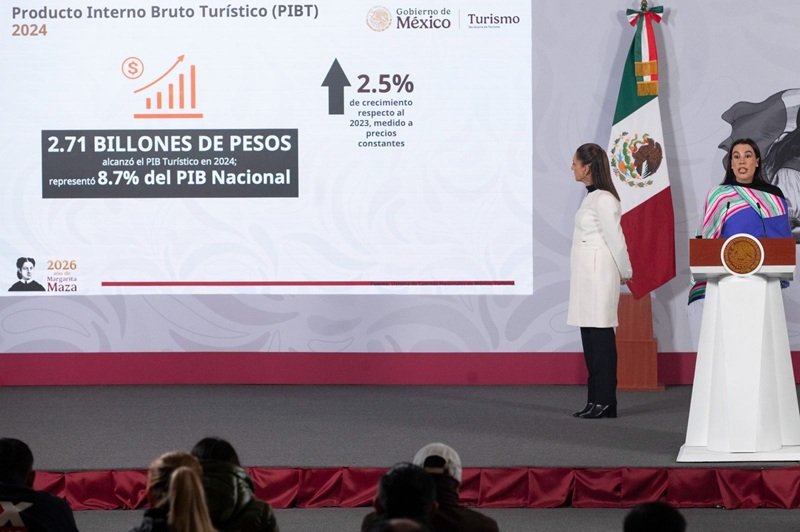
According to the Tourism Ministry, the country’s tourism gross domestic product reached 2.71 trillion pesos, matching 2024 levels and accounting for 8.7% of national GDP. Foreign direct investment in tourism totaled $787.6 million in the third quarter of 2025, representing a 40.3% increase compared with the same period a year earlier. Much of that investment was concentrated in serviced apartments, vacation properties, and hotels with integrated services.
Tourism-related employment continued to grow, Rodríguez said, reaching about 5 million jobs nationwide. Roughly one in every 10 jobs in Mexico is now linked to tourism, according to official figures. In November 2025, employment in the sector increased 4.9% compared with the previous year.
Air travel also showed steady growth. Rodríguez said airlines operating in Mexico transported more than 110.7 million passengers in 2025, a 2.3% increase from 2024. A total of 111 new air routes were launched during the year, including 67 international and 44 domestic routes.
From November 2025 through March 2026, airlines scheduled approximately 14 million seats on flights from the United States and Canada to Mexico, a 2.5% increase from the same period a year earlier. For Mexico’s beach destinations alone, about 8 million airline seats were booked on more than 45,000 flights from the United States during November and December 2025, an increase of 4.8% year over year.
Rodríguez said the government expects global tourism to grow between 4% and 5% by the end of 2025, according to estimates from the United Nations. In Mexico, international tourist arrivals are projected to rise 6.6% for the full year, generating an estimated $35.1 billion in revenue. Domestic tourism is expected to account for roughly 111 million hotel room nights nationwide.
For the year-end holiday period, from Dec. 20, 2025, through Jan. 11, 2026, officials estimate that hotel occupancy by domestic and international travelers will increase 7.5% compared with the same period in 2024.
Rodríguez cited several destinations that posted notable gains. In Mazatlán, she said, cruise ship arrivals reached more than 253,000 passengers from January through November 2025, supported by 112 port calls. The city recorded an estimated economic impact of 637 million pesos from cruise tourism, along with more than 5,100 scheduled flights carrying about 690,000 passengers. Seven new domestic air routes were added during the year, and hotel occupancy increased by more than 14 percentage points compared with November 2024.
In Acapulco, tourism activity rebounded sharply, Rodríguez said, with visitor numbers increasing 47.2% and tourism-related revenue rising 110%. Hotel occupancy reached 96.1%, and four new air routes were launched.
Looking ahead, Sheinbaum said the government is preparing for the 2026 FIFA World Cup, which Mexico will co-host with the United States and Canada. She said investments are underway to modernize airports, streamline immigration procedures for visitors, and strengthen security protocols ahead of the tournament.
Officials said they expect the event to further boost tourism, investment, and international visibility for Mexico as the country continues to position tourism as a cornerstone of economic growth.