


The Mexico–United States Border Economy and the November 2026 Elections
Share your love
 By: Dr. Alejandro Diaz-Bautista, Economist and Researcher (PhD).
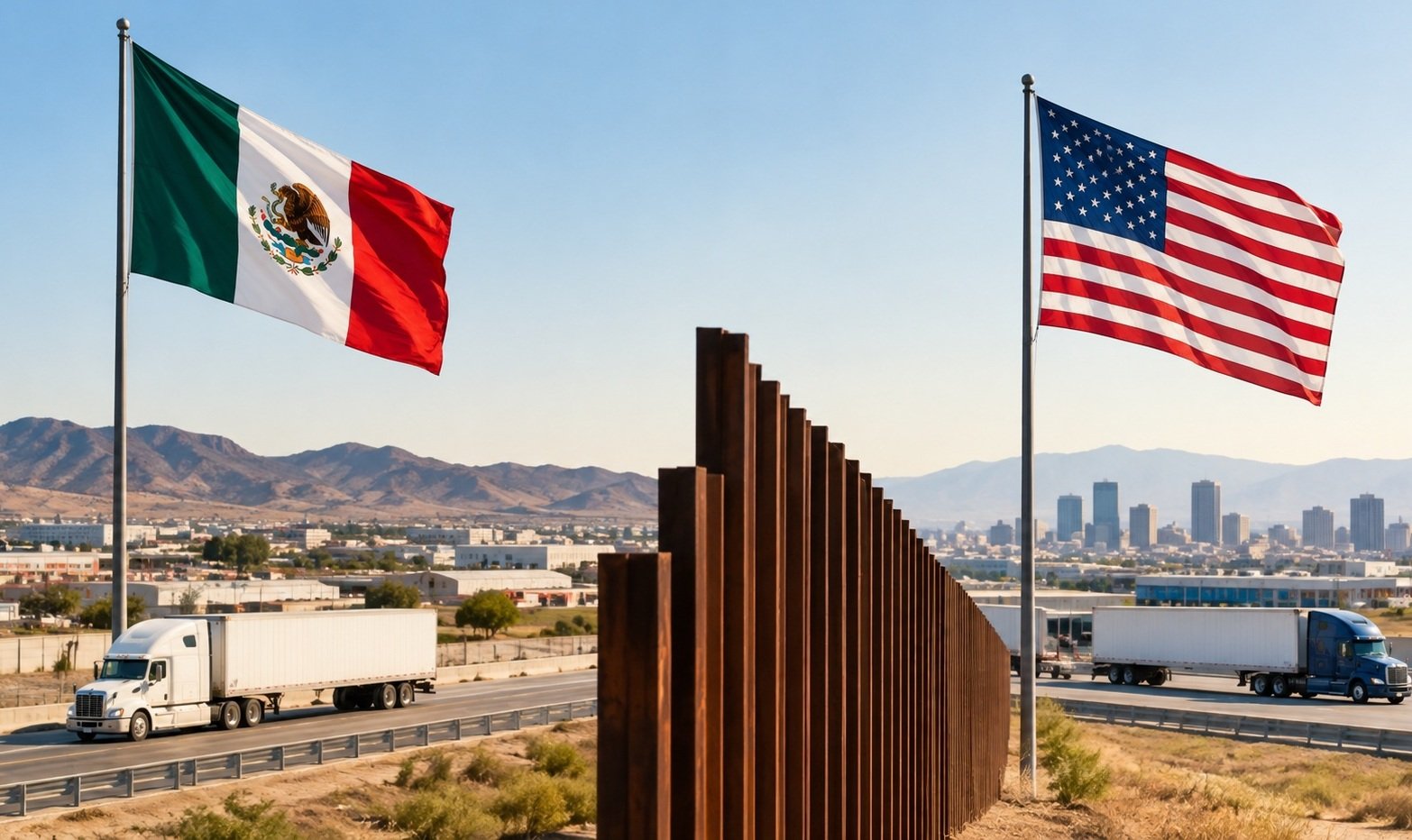
The economy of the Mexico–United States border constitutes one of the areas of greatest productive and commercial integration in North America.
The bilateral relationship is not limited to the exchange of goods. It also encompasses closely interconnected supply chains, manufacturing, agriculture, services, transportation, investment, and labor markets.
In 2025, trade in goods and services between the two countries reached approximately $964.1 billion, while goods trade totaled $871.6 billion. Mexico was also the leading source of U.S. imports.
In this context, the November 2026 U.S. elections are particularly relevant to the border economy.
The review of the United States–Mexico–Canada Agreement (USMCA) constitutes one of the main economic issues.
During 2026, both governments have held several rounds of negotiations on rules of origin, automobiles, steel and aluminum, agriculture, economic security, and regional supply chains.
The electoral dimension may influence the debate over the economy, trade, tariffs, immigration, and border security.
According to recent information, Mexico and the United States are accelerating their trade negotiations in 2026. Issues under discussion include tariffs on vehicles and U.S. content requirements for automotive production in Mexico.
For border cities, trade uncertainty can have differing effects.
 Greater productive integration may support investment, employment, and cross-border trade; conversely, higher tariff costs or changes to rules of origin could increase production costs and influence business location decisions.
The automotive industry is a particularly relevant example due to the high degree of integration within its production chains.
California illustrates the importance of this relationship. During 2025, it exported $34.9 billion in goods to Mexico, equivalent to 19% of the state’s exports.
Therefore, the legislative outcomes and trade policy directions that emerge after November 2026 will have implications that extend beyond Washington and Mexico City and may directly affect regional border economies.
From an academic perspective, the electoral period provides an opportunity to study how trade policy, regional economic integration, and border dynamics interact, avoiding the view of the border solely as a space of immigration control.
Analyzing trade, investment, employment, logistics, and competitiveness will provide a better understanding of the potential economic effects of decisions adopted during the electoral process and the subsequent review of the USMCA.
Dr. Alejandro Díaz-Bautista, Research Professor of International Economics at El Colef. Distinguished member of Mexico’s National System of Researchers. He has also been a professor at Universidad Iberoamericana and CISE, a “fellow” and “guest scholar” at UCSD, and a visiting professor at UC Irvine.