


Trump Awards National Science and Technology Medals to Six U.S. Innovators
Share your love
 -Editorial
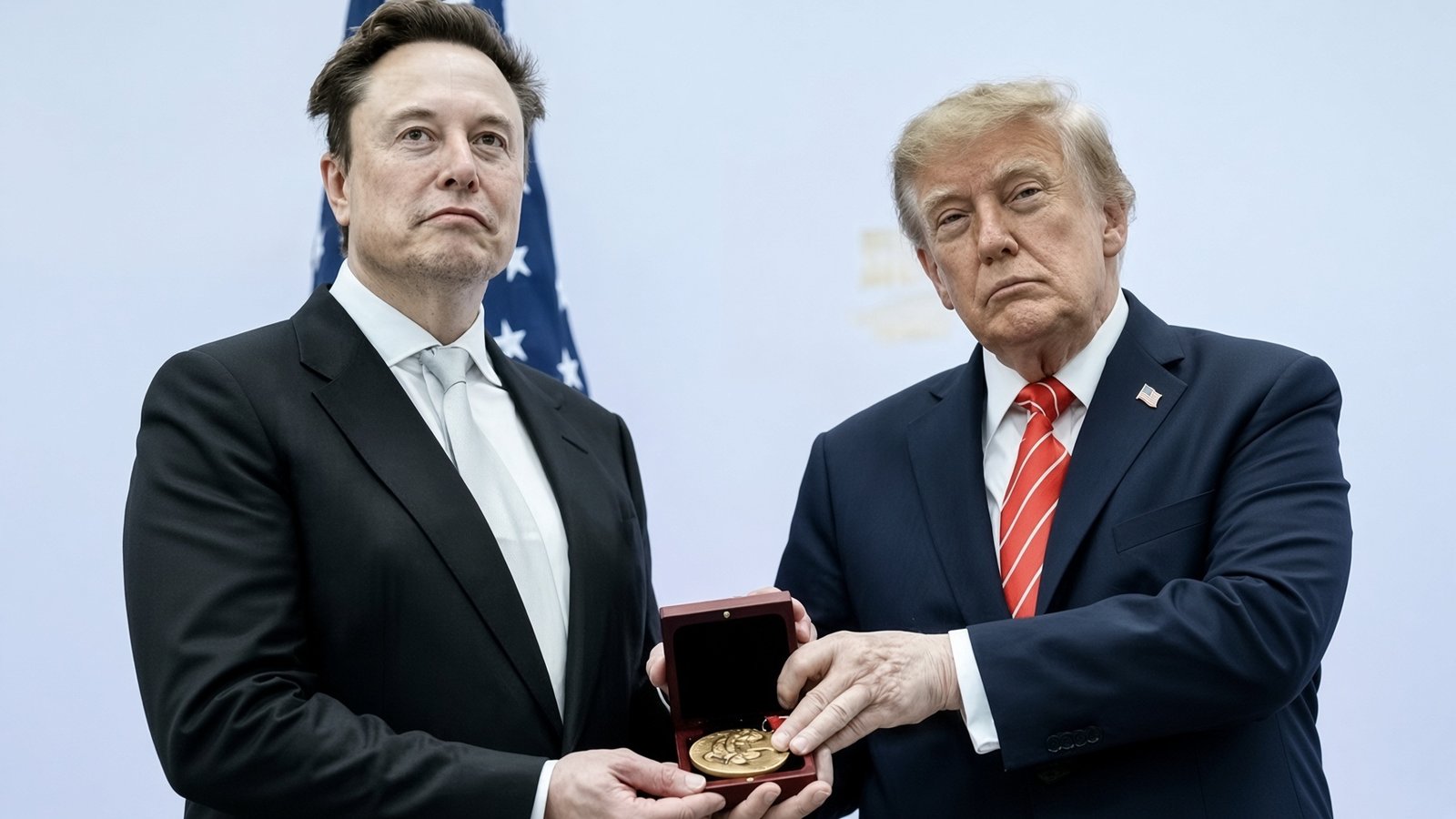
President Donald Trump presented the National Medal of Science and the National Medal of Technology and Innovation to six prominent technology executives and innovators on Oct. 8 during the Science: A New Golden Age Summit, recognizing their contributions to scientific research, computing, semiconductor development and technological advancement.
The recipients included Elon Musk, Sergey Brin, Jensen Huang, Lisa Su, Michael Dell and Satya Nadella, whose work has influenced industries ranging from space exploration and artificial intelligence to personal computing and cloud infrastructure.
The awards are among the federal government’s highest honors for scientific and technological achievement.
Established in 1959 and first awarded in 1963, the National Medal of Science recognizes individuals who have made significant contributions to scientific knowledge. The National Medal of Technology and Innovation, first awarded in 1985, honors individuals whose technological achievements have contributed to economic development and improvements in quality of life.
Four recipients received the National Medal of Science, while two were recognized with the National Medal of Technology and Innovation.
Musk, the chief executive of Tesla and SpaceX, received the National Medal of Science for engineering achievements involving space exploration, communications, intelligent systems, and manufacturing. The White House cited his role in advancing technologies that have expanded commercial spaceflight and other engineering capabilities.
Brin, Google’s co-founder, was recognized for his contributions to information retrieval and data processing. His work on search algorithms helped establish technologies that changed how individuals, businesses, and researchers access information.
Huang, founder and chief executive of Nvidia, received the award for advancements in graphics processing units and parallel computing. His contributions helped expand the use of GPUs beyond graphics applications into scientific research, high-performance computing and artificial intelligence.
Su, chair and chief executive of Advanced Micro Devices, was honored for her leadership in semiconductor engineering and processor development. The White House highlighted her contributions to chiplet-based integration and high-performance computing, including technologies used in the development of the world’s first exascale supercomputer.
The National Medal of Technology and Innovation was awarded to Dell and Nadella.
Dell, founder and chief executive of Dell Technologies, was recognized for his contributions to the expansion of personal and enterprise computing. The White House also cited his leadership in developing a global technology company and his support for education and future generations of scientists and engineers.
Nadella, chair and chief executive of Microsoft, received the medal for his leadership in expanding the company’s cloud computing operations and developing large-scale computing infrastructure. The administration highlighted Microsoft’s role in supporting artificial intelligence development and deployment.
Michael Kratsios, director of the White House Office of Science and Technology Policy, said the recipients had made contributions that continue to influence technological development.
“Each of these medalists has transformed their field or industry, laying the foundations for technologies we already can barely imagine living without,” Kratsios said.
He also emphasized the role of individual researchers, engineers and business leaders in advancing scientific progress.
“Innovators like these six awardees are the architects of the future,” he said.
The recognition ceremony was part of the administration’s broader initiative to strengthen U.S. competitiveness in scientific research and emerging technologies.
The summit brought together scientists, technology executives, researchers and representatives of academic institutions to discuss changes in scientific discovery, research funding and collaboration between the public and private sectors.
The event followed the July 2026 release of Science: A New Golden Age, a policy report authored by Kratsios that outlines recommendations for restructuring and expanding the nation’s scientific research efforts.
According to the White House, the report examines how scientific discovery has changed since the publication of Vannevar Bush’s influential 1945 report, Science: The Endless Frontier, which helped shape federal support for scientific research after World War II.
The administration’s report identifies the growing role of private industry in research and development, along with increasing connections between fundamental scientific research and commercial applications.
Its recommendations include expanding opportunities for early-career scientists, establishing new research funding models, supporting large-scale scientific initiatives, and improving methods for evaluating research effectiveness.
The report also calls for greater use of artificial intelligence in scientific discovery through the administration’s Genesis Mission, an initiative intended to integrate advanced computing technologies into research activities.
Other administration priorities discussed in connection with the summit include nuclear energy development, space technology, quantum computing, and the expansion of advanced computing infrastructure.