


SpaceX Achieves First Starship Tower Catch in Milestone 15th Test Flight
Share your love
 – Editorial
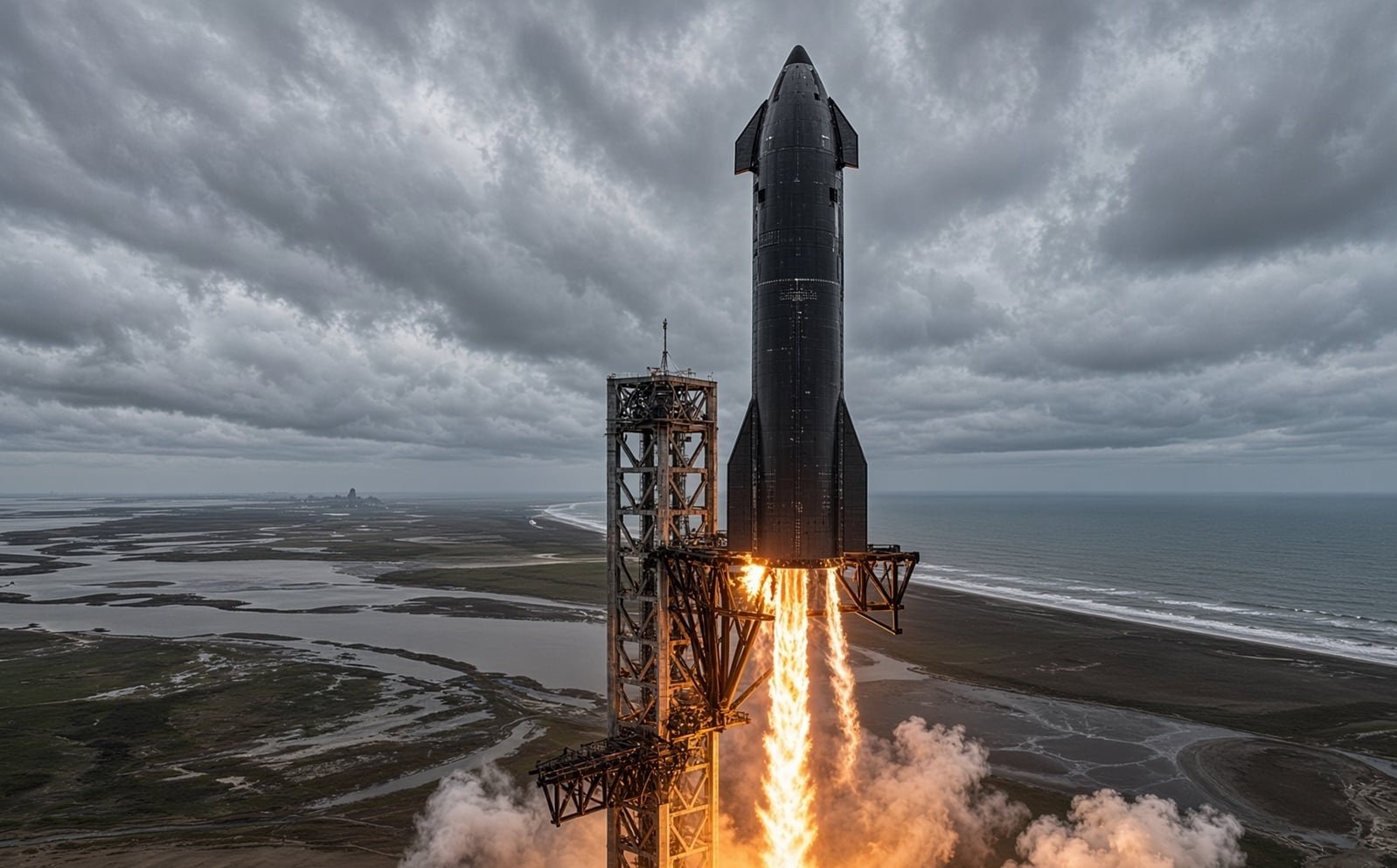
SpaceX reached a major milestone in aerospace engineering Saturday, November 14, after successfully capturing its Starship spacecraft with the mechanical arms of its launch tower following an approximately 22½-hour orbital mission. The achievement marked the first successful tower capture of a Starship upper stage returning from orbit, advancing the company’s efforts to develop a fully reusable launch system.
The 15th integrated Starship test flight began Friday, November 13, at SpaceX’s Starbase facility in South Texas. The mission was designed to evaluate several critical technologies, including orbital operations, satellite deployment, engine performance, atmospheric reentry and spacecraft recovery. Although Starship completed its planned orbital mission and returned successfully, the Super Heavy booster did not accomplish its intended recovery.
Starship consists of two primary components: the Super Heavy first-stage booster and the spacecraft itself, which serves as the upper stage. Together, they form a massive launch system designed to transport satellites, cargo and eventually astronauts beyond Earth orbit.
During liftoff, Super Heavy’s 33 Raptor engines generated the thrust necessary to propel the vehicle through Earth’s atmosphere. Following the initial ascent, the booster separated from Starship through a maneuver known as hot staging, allowing the spacecraft’s engines to ignite before physical separation was completed.
Starship continued toward orbit using its six Raptor engines, while Super Heavy initiated its return sequence. The booster performed a directional maneuver and attempted to reignite its engines for the boostback burn, which is intended to redirect the vehicle toward its recovery location. However, a low-fuel-mass alarm caused the maneuver to end prematurely.
According to SpaceX, the booster’s automated guidance system determined that the vehicle could not safely proceed with its planned recovery. It redirected the booster toward a designated offshore contingency area in the Gulf of Mexico, where its landing sequence concluded with the activation of its flight termination system. The company said the underlying cause of the fuel-related issue remained under investigation.
Meanwhile, Starship successfully reached orbit and deployed 26 next-generation Starlink V3 satellites, demonstrating its capacity to transport and release multiple payloads during a single mission. SpaceX reported establishing communication with the satellites following deployment as they began raising their orbits to join the company’s global satellite internet constellation.
The spacecraft subsequently remained in orbit for more than 20 hours, allowing flight controllers to monitor its systems and collect operational data before beginning its return to Earth. This extended phase provided additional information about spacecraft performance, propulsion systems and the procedures required for controlled orbital reentry.
Starship then performed a deorbit burn using one of its Raptor engines, changing its trajectory to begin its descent through Earth’s atmosphere. During reentry, the spacecraft relied on its aerodynamic control surfaces to regulate its orientation and manage the extreme conditions associated with returning from orbital velocity.
As it approached the Texas coastline, Starship completed its final descent maneuvers over the Gulf of Mexico before heading toward the Starbase launch facility. Three Raptor engines ignited during the landing sequence to slow the spacecraft and guide it into an upright position.
The mission’s defining moment came when Starship approached the launch tower’s mechanical recovery system, known as Mechazilla. Equipped with two enormous mechanical arms, commonly called chopsticks, the structure is designed to capture returning rocket stages in midair rather than requiring conventional landing legs or a separate recovery platform.
The tower’s mechanical arms successfully secured Starship, completing the first tower capture of an orbital-class spacecraft upper stage following its return from space. The maneuver demonstrated a new recovery capability and provided an important validation of SpaceX’s approach to retrieving major rocket components directly at the launch facility.
The technological implications extend well beyond the achievement of a successful landing. SpaceX is pursuing a launch system in which both stages can potentially return, undergo inspection and refurbishment, and fly again. Traditionally, many orbital launch systems have discarded or expended substantial portions of their hardware after missions, increasing manufacturing requirements and operational costs.
Recovering and reusing both Starship and Super Heavy could eventually reduce the resources required for frequent launches while increasing the amount of cargo transported into space. For the satellite communications industry, this capability could support the deployment of larger satellite networks and more sophisticated telecommunications infrastructure. It could also expand opportunities for commercial space transportation, scientific research and future exploration.
The development is particularly relevant to NASA’s Artemis program, which selected a modified version of Starship as its Human Landing System for future lunar missions. The spacecraft is also central to SpaceX’s longer-term ambitions for missions to Mars. However, achieving these objectives will require additional testing, technological improvements and successful demonstrations of the systems needed for sustained human spaceflight.
Despite the historic tower capture, Flight 15 did not accomplish every planned objective. The Super Heavy booster failed to complete its intended recovery, and the fuel-related issue remains under investigation. Furthermore, one successful spacecraft capture does not establish that Starship is ready for routine commercial operations. Engineers must continue evaluating heat-shield performance, structural integrity, propulsion reliability and the inspection and refurbishment requirements between flights.
Nevertheless, the successful orbital return and tower capture represent a significant engineering achievement for SpaceX and the broader aerospace industry. Flight 15 demonstrated that an orbital spacecraft can return to its launch facility and be captured mechanically, bringing the concept of a fully reusable launch system closer to operational reality.
As competition and investment in the global space economy continue to grow, advances in reusable rocket technology could reshape how satellites are deployed, how commercial missions are conducted and how humanity approaches exploration beyond Earth. SpaceX’s latest achievement does not eliminate the technical challenges ahead, but it marks an important step toward making access to space more scalable, efficient and potentially less expensive.