


San Diego and Baja California Leaders Mark 20 Years of Binational Cooperation
Share your love
-Editorial
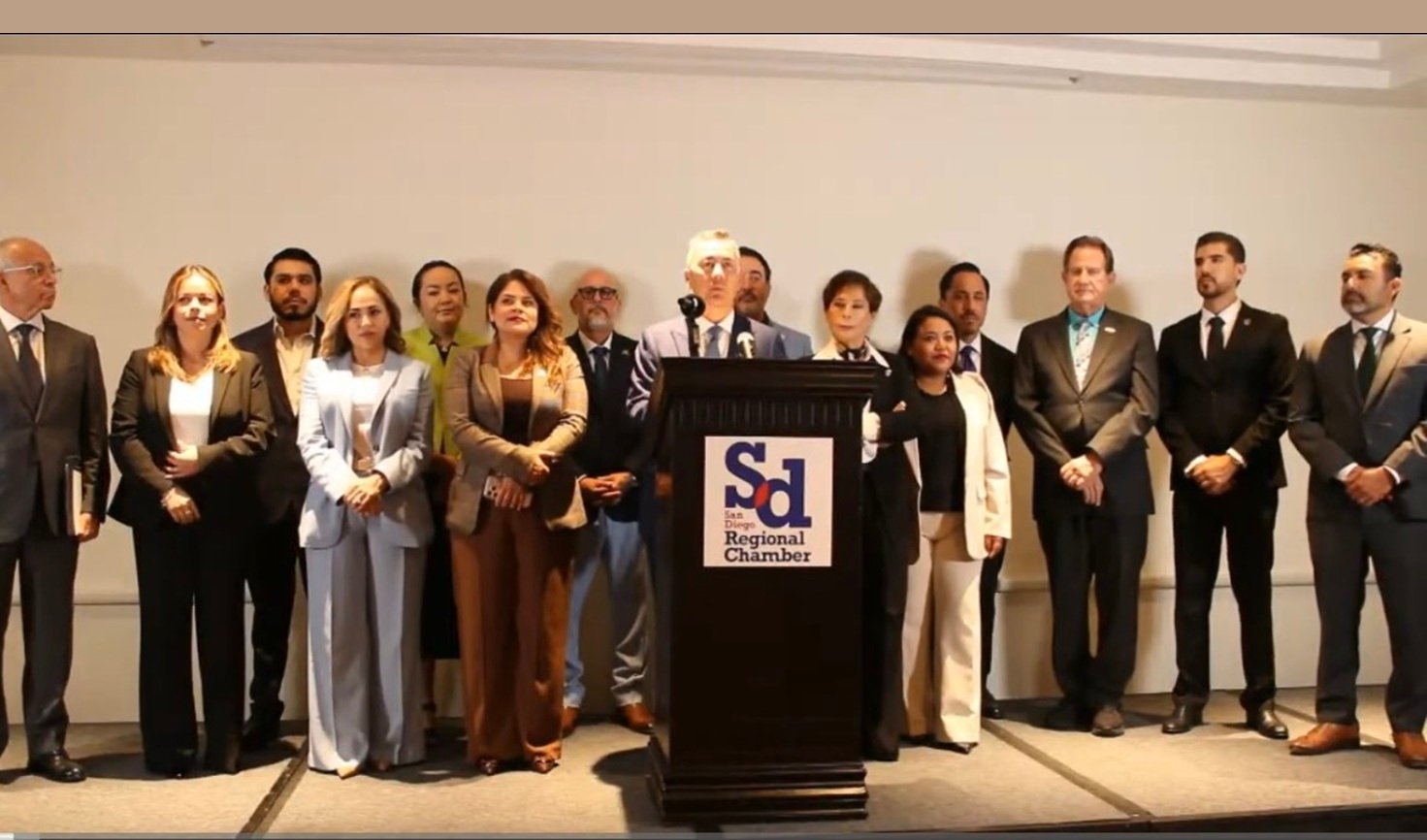
More than 100 business and community leaders from San Diego and Baja California gathered in Mexico City for the San Diego Regional Chamber of Commerce’s 20th annual Binational Delegation, marking two decades of efforts to strengthen cross-border trade, infrastructure development, and economic cooperation between the United States and Mexico.
The delegation includes regional mayors, city council members, elected officials, business representatives, and community leaders from both sides of the border. Over three days, participants are scheduled to meet with members of the Mexican Senate, federal cabinet officials and other government representatives to discuss shared economic and infrastructure priorities.
San Diego Regional Chamber of Commerce President and CEO Chris Cate said the annual delegation has evolved into an important platform for addressing challenges affecting businesses and communities throughout the CaliBaja region.
“Twenty years ago, the chamber had a simple idea: send our region’s best and brightest to Mexico City, sit them down across the table from decision-makers who matter, and solve real problems,” Cate said.
Cate highlighted several initiatives that the chamber has supported over the past two decades, including the modernization and expansion of the San Ysidro and El Chaparral ports of entry, development of the Cross Border Xpress terminal and progress on the Otay Mesa East port of entry project.
He also pointed to the delegation’s advocacy for the United States-Mexico-Canada Agreement, commonly known as USMCA, and efforts to secure funding for wastewater infrastructure improvements in Tijuana.
According to Cate, the chamber’s binational advocacy contributed to securing $144 million in Mexican federal funding to address wastewater problems affecting the Tijuana River Valley. The funding has supported improvements to wastewater treatment facilities and rehabilitation of pumping stations on the Mexican side of the border.
The chamber has also pursued agreements with the Mexican Senate and the American Chamber of Commerce to establish formal channels for cooperation on trade and economic development.
Cate said the delegation’s current priorities include water management, infrastructure investment, economic development and reducing barriers to cross-border commerce.
“When you take 100-plus business leaders, put them in rooms with Mexican senators, cabinet secretaries and federal decision-makers, and you have serious conversations about shared challenges, things move,” Cate said.
Mexican Consul General in San Diego Alicia G. Kerber-Palma emphasized that economic and social integration between San Diego and Baja California is already well established and that future efforts should focus on creating permanent mechanisms to strengthen existing partnerships.
Kerber-Palma pointed to educational exchanges and business initiatives as examples of cooperation that could be expanded through formal agreements and public policies.
Among the initiatives discussed was a cross-border educational consortium connecting universities in San Diego and Baja California to encourage student exchanges and academic collaboration.
She also highlighted the development of a cross-border women’s business coalition intended to strengthen representation and opportunities for women involved in regional commerce.
“The CaliBaja region is already an integrated zone that has shown the world how we can cooperate,” Kerber-Palma said.
She encouraged regional leaders to coordinate their efforts so that issues affecting border communities receive greater attention from policymakers in Washington and Mexico City.
San Diego Mayor Todd Gloria outlined three objectives for the delegation: strengthening relationships with Mexican partners, advocating for businesses and workers involved in binational trade, and advancing solutions to cross-border infrastructure and environmental challenges.
Gloria said the relationship between San Diego and Mexico is essential to the region’s economy, with families, businesses, and supply chains operating across the international boundary.
He cited more than $60 billion in goods moving through the Otay Mesa Port of Entry in 2024, illustrating the importance of border infrastructure to regional and international commerce.
Gloria also noted that approximately one in five personal vehicles entering the United States through land ports of entry passes through San Ysidro.
“These ports are absolutely foundational economic infrastructure for both of our countries,” Gloria said.
The mayor emphasized the importance of maintaining stable trade relations among the United States, Mexico, and Canada amid uncertainty surrounding the future of the USMCA.
He said predictable trade policies allow businesses to make long-term investments, support employment opportunities, and help limit costs for consumers.
“North America is stronger when the United States, Mexico, and Canada maintain a predictable, integrated, and competitive economic partnership,” Gloria said.
Gloria, who also serves as president of the U.S. Conference of Mayors, said local leaders from communities along both the northern and southern U.S. borders recognize the economic importance of international trade.
He urged federal governments to resolve trade disagreements through negotiations while preserving the trilateral framework.
Another major priority is the ongoing Tijuana River Valley sewage crisis, which has affected public health, environmental conditions, and recreational access in communities near the international border.
Gloria said addressing the problem requires continued infrastructure investment and coordination among government agencies in both countries.
He also identified improvements to border crossing efficiency and security as essential to maintaining regional competitiveness.
“Investments that reduce wait times and improve the movement of people and goods strengthen our binational region,” Gloria said.
Baja California Secretary of Economy and Innovation Kurt Honold underscored the economic importance of cooperation between Mexico and the United States, particularly for border states whose industries and communities depend on international commerce.
“As a border state, we experience firsthand the opportunities that arise when we work together,” Honold said in Spanish.
Chula Vista Councilmember Carolina Chavez, who said she has participated in the delegation for 11 years, emphasized the region’s economic interdependence.
Chavez said cross-border partnerships contribute to investment, innovation, employment and business development, benefiting communities in both countries.
“Our borders should not be viewed as a dividing line, but as a strategic economic asset,” Chavez said.
She highlighted the region’s geographic proximity, shared infrastructure and cultural connections as competitive advantages in international commerce.
“We have great representation at the federal level but they need to hear our voice,” Chavez concluded.