


Record-Breaking State of the Union: Trump Claims Economic Revival and Border Control as Partisan Divisions Take Center Stage
Share your love
 -Editorial
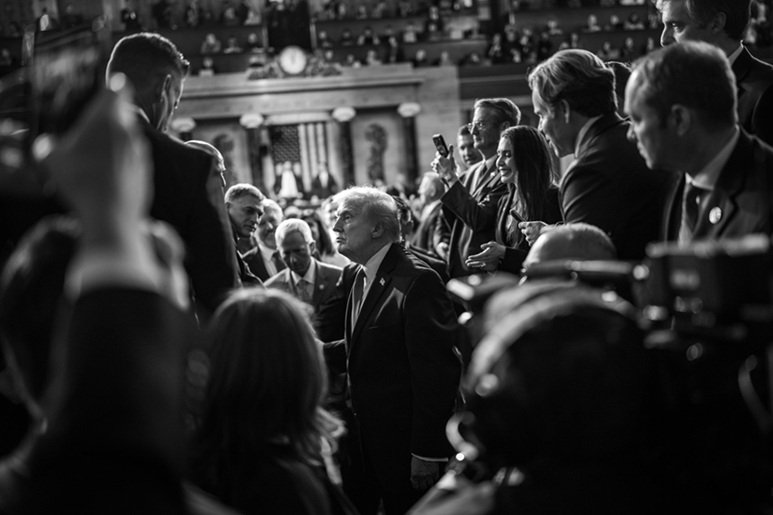
In the longest State of the Union address in modern American history, President Donald Trump stood before a joint session of Congress and declared the nation “strong,” pointing to falling inflation, tightened border enforcement, lower crime rates, and renewed energy production as proof that his administration has reversed what he described as years of national decline.
Delivered during the 250th anniversary year of American independence, the address combined ceremonial pageantry with unmistakable political tension. Republican lawmakers responded with sustained applause throughout much of the speech, while many Democrats remained seated for extended periods, some signaling dissent through symbolic gestures. Several members wore lapel pins reading “Release the Epstein Files,” referencing calls for transparency surrounding government-held documents tied to financier Jeffrey Epstein. Others displayed pins reading “Fuck ICE,” a pointed protest against federal immigration enforcement policies.
The evening’s tensions escalated when Rep. Al Green was escorted out of the chamber after holding a sign that read, “Black People Aren’t Apes,” an act of protest that briefly interrupted proceedings. The chamber’s atmosphere underscored the nation’s deep political divisions—extending beyond policy disagreements to broader disputes over rhetoric, accountability, and the direction of public institutions.
A Narrative of Economic Turnaround
The president framed his remarks around a central claim: that his administration inherited an economy burdened by inflation, weakened purchasing power, and declining consumer confidence—and that decisive policy shifts have changed its trajectory.
Trump cited inflation declining to near 2 percent in recent readings, gasoline prices easing in multiple states, mortgage rates stabilizing compared to recent peaks, and rental costs softening in several major metropolitan areas. He emphasized private-sector job growth, rising wages in blue-collar industries, and record-high domestic oil and natural gas production.
Economists note that inflation trends are influenced by a range of factors, including Federal Reserve monetary policy, global supply chains, commodity markets, and consumer demand. While inflation has cooled from its pandemic-era highs, core inflation—excluding food and energy—remains closely watched. Gasoline prices fluctuate regionally based on taxes, refinery capacity, and global oil markets, and mortgage rates are primarily driven by bond yields and central bank policy rather than direct executive action.
On employment, the president highlighted that overall workforce numbers are at historic highs. Analysts point out that total employment typically grows alongside population increases, making long-term comparisons complex. Wage growth in certain sectors has outpaced inflation in recent quarters, though purchasing power gains vary across income levels and geographic regions.
Still, the administration’s central message was clear: economic momentum, in its view, has shifted positively. Trump credited tax policy changes, regulatory rollbacks, and energy expansion for what he described as renewed business confidence and investment commitments totaling trillions of dollars.
Policy experts caution that announced investment commitments do not always translate into completed projects and that long-term economic performance depends on sustained productivity growth, labor force participation, and global market conditions. Nonetheless, the administration’s emphasis on domestic energy production aligns with record output levels achieved through advances in shale extraction and expanded drilling capacity.
Border Security and Immigration Enforcement
Immigration was one of the most forcefully delivered sections of the speech. The president declared the border “secure” and described what he characterized as dramatic reductions in unlawful crossings and drug trafficking. He cited a significant decline in fentanyl entering the country and asserted that immigration policy reforms have restored order.
Data from U.S. Customs and Border Protection historically show that border encounters can fluctuate sharply depending on enforcement practices, asylum policy shifts, seasonal migration patterns, and cooperation agreements with neighboring countries. Analysts note that reductions in recorded encounters may reflect deterrence strategies, regional diplomatic arrangements, or changes in processing procedures.
Regarding fentanyl, federal agencies report seizure totals annually. Experts emphasize that seizure reductions do not necessarily correspond directly to declines in trafficking volume, as interdiction rates and smuggling routes evolve. Much of the fentanyl entering the U.S. is trafficked through established networks that adapt quickly to enforcement patterns.
The president reiterated support for legal immigration while advocating firm enforcement against unlawful entry. That dual emphasis—expanded legal pathways combined with aggressive border controls—has become central to the administration’s immigration narrative.
Public Safety and Crime Trends
Trump also cited a substantial decline in the national murder rate, calling it one of the most significant annual reductions in over a century. Violent crime statistics in recent years have shown dramatic swings: pandemic-era increases followed by declines in several major cities.
The FBI’s Uniform Crime Reporting system compiles national crime data, though reporting methodologies and agency participation can affect year-to-year comparisons. Criminologists caution against interpreting single-year changes without broader context, noting that long-term trends over decades provide more reliable indicators.
The administration attributes improvements to strengthened law enforcement support, expanded funding for policing, and tougher sentencing frameworks. Critics argue that crime trends are influenced by complex socioeconomic variables including economic stability, local policy, community programs, and demographic shifts.
Government Reform and Social Policy
The president also emphasized reductions in federal workforce share, elimination of diversity, equity, and inclusion (DEI) initiatives across federal agencies, and a decline in enrollment in federal food assistance programs.
Changes in Supplemental Nutrition Assistance Program (SNAP) participation can stem from improved employment conditions, updated eligibility rules, administrative adjustments, or work requirement enforcement. A reduction in enrollment may indicate stronger labor markets—or stricter qualification thresholds—depending on implementation.
The rollback of DEI programs has prompted debate in legal, corporate, and academic circles. Supporters frame the shift as a return to merit-based policy; opponents argue that such programs addressed longstanding disparities in federal hiring and contracting.
Data Centers
On another front, the president addressed emerging concerns over artificial intelligence infrastructure and its impact on energy demand. During his speech, President Donald Trump introduced a “Ratepayer Protection Pledge,” aimed at preventing higher utility costs for consumers amid the rapid expansion of AI data centers. Trump argued that the nation’s aging electrical grid cannot support the massive energy requirements of these facilities without risking widespread strain. His proposal would require technology companies, including those planning projects in areas such as the Imperial Valley, to build and operate their own power plants alongside new data centers—a plan that has sparked protests from local residents concerned about industrial development and environmental impacts.
Political Theater and Transparency Demands
The symbolic protest pins worn by several Democratic lawmakers underscored broader issues beyond the speech’s policy claims. Calls to release Epstein-related documents have intensified amid ongoing public scrutiny regarding what federal agencies knew about Epstein’s activities and associates. Transparency advocates argue that full disclosure is necessary to restore trust in institutions.
The anti-ICE messaging reflected deep disagreement over immigration enforcement tactics, detention policies, and deportation procedures. Immigration and Customs Enforcement remains one of the most polarizing federal agencies in the current political climate.
The atmosphere in the chamber reflected these divides. Applause and silence alternated sharply, often along party lines. At moments, the speech felt less like a ceremonial constitutional tradition and more like a referendum on competing visions of governance.
The Longest Address, and What It Signals
The length of the address itself became a point of historical note. By surpassing prior records, the speech signaled the president’s intent to comprehensively frame his administration’s narrative ahead of a politically consequential year.
Long State of the Union addresses often aim to project command of detail and momentum. Political historians observe that such speeches serve dual purposes: informing Congress of executive priorities and shaping public perception through carefully curated achievements.
In this case, the administration’s strategy was unmistakable. The president presented a portrait of restoration—of order at the border, stability in markets, strength in energy production, and progress in crime reduction. Whether those claims will withstand continued independent scrutiny remains part of the ongoing democratic process.
A Divided Chamber, A Watchful Nation
As the president concluded, declaring the state of the union strong, the chamber offered a split-screen image of American politics. One side stood and applauded enthusiastically; the other remained seated, holding silent symbols of dissent.
Beyond the immediate reactions, the address set the tone for the months ahead. Economic data will continue to be analyzed, immigration trends monitored, and crime statistics evaluated. Congressional oversight committees and independent watchdog groups are likely to scrutinize the administration’s claims, particularly regarding investment commitments, enforcement outcomes, and social program impacts.
State of the Union speeches are snapshots in time—moments when executive leadership presents its version of national reality. The enduring test lies not in the applause or protest within the chamber, but in measurable outcomes felt by households, businesses, and communities across the country.
In a speech marked by ambition, confrontation, and historical significance, the president aimed to craft a narrative of national renewal. Whether that narrative gains broad acceptance or remains fiercely contested will play a pivotal role in shaping the country’s political and economic trajectory during a consequential election year.