


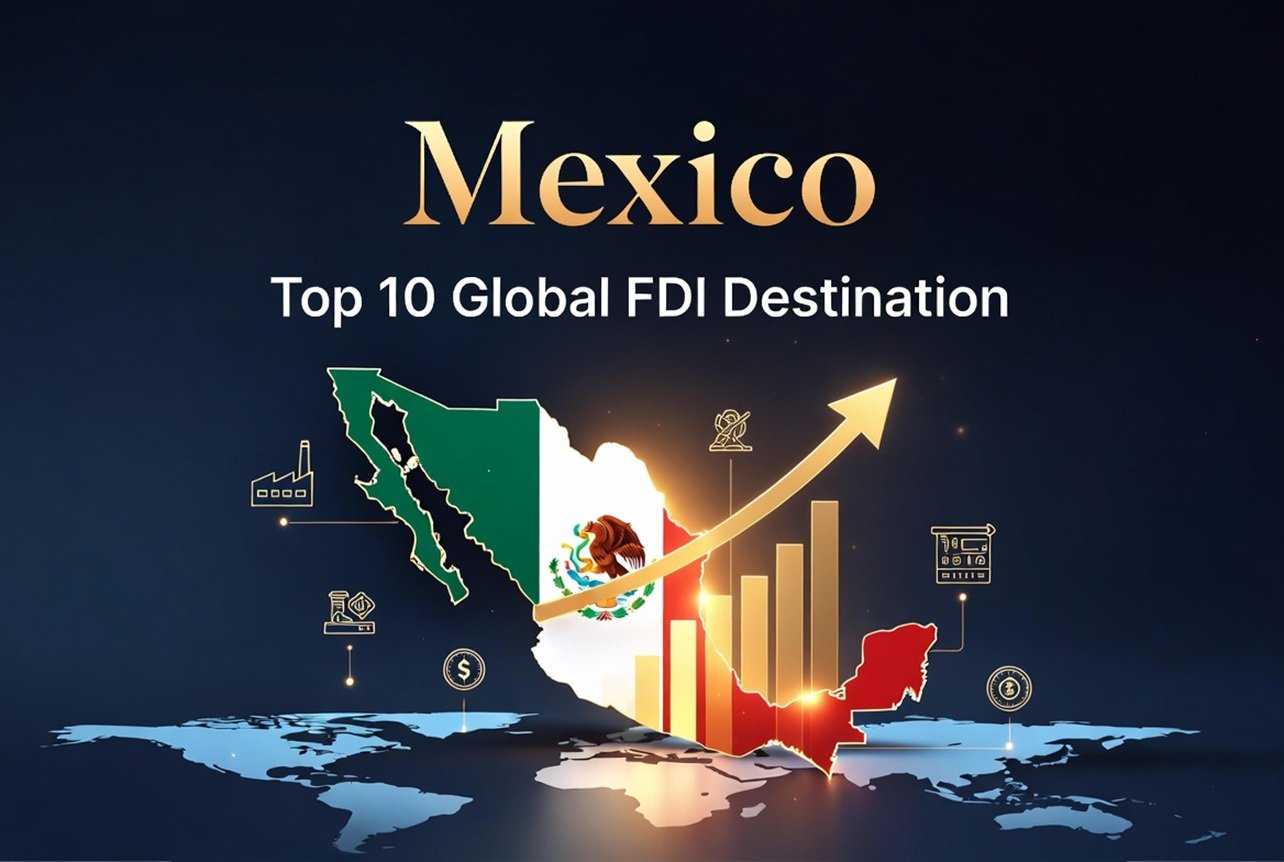

Mexico Ranks Among the World’s Top 10 Destinations for Foreign Direct Investment
Share your love
- Foreign investment growth highlights Mexico’s position in the global economy as strategic industries, technology and supply chain shifts reshape international capital flows
Mexico has positioned itself among the world’s top 10 economies attracting foreign direct investment (FDI), reflecting its growing role in global supply chains and its importance as companies continue to adjust their investment strategies amid economic uncertainty, according to the United Nations Conference on Trade and Development (UNCTAD) World Investment Report 2026.
The report showed that global foreign direct investment increased 6% in 2025, reaching approximately $1.624 trillion after two consecutive years of decline. However, UNCTAD warned that the recovery remains uneven, with geopolitical tensions, trade policy uncertainty and higher financing costs influencing business decisions worldwide.
Mexico’s performance comes as global investment increasingly concentrates in strategic sectors, including advanced manufacturing, digital infrastructure, semiconductors, artificial intelligence and clean energy. These industries have become major drivers of new investment projects as companies seek more resilient supply chains and governments promote industrial development.
UNCTAD reported that developed economies experienced the largest increase in foreign investment, with inflows rising 11% to approximately $723 billion. Developing economies attracted $901 billion, a 2% increase, with Latin America and the Caribbean recording a 14% rise to $188 billion.
The region’s growth was led primarily by South America, particularly Brazil. However, UNCTAD noted that the increase in investment did not translate into stronger commitments for new manufacturing projects, as announced greenfield investment declined in several sectors.
Mexico’s continued presence among the leading global investment destinations reflects its strategic advantages, including its proximity to North American markets, participation in regional trade networks and its role in industries such as automotive manufacturing, electronics, aerospace, logistics and emerging technologies.
The report highlighted that global investment patterns are shifting toward sectors considered critical for economic security and technological competitiveness. Strategic industries now represent nearly half of announced greenfield investment worldwide, compared with 16% in 2020.
Digital infrastructure was the fastest-growing area of investment in 2025, with greenfield projects increasing more than 80%, driven largely by demand for artificial intelligence-related data centers. Semiconductor manufacturing and critical minerals also attracted significant attention as governments and companies expanded efforts to secure key technologies and resources.
At the same time, traditional manufacturing sectors experienced declines. UNCTAD reported that investment announcements in global value chain-intensive manufacturing fell 13%, including decreases in electronics, automotive and textile-related projects.
The organization also noted that governments are playing a larger role in directing investment flows. A record 229 national investment policy measures were adopted in 2025, with many focused on encouraging investment in strategic sectors while strengthening national security reviews.
Foreign direct investment continues to represent a vital source of external financing for developing economies, supporting technology transfer, employment opportunities and integration into global markets.
Looking ahead, UNCTAD said the global investment outlook for 2026 remains uncertain due to slower economic growth, geopolitical tensions and ongoing trade policy challenges. However, strong corporate earnings and continued demand for advanced technologies could support investment growth in sectors such as artificial intelligence, semiconductors, clean energy and critical minerals.
For Mexico, maintaining its position among the world’s leading investment destinations underscores its growing importance in the evolving global economy and the competition among nations seeking to attract strategic capital.