



Binational Leaders Address Climate Resilience, Infrastructure and Economic Opportunities Along the Border During July Meeting
Share your love
 -Editorial
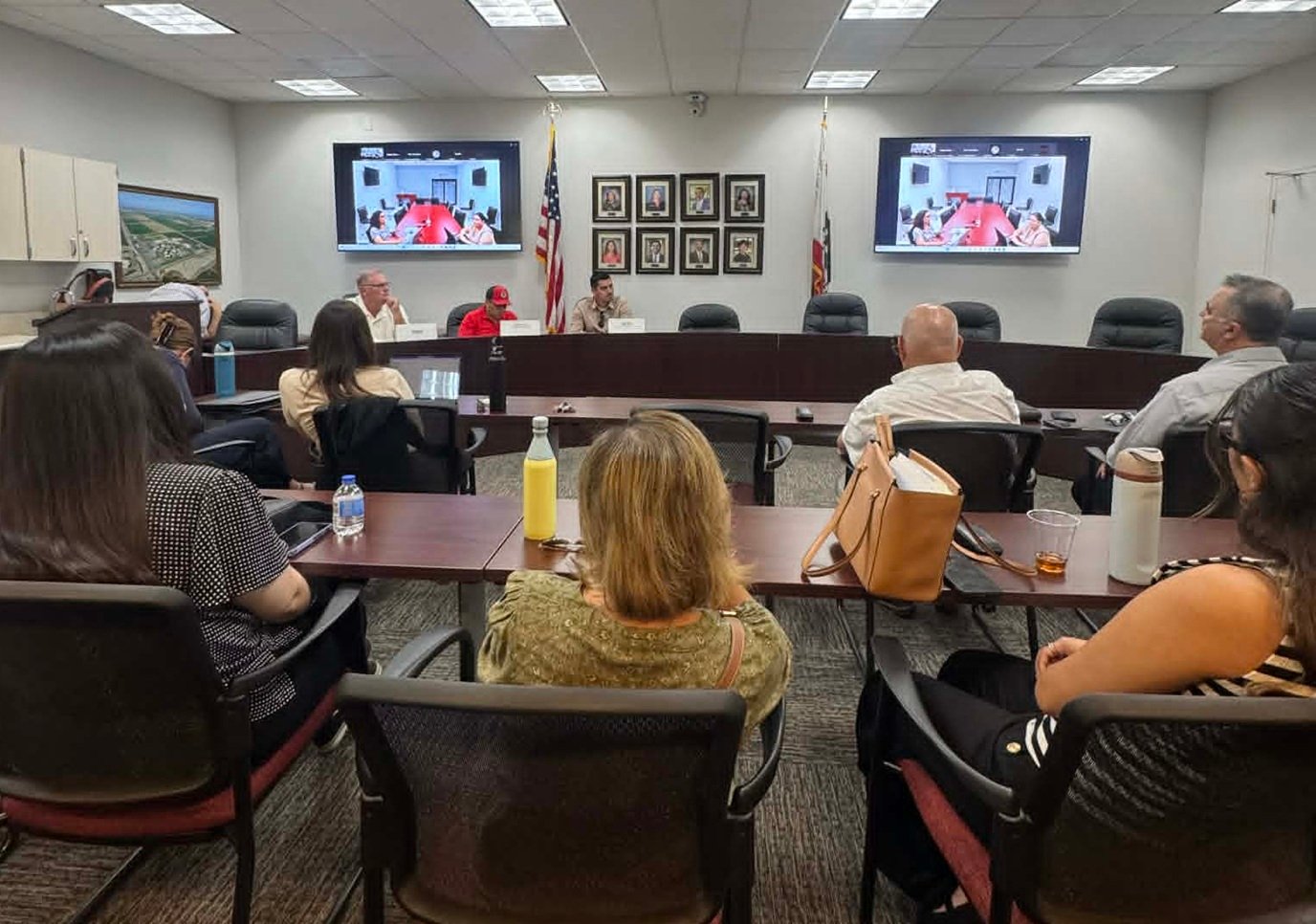
The Imperial Valley–Mexicali Binational Alliance convened on July 9 at Imperial Valley College, bringing together regional leaders, public agencies, educators and economic development organizations to discuss cross-border collaboration on climate resilience, infrastructure, transportation and economic growth.
A major focus of the meeting was an update from the San Diego Association of Governments (SANDAG) on the California Border Resiliency Plan, a long-term initiative designed to help communities and transportation systems adapt to the growing impacts of climate change along the California-Baja California border.
Kim Smith, Senior Regional Planner at SANDAG, delivered the presentation, noting that the agency received a Caltrans Climate Adaptation Planning Grant in fall 2024 to develop the comprehensive resiliency strategy. Smith, who previously spent more than 20 years as a biologist with Caltrans District 11, said she was pleased to once again work closely with Imperial Valley communities.
The study area stretches approximately 10 miles north and south of the U.S.-Mexico border, extending from the Pacific Ocean to the California-Arizona state line. Smith explained that the plan also considers broader cross-border travel patterns because of the region’s highly interconnected transportation network.
She described the California-Baja California border as a shared economic, environmental and transportation corridor increasingly vulnerable to flooding, extreme heat, severe storms, wildfires and other climate-related hazards.
“Our border region is not immune to environmental impacts,” Smith said. “In many cases, the lack of a comprehensive binational and coordinated planning approach to get ahead of these issues has also contributed to the crises we face today.”
The California Border Resiliency Plan aims to identify climate vulnerabilities, evaluate public health risks, review existing planning efforts, prioritize adaptation projects, identify funding opportunities, and strengthen binational coordination.
Potential projects under consideration include improvements to emergency evacuation routes, stormwater drainage systems, transportation infrastructure and resilience hubs designed to better serve border communities during emergencies.
Smith said SANDAG is currently evaluating four primary climate hazard categories—rising temperatures, changing precipitation patterns, wildfires, and sea-level rise and storm surge—along with related air and water quality impacts. The agency is conducting research, data analysis and extensive collaboration with stakeholders on both sides of the border to understand how these hazards affect multimodal transportation systems and surrounding communities.
During the question-and-answer session, attendees asked whether recent seismic activity had prompted the plan to address earthquake preparedness.
Smith responded that while the project’s primary emphasis remains climate adaptation, many proposed improvements—including enhanced evacuation routes, resilience centers and emergency communications—would also strengthen preparedness for other natural disasters, including earthquakes.
Natasha Dulik, who also presented on behalf of SANDAG, said the agency has established an interagency task force that has already completed five meetings while reviewing previous climate resilience studies and ongoing regional projects. SANDAG is also developing mapping tools to identify vulnerable communities and infrastructure most at risk from climate-related events.
Dulik reported that a public survey conducted earlier this year generated more than 200 responses. Participants identified extreme heat, flooding and heavy rainfall as the most significant climate concerns affecting their communities, while also citing impacts on driving, public transit, walking, and bicycling.
SANDAG expects to spend the summer developing adaptation strategies before releasing a draft plan during the fall and winter, with the final California Border Resiliency Plan anticipated in summer 2027 following additional public outreach.
The meeting also highlighted several economic development initiatives aimed at strengthening Imperial County’s position as a key hub for cross-border commerce.
The Imperial Valley Economic Development Corporation (IVEDC) announced it recently submitted three grant applications through the U.S. Department of Agriculture’s Rural Development Program.
One proposal would expand the Imperial Regional Alliance, enhancing business assistance, internship opportunities, broadband initiatives and loan programs. A second application seeks funding for a Retail Academy, led by Retail Strategies, to provide retail recruitment training and marketing support for El Centro, Brawley and Holtville while remaining available to all Imperial County communities. The third application, known as the AHEAD Grant, would assist local jurisdictions in marketing commercial and industrial properties through Team California while supporting participation in major economic development conferences, including the International Council of Shopping Centers convention.
IVEDC officials expect to receive grant decisions by the end of July.
Presenters also emphasized the growing importance of the Calexico East Port of Entry, describing it as one of the Southwest’s most strategic commercial freight gateways. While Otay Mesa remains California’s busiest commercial border crossing, Calexico East processes nearly half that volume and continues to play a critical role in attracting manufacturing, logistics and industrial investment throughout the region.
Planned transit connections linking the East Port of Entry with downtown Calexico are also expected to improve retail accessibility while reducing congestion at the historic downtown crossing.
Representatives from California Jobs First announced the creation of a regional warehouse and logistics cluster that will bring together businesses, educational institutions, and industry partners from both sides of the border through a series of roundtable discussions beginning July 30. The initiative is intended to align workforce development with the region’s expanding logistics and supply chain industries.
The meeting concluded with a tour of Imperial Valley College’s Building 3100, home to the Career Technical Education programs that continue preparing the next generation of skilled professionals for the region’s evolving workforce.
Before adjournment, Beyond Borders Gazette Editor-in-Chief and Publisher Ellie Burgueño announced the upcoming 4th Regional Business Forum, Mujer de Éxito, which will be held for the first time in the City of San Diego on July 31. Burgueño invited business leaders, entrepreneurs and professionals from both sides of the border to participate in the regional networking and leadership event, adding that additional details will soon be available through the publication’s multimedia platforms. Event tickets are available through Eventbrite, here: https://www.facebook.com/events/614834224792075/