


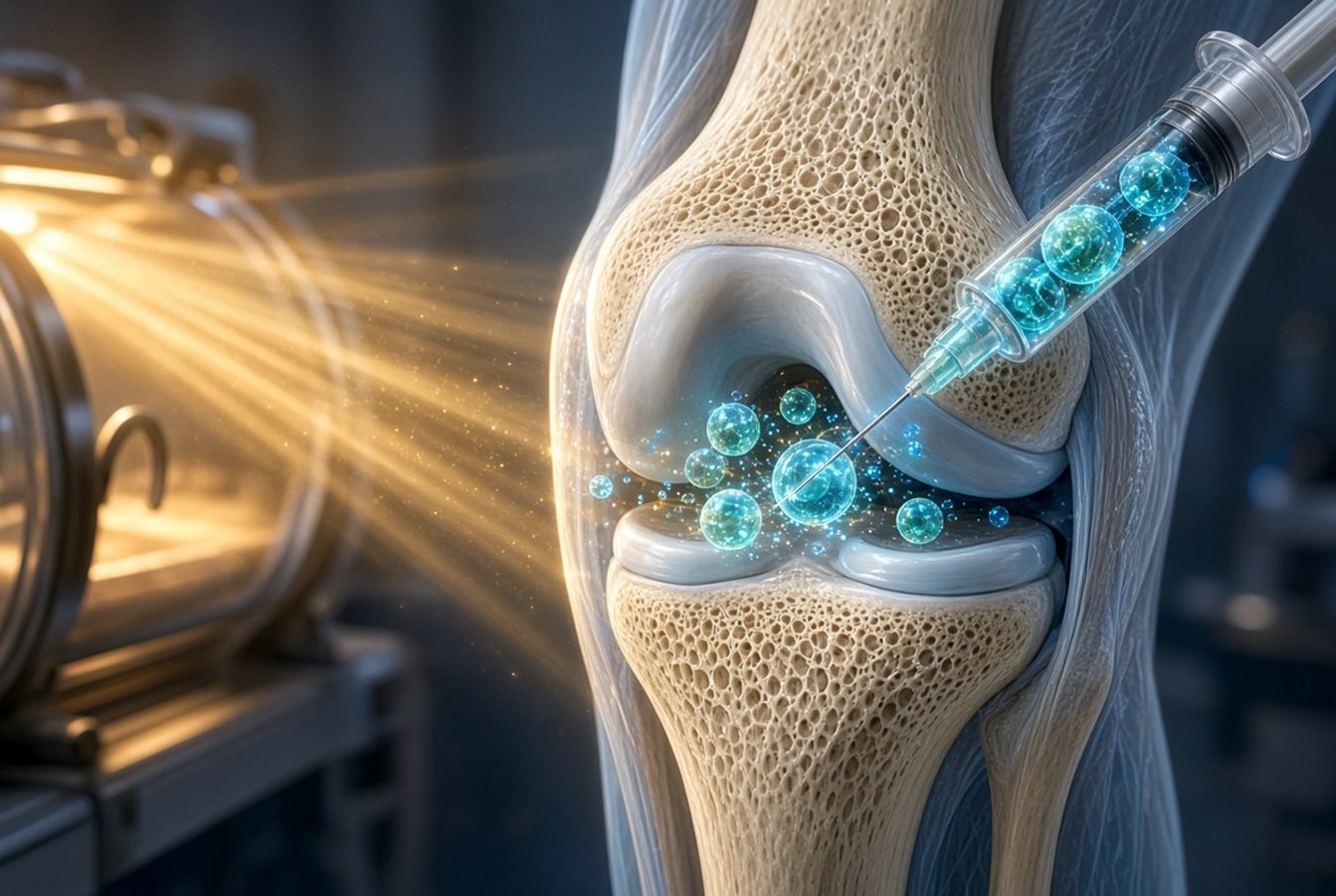

Mesenchymal Stem Cell Therapy for the Knee and Adjunctive Hyperbaric Oxygen Therapy
Share your love
 By Dr. Elton Gomez, Specialist in Regenerative Medicine.
biohipercell@hotmail.com
Intra-articular administration of mesenchymal stem cells is an emerging regenerative medicine strategy being studied, particularly for patients with knee osteoarthritis, cartilage deterioration, and inflammatory or degenerative joint conditions.
The goal is not simply to provide temporary pain relief, but to potentially improve the biological environment within the joint by modulating inflammatory signals and creating conditions that may support the body’s natural tissue-repair mechanisms.
Clinical objective: to reduce pain, improve function, and promote a more favorable biological environment within the joint—without promising complete or guaranteed cartilage restoration.
Potential Benefits of Mesenchymal Stem Cells
Mesenchymal stem cells have paracrine and immunomodulatory properties. Much of their potential therapeutic effect is believed to involve the signaling molecules they release and their interaction with the cells and tissues within the joint.
Potential benefits may include reduced joint pain in appropriately selected patients, modulation of inflammatory mediators, and improvement of the intra-articular environment.
Patients may also experience improvements in knee mobility and function, greater tolerance for walking and everyday activities, and stimulation of cellular mechanisms associated with tissue maintenance and repair.
In certain patients, depending on the cellular product, dose, and severity of osteoarthritis, mesenchymal stem cell therapy has also been investigated for its potential to reduce the progression of symptoms.
Important: Some clinical trials have reported improvements in pain and function following intra-articular administration of mesenchymal stem cells. However, results have not been consistent across all studies, and current evidence does not support claiming that the treatment can predictably or completely regenerate lost cartilage in every patient.
Why Consider Hyperbaric Oxygen Therapy Before the Procedure?
As part of a comprehensive regenerative medicine protocol, hyperbaric oxygen therapy (HBOT) may be used as a complementary treatment with the goal of temporarily increasing oxygen availability to tissues and supporting an appropriate physiological environment before the procedure.
During an HBOT session, the patient breathes oxygen at a pressure greater than normal atmospheric pressure. This increases the amount of oxygen dissolved in the blood plasma and its availability to tissues.
Potential objectives include improving tissue oxygenation, modulating certain inflammatory processes, supporting the recovery of periarticular tissues affected by inflammation or injury, and contributing to a metabolic environment compatible with tissue-repair processes.
HBOT may also be incorporated into a multimodal rehabilitation program designed to support functional recovery.
 Evidence regarding the combination: HBOT has established physiological mechanisms and evidence in certain contexts involving tissue repair and inflammation. However, the specific combination of pre-procedure HBOT followed by intra-articular mesenchymal stem cell therapy for the knee does not yet have sufficient clinical evidence to confirm that it improves cell survival, cellular integration, or cartilage regeneration in humans.
Preparing for the Procedure
Before an intra-articular cellular therapy procedure, an individualized medical evaluation is recommended to determine whether the patient is an appropriate candidate and to establish realistic treatment expectations.
The evaluation may include a comprehensive medical history and musculoskeletal examination, along with imaging studies to assess the severity and distribution of joint damage.
Additional factors should be evaluated, including knee alignment, ligament stability, muscle strength, biomechanics, body weight, physical activity, metabolic conditions, and current medications.
Active infection and other potential contraindications to intra-articular injection should also be ruled out.
For patients undergoing HBOT, an assessment of their suitability for hyperbaric treatment should be performed, including screening for specific contraindications to hyperbaric oxygen therapy.
A Comprehensive Treatment Approach
Clinical outcomes do not depend exclusively on the cellular treatment. The knee functions as an integrated biomechanical and biological system, which is why a comprehensive treatment plan may include weight management, muscle strengthening, physical rehabilitation, correction of biomechanical abnormalities, and regular medical follow-up.
The overall goal is to reduce pain, improve mobility, and enhance quality of life while seeking to preserve joint function for as long as possible.
Safety and Clinical Considerations
Responses to cellular therapies can vary considerably among patients. Treatment selection, the source and processing of the cellular product, dosage, administration technique, and follow-up should be determined according to the individual clinical circumstances and applicable regulatory requirements.
Hyperbaric oxygen therapy should be prescribed and supervised by appropriately trained medical professionals.
This article is intended for educational purposes only and does not replace an individualized medical evaluation or professional medical advice.