


IVC’s AgSTEP Program Opens New Opportunities for Imperial Valley Farmworkers
Share your love
 -Editorial
Long before sunrise, hundreds of agricultural workers begin their daily journey from Mexicali, Mexico, into Calexico, joining residents who depend on the Imperial Valley’s agricultural industry to support themselves and their families.
For many, the day begins in the early morning hours, waiting to cross the U.S.-Mexico border before heading to agricultural fields throughout Imperial County. Others, already living in Calexico and neighboring communities, prepare for another day of physically demanding work or search for employment opportunities in the fields.
These workers form an essential part of the region’s agricultural economy, contributing to an industry that supplies produce to markets across the United States.
However, while agricultural employment provides an important source of income for thousands of families, opportunities for professional advancement, additional education, and higher-paying positions can sometimes be difficult to access.
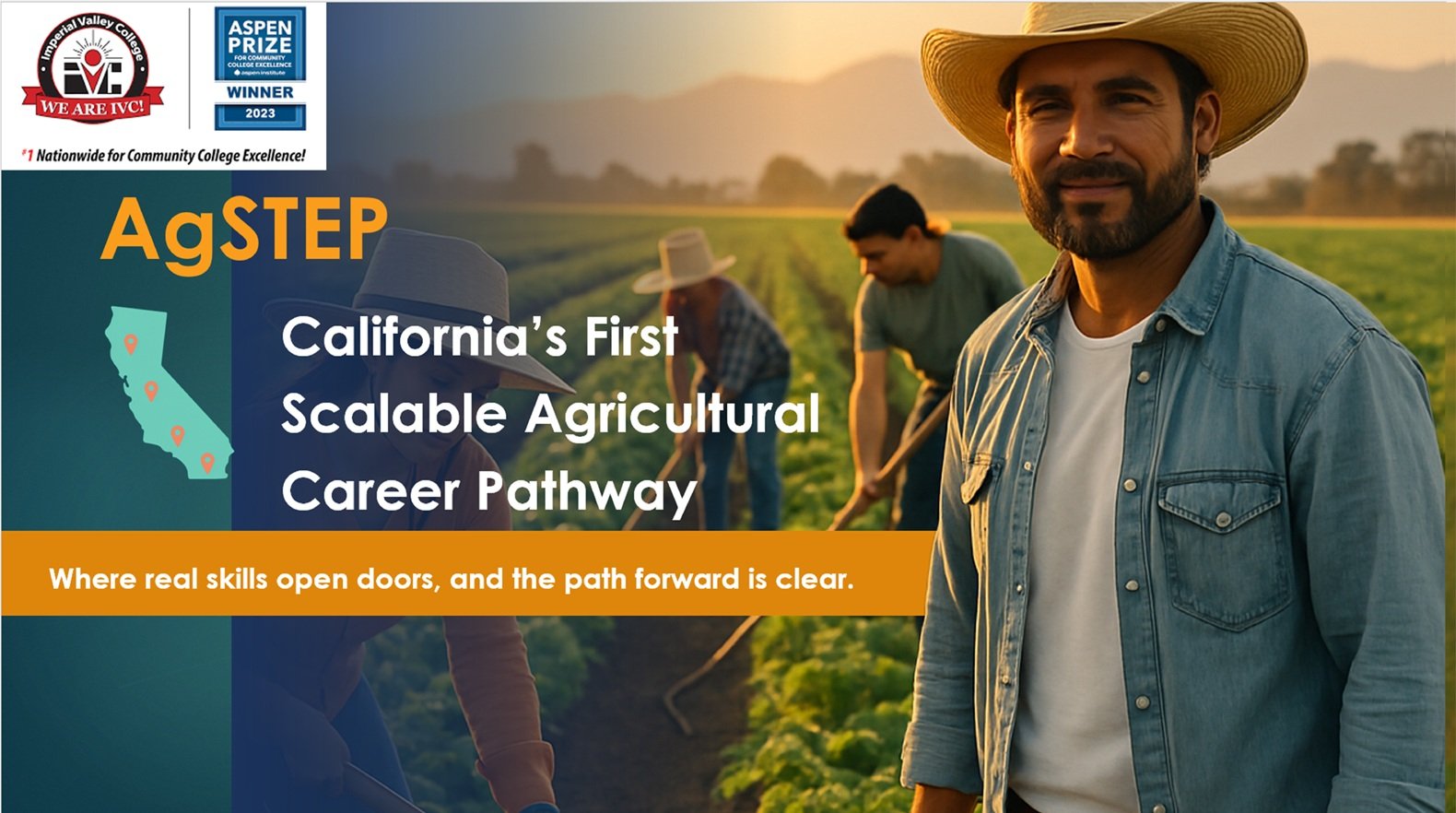
Imperial Valley College is seeking to help address that challenge through AgSTEP, a workforce development program designed to provide agricultural workers with opportunities to expand their knowledge, develop new skills, and pursue career advancement within the industry.
The program will offer tuition-free, bilingual instruction through a series of 14 short-term courses designed to strengthen workers’ technical abilities while addressing the evolving workforce needs of Imperial Valley’s agricultural industry.
Efrain Silva, dean of economic and workforce development at Imperial Valley College, said the initiative is intended to ensure agricultural workers have access to the training necessary to keep pace with technological advancements in farming.
“We’re so excited to announce to the community the start of a new program called AgSTEP,” Silva said. “AgSTEP is a program specifically designed around upskilling farmworkers with the latest technologies and innovations to be consistent with the local farming operations.”
Silva emphasized that technological advancements should create opportunities for agricultural workers to improve their employment prospects rather than leave them behind.
“As farming gets more sophisticated with technologies, we want to make sure that our local farmworkers are also equipped with the same skills necessary in industry, so that they can maintain their jobs, and better yet, they can obtain better employment,” Silva said.
The initiative is intended to help existing agricultural employees adapt to technological changes rather than risk being displaced as farms introduce new equipment, automated systems, and production methods.
Julian Lopez, a new professor for the AgSTEP program at Imperial Valley College, said the curriculum will emphasize practical skills and digital literacy to help agricultural workers adapt to the demands of modern farming operations.
“We will be covering some very interesting subjects, such as digital literacy, that will help empower you as a student to become a modern worker in the ag workforce,” Lopez said.
Unlike traditional classroom instruction, the program will allow students to progress at their own pace while demonstrating their abilities through practical applications rather than relying exclusively on written examinations.
“The pace is on your own time, at your own pace,” Lopez said. “Instead of showing mastery of a subject through traditional means such as a pen and paper, you’ll be coming in, and you’ll be showing us whether or not you know how to drive a tractor, if you can develop and create reports and send them through email or other forms of technology.”
The approach is designed to recognize skills that agricultural employees may already possess while helping them develop additional competencies necessary for an increasingly technology-driven industry.
For workers who have spent years performing physically demanding agricultural jobs, AgSTEP represents an opportunity to build upon their practical experience through formal education and specialized training.