



Imperial County Supervisors To Consider Data Center Moratorium
Share your love
 -Editorial
After more than two hours of public testimony and board discussion, the Imperial County Board of Supervisors declined to act on the original data center development proposal, instead directing staff and County Counsel to return at their June 16 meeting with a resolution to establish an ad hoc committee composed of various stakeholders and implement a temporary moratorium on data center projects.
The original proposal, introduced by Board Vice-Chairwoman Martha Cardenas-Singh and Chairwoman Peggy Price, sought to establish countywide guidelines for future data center development in unincorporated Imperial County.
The measure directed staff to develop potential land-use and zoning amendments requiring discretionary county review of data center projects and to return with recommendations within 45 days. Proposed standards included a 1,000-foot buffer from homes, schools, and other sensitive sites; infrastructure and environmental impact assessments; developer-funded utility improvements; water-use disclosures; workforce development commitments; community benefit agreements; and decommissioning requirements. The agenda item stated that the proposal was intended to provide policy guidance and did not approve any specific project.
Many, however, viewed the item as a slap in the face to those who have opposed the project from the beginning. They also questioned why the item was being discussed on Election Day.
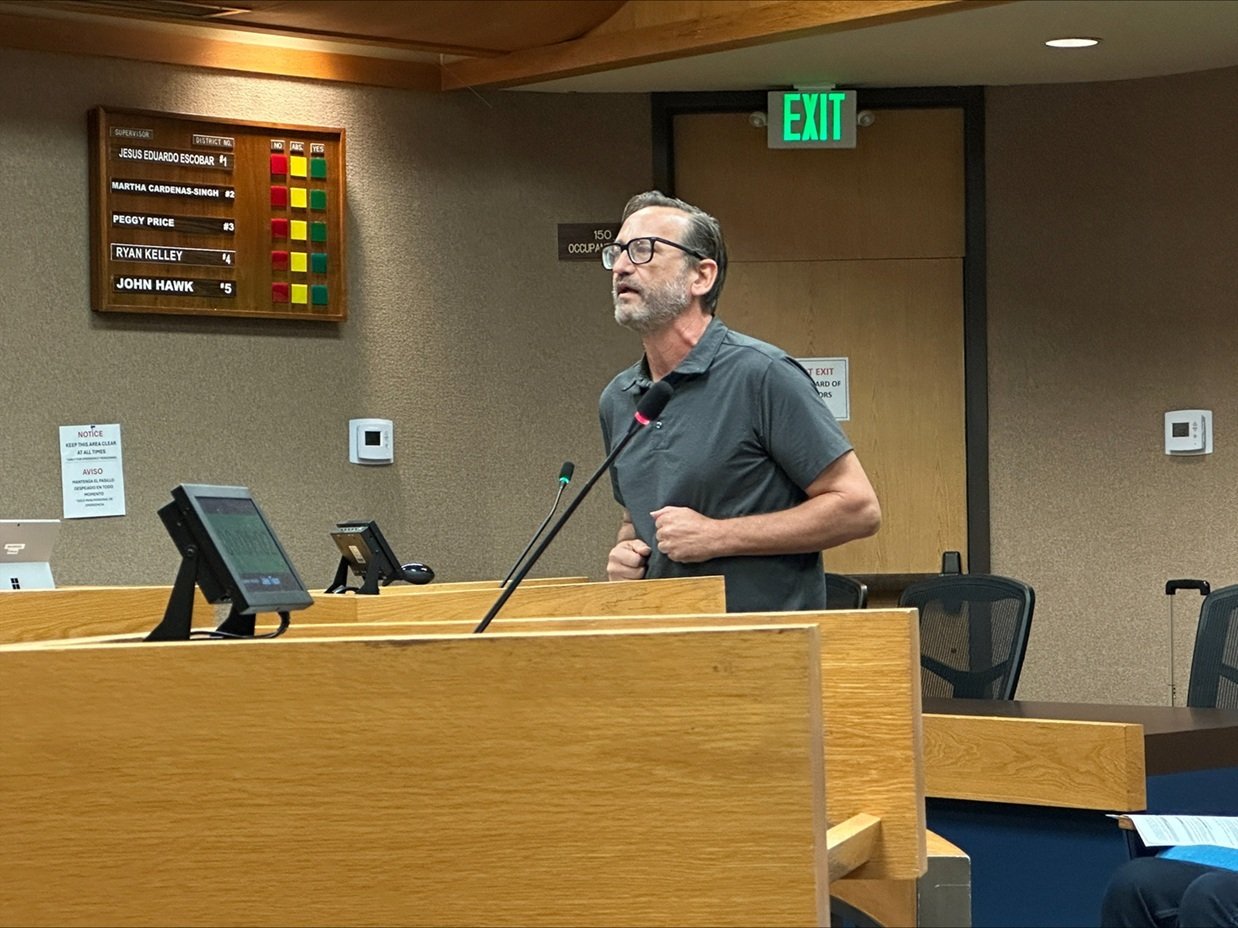
During public comment, Christopher Scurries urged the board to reject the proposed data center resolution, arguing that it failed to provide meaningful protections for residents. Scurries contended that the measure appeared designed to accommodate future data center applications rather than address community concerns, pointing to exceptions that could still allow such projects under specific area plans. He called on the board to instead adopt an interim moratorium on all data center developments under California Government Code 65858, saying a temporary pause would give county officials and residents time to develop stronger safeguards. Scurries also challenged Supervisors Martha Cardenas-Singh and Jesus Escobar to support a moratorium, saying it was time to turn concerns about data center projects into action.
Jake Tison criticized the proposed data center guidelines during public comment, questioning their origin and scope and urging the county to adopt stronger regulations. “Who are you guys trying to fool here? Where’d you get 1,000 feet from? Who wrote this, by the way? Who wrote these guidelines? Nobody wants to take responsibility for it,” Tison said.
He argued that the guidelines were insufficient and called for enforceable ordinances instead. “Guidelines are not enough. Imperial County needs enforceable ordinances, not suggestions, checklists, or voluntary promises from developers,” he said.
Tison urged the board to take stronger action, including removing data centers as a by-right use, requiring discretionary review and conditional use permits, and mandating full environmental review for all projects. “The public is not asking the county to manage data centers better, but we are asking the county to ban them,” he said.
Shelby Trimm, executive director of the Coalition of Labor, Agriculture and Business, known as COLAB, voiced support for the proposed data center guidelines. Trimm said the organization represents about 200 Imperial Valley employers across sectors, including agriculture, construction, and labor unions, and that many members were unable to attend but had expressed support for the measure. She said the board’s approach reflects a “proactive planning” effort that balances transparency, consistency, and accountability while still encouraging economic development rather than imposing a moratorium. Trimm added that Imperial County has an opportunity to attract investment and create jobs by leveraging existing energy resources. She commended the board for pursuing guidelines rather than a moratorium, saying COLAB looks forward to working with stakeholders as the process moves forward.
Timothy Kelley of the Imperial Valley Economic Development Corporation said the region has spent years trying to attract data center development and criticized what he described as a widespread misunderstanding of the industry. “How many of you have visited a data center?” Kelley asked supervisors, adding that there are “a lot of experts in this building about data centers” while questioning what critics really know. He argued that much of the information being presented is inaccurate, saying that “a lot of the information that continually is said here in this building is misinformation,” and emphasized that backup generators would use natural gas, not diesel, as has been suggested by opponents. Kelley urged the board to focus on “facts over fear,” saying regional water allocations for industry have been misunderstood and that agriculture remains the largest water user while data centers would use comparatively little.
“When we started this discussion, there were people in the vicinity of a data center being considered, and I can understand their concerns,” Kelley said. “Over time, many of them have come to understand that maybe it’s not such a bad thing, but they still don’t want a data center in front of their house. Neither would you, and I wouldn’t. But I didn’t buy a house next to an industrial park.”
Kelley also said residents rely on the same digital infrastructure they are opposing, noting, “We all use data centers, we all use AI, and we’re paying for it, and others are benefiting.” He argued that the projects would provide substantial local revenue, calling the proposed facility “the largest taxpayer in Imperial County,” and said existing environmental review processes already include safeguards, with additional protections still under consideration.
Singh said she was the one who worked on the resolution and explained that the intent behind it was to ensure that no project would be approved by right and to begin moving the county toward a formal ordinance through a structured public process.
“But I will tell you that the spirit of making sure that there was a resolution, and what was most concerning to me, is that no project be approved by right. That was my primary focus,” Singh said. She explained that her goal was to direct staff to return with a framework that would lead to public hearings, allowing residents and stakeholders to weigh in before any final decision by the board.
Singh said she worked with another supervisor on drafting the resolution and stressed there was no Brown Act violation, noting that only two supervisors may work on a document at one time without triggering concerns about a serial meeting. She said she did not see the guidelines until they were released on Friday and added that, in her view, the resolution and guidelines were initially separate but were later merged due to similarities. Singh said she has since reviewed the materials and developed her own concerns and feedback after seeing them for the first time.
She said she intends to ensure that any project ultimately goes through the California Environmental Quality Act (CEQA) process and that the board has sufficient data and information before making decisions. Singh also called for bringing in an industry expert on data centers to advise the county on technical requirements and potential mitigation measures to align projects with environmental review standards.
Singh added that while she does not apologize for advancing the resolution, she is willing to adjust course as needed. “I don’t apologize for trying to put a project forward, and I don’t apologize for at least not sitting here idle and taking an opportunity,” she said. “I’m willing and able to pivot, recalibrate, whatever it may be, but we need to make sure that we protect the safety of our constituents.”
She clarified that because the board had not met for two weeks, it did not discuss the matter earlier, and she said it had nothing to do with Election Day.
Supervisor John Hawk requested that the item return in three weeks, noting the board’s upcoming trip to Washington, D.C., and saying more time was needed for review. However, direction was ultimately given to bring the matter back for consideration on June 16.