

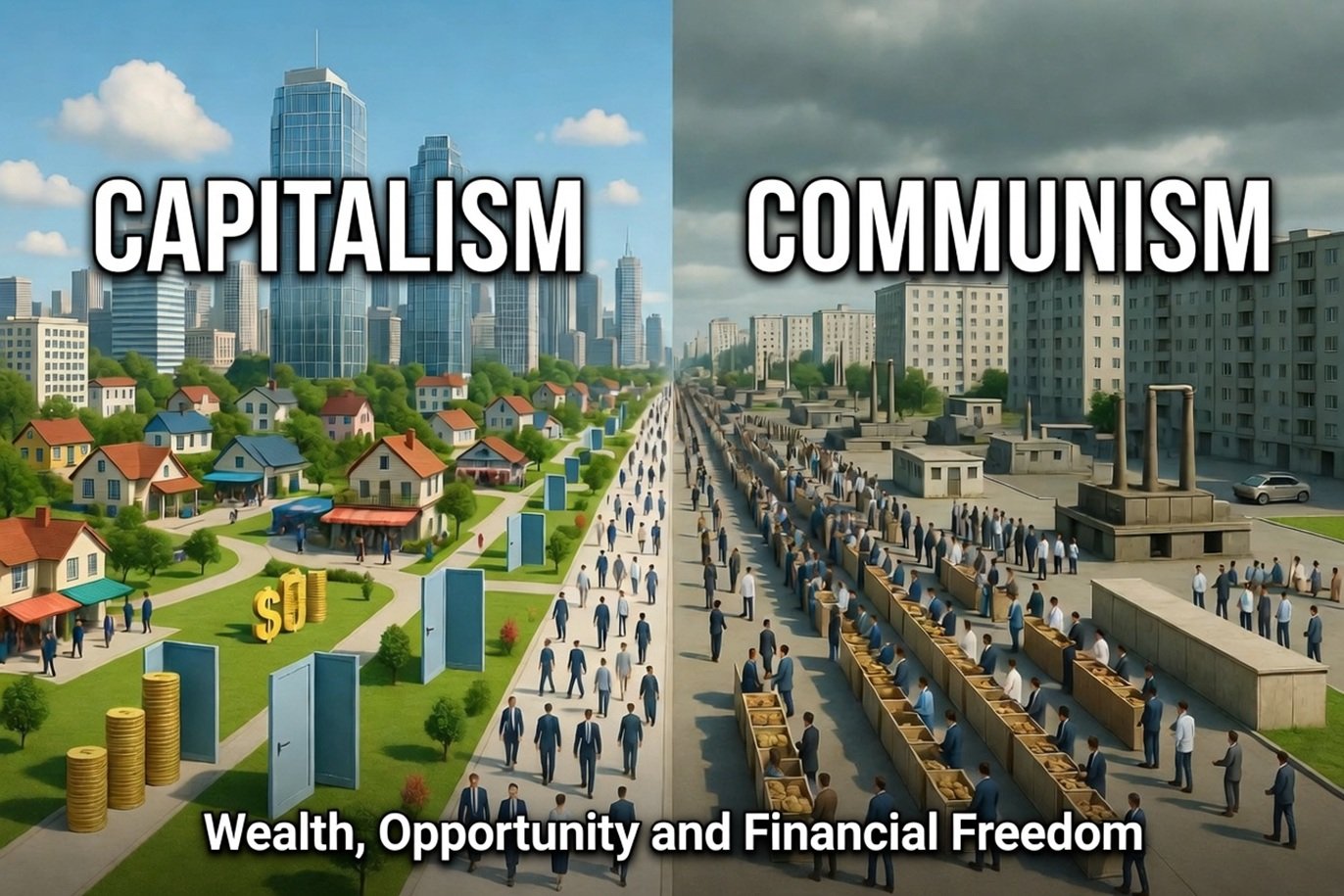

Capitalism vs. Communism: What They Mean for Wealth, Opportunity and Financial Freedom
Share your love
 By: Ellie Burgueño, Journalist and Writer.
Few topics have shaped the course of history more profoundly than the debate between capitalism and communism. For more than a century, these competing economic philosophies have influenced governments, sparked revolutions, fueled innovation and transformed the lives of billions of people. Even today, discussions about wealth inequality, entrepreneurship, taxation, government intervention and financial opportunity continue to dominate political conversations around the world.
Yet beyond the headlines and political rhetoric lies a more personal question: What economic system gives ordinary people the greatest opportunity to build a better life?
For me, that question isn’t merely academic. It began long before I understood economics, politics or financial markets.
As a young child, I watched my mother take a leap of faith by starting a small business selling blankets to help support our family. Around the age of six, I eagerly became her little assistant. I loved accompanying her to meet customers, organizing inventory, carefully writing clients’ names into a notebook, and watching each sale come together. There was something fascinating about seeing a simple idea become a source of income through hard work, trust and determination.
At the time, I had no idea I was witnessing entrepreneurship in its purest form. I wasn’t thinking about capitalism, free markets or wealth creation. I simply enjoyed connecting with people and being part of something that was helping our family move forward. Looking back, those moments quietly laid the foundation for what would eventually become my own entrepreneurial journey as a journalist, publisher and businesswoman.
That early experience also sparked a lifelong curiosity about the relationship between opportunity, economic systems and financial freedom. As I have covered business, government, economic development and public policy throughout my career, one lesson has become increasingly clear: the conversation is far more complex than choosing between capitalism and communism. Understanding their principles, strengths, limitations and real-world applications is essential for anyone seeking to make informed decisions—not only as voters, but also as entrepreneurs, investors and citizens navigating an increasingly interconnected global economy.
Capitalism is an economic system built on private ownership, voluntary exchange, competition and the pursuit of profit. Individuals and businesses generally decide what to produce, what to buy and where to invest, while prices are largely determined by supply and demand. At its core, capitalism rewards innovation, efficiency and risk-taking.
Throughout history, capitalist economies have driven remarkable advances in science, medicine, technology and global commerce. From the Industrial Revolution to today’s digital economy, the ability of entrepreneurs to develop new ideas and compete in the marketplace has contributed to unprecedented economic growth. According to institutions such as the World Bank and the Organisation for Economic Co-operation and Development (OECD), countries that embrace market-based economies—supported by strong institutions, education and the rule of law—have generally experienced higher productivity and significant reductions in poverty over time.
However, capitalism is not without criticism. Free markets can also produce income inequality, wealth concentration and uneven access to opportunities. Without appropriate oversight, monopolies may emerge, environmental concerns may be overlooked, and essential services such as healthcare or education can become less accessible for lower-income families. For these reasons, many democratic nations regulate markets and invest in public programs designed to balance economic growth with social well-being.
Communism, by contrast, is based on the principle that the means of production should be collectively owned rather than privately controlled. Developed primarily through the writings of Karl Marx and Friedrich Engels during the nineteenth century, communism envisioned a classless society where resources would be distributed according to need rather than accumulated through private wealth.
In theory, communism sought to eliminate economic inequality and ensure that everyone had access to housing, education, healthcare and employment. In practice, however, countries that implemented centrally planned communist economies often encountered significant economic and political challenges. The former Soviet Union, Cuba and North Korea experienced recurring shortages, limited consumer choice, restrictions on private enterprise and slower rates of innovation. Economic decision-making became concentrated within the government, reducing the flexibility and competition that typically drive market economies.
China represents a more nuanced example. Although governed by the Chinese Communist Party, the country has incorporated market reforms, encouraged private enterprise and become one of the world’s largest trading economies. As a result, many economists describe China’s model as a hybrid system or state capitalism rather than traditional communism.
It is important to distinguish economic systems from political ideologies. Modern governments rarely fit neatly into one category. Most democratic nations operate mixed economies that combine elements of capitalism with government regulation and social programs.
The distinction between left-leaning and right-leaning governments further illustrates this complexity. Generally, center-left governments advocate for a stronger role for government in providing healthcare, education, labor protections and social welfare while maintaining private enterprise and competitive markets. Center-right governments typically emphasize lower taxes, fewer regulations, private investment and policies that encourage business growth and entrepreneurship. Neither approach represents pure capitalism or pure communism. Instead, both seek different balances between market freedom and government responsibility.
The United States provides an example of this balance. While it remains one of the world’s most market-oriented economies, it also funds public education, Social Security, Medicare, transportation infrastructure and numerous regulatory agencies that oversee financial markets, environmental protections and workplace safety. Likewise, Mexico maintains a dynamic market economy while supporting extensive public programs and government participation in strategic sectors such as energy and infrastructure. Both countries illustrate that economic policy is often shaped less by ideology than by evolving national priorities, demographic needs and global economic conditions.
The debate surrounding these systems continues to influence public policy. Recently, U.S. Secretary of State Marco Rubio argued that communism should not simply be viewed as an attractive theory that fails in practice. Instead, he contended that the ideology itself limits private initiative, entrepreneurship and individual freedom because it places the state at the center of economic decision-making. His comments resonated with supporters who believe free markets provide the greatest opportunities for prosperity, while critics argued that his remarks oversimplified distinctions between communism, democratic socialism and progressive p ublic policy. Such reactions demonstrate how discussions about economic systems often extend beyond economics into broader political and philosophical debates.
Despite these differences, one lesson consistently emerges from economic research: institutions matter. Nations with transparent governments, independent courts, secure property rights, sound monetary policy and access to quality education tend to create stronger environments for long-term investment and sustainable economic growth. Whether governments lean left or right, these institutional foundations often determine whether businesses can thrive and whether citizens have confidence to invest, innovate and build wealth.
Financial freedom itself is perhaps best understood not as a political outcome, but as a personal one. It is the ability to make choices without being constrained by financial insecurity. For some, that means owning a successful business. For others, it means purchasing a home, investing for retirement, creating multiple sources of income or simply achieving enough financial stability to support their families with dignity.
The blanket business my mother started was never part of an economic theory. It was born from necessity, determination and hope. Yet it taught me a lesson that continues to shape my understanding of wealth and opportunity: economic systems may create the environment in which people operate, but it is ultimately individuals—their ideas, work ethic, resilience and willingness to serve others—who transform opportunity into prosperity.
Capitalism and communism will likely remain subjects of debate for generations to come. Reasonable people will continue to disagree about the proper role of government, the responsibilities of the private sector and the best ways to reduce inequality while encouraging innovation. Those debates are healthy and necessary in democratic societies.
Ultimately, the goal should not be to defend one ideology unconditionally or dismiss another outright. Instead, it should be to understand how different economic models have performed throughout history, learn from their successes and failures, and pursue policies that expand opportunity, encourage innovation and protect the dignity of every individual.
Financial freedom is not guaranteed by any single economic system. It is built through knowledge, discipline, opportunity and the freedom to create value. When governments establish fair rules, protect individual rights and foster environments where businesses and communities can flourish, they provide the foundation upon which prosperity can grow.
The challenge for every generation is finding the balance that allows both economic opportunity and social responsibility to coexist—ensuring that future generations have not only the freedom to dream, but also the opportunity to achieve those dreams.