


American Society of Mexico Proposes Bilateral Anti-Crime Pact During 250th U.S. Independence Gala
Share your love
 -Editorial
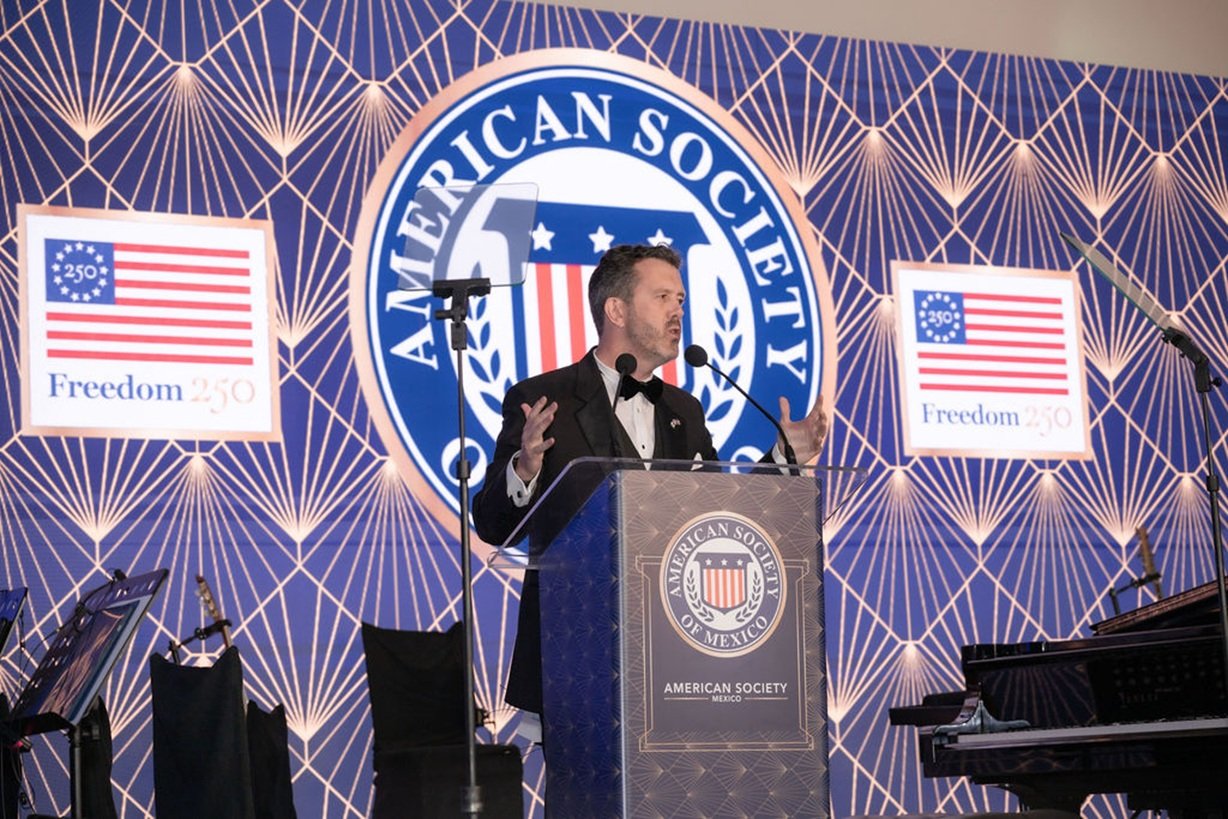
The American Society of Mexico proposed creating a formal bilateral anti-crime treaty between Mexico and the United States to combat organized crime, fentanyl trafficking, and money laundering during a gala marking the 250th anniversary of U.S. independence.
The proposal was presented by Larry Rubin, who called for a structured security cooperation framework comparable in ambition to the North American Free Trade Agreement. He argued that transnational criminal activity now requires a similarly institutionalized response between the two countries.
“Just as NAFTA transformed the way our economies work together, today we need a new level of cooperation to jointly confront those who threaten our security and prosperity,” Larry Rubin said during his speech.
The event, held in Mexico City with participation from the U.S. Embassy in Mexico, brought together political leaders, business executives, diplomats, and civil society representatives from both nations. The gathering was intended to commemorate the historic anniversary while highlighting the depth of the bilateral relationship and its future direction.
Rubin introduced the concept of a “Treaty of Lucha Contra el Crimen” (TLCC), which would establish formal mechanisms for coordination between Mexico and the United States in addressing transnational criminal organizations. The proposed framework would prioritize joint efforts to disrupt drug trafficking networks, particularly those linked to fentanyl, as well as enhance cooperation on identifying and dismantling money laundering operations that move across the border.
He said the proposal is rooted in the belief that criminal networks already operate across national boundaries and therefore require coordinated government responses that do the same. According to Rubin, fragmented enforcement efforts are no longer sufficient to address the scale and sophistication of modern criminal organizations operating in North America.
Rubin emphasized that increased cooperation on security issues would not diminish sovereignty for either country, but rather strengthen it. He argued that nations facing shared threats become more effective when they coordinate intelligence, enforcement, and policy strategies. “Security is a shared challenge and requires a shared response,” he said during his remarks, according to organizers.
The proposal envisions engagement with the governments of Mexican President Claudia Sheinbaum and President Donald Trump, along with participation from political parties, private sector leaders, and civil society organizations in both countries. Organizers said the initiative is intended to be inclusive of multiple sectors, reflecting the cross-border nature of both economic and security challenges.
Speakers at the event highlighted the scale and complexity of the U.S.-Mexico relationship, noting that it remains one of the most significant bilateral partnerships in the world. Mexico is the United States’ largest trading partner, while the United States is Mexico’s largest source of foreign direct investment and tourism.
They also pointed to the high volume of daily cross-border trade, with hundreds of billions of dollars in goods and services exchanged annually. Organizers said this level of integration demonstrates that the two economies are deeply interconnected, with supply chains, manufacturing systems, and labor markets increasingly functioning as a shared regional ecosystem.
In that context, speakers described the U.S.-Mexico border not as a dividing line, but as a central axis of economic activity. They pointed to ongoing trends such as nearshoring, technological innovation, and regional supply chain restructuring as forces that are strengthening North American competitiveness in global markets.
The TLCC proposal would seek to build on this economic integration by addressing what organizers described as one of the primary barriers to regional stability and growth: transnational crime. The framework would include shared objectives, coordinated enforcement strategies, and institutional mechanisms designed to improve information sharing and operational cooperation between agencies in both countries.
Rubin said the initiative aims to position North America as the most competitive and secure region in the world. He argued that future prosperity depends not only on economic alignment but also on the ability to jointly address security threats that affect both nations.
Founded in 1942, the American Society of Mexico is a nonprofit, nonpartisan organization dedicated to strengthening U.S.-Mexico relations through institutional dialogue, cross-border engagement, and collaboration between public and private sector leaders.