


IID Charts Its Future at First State of the District Address
Share your love
 -Editorial
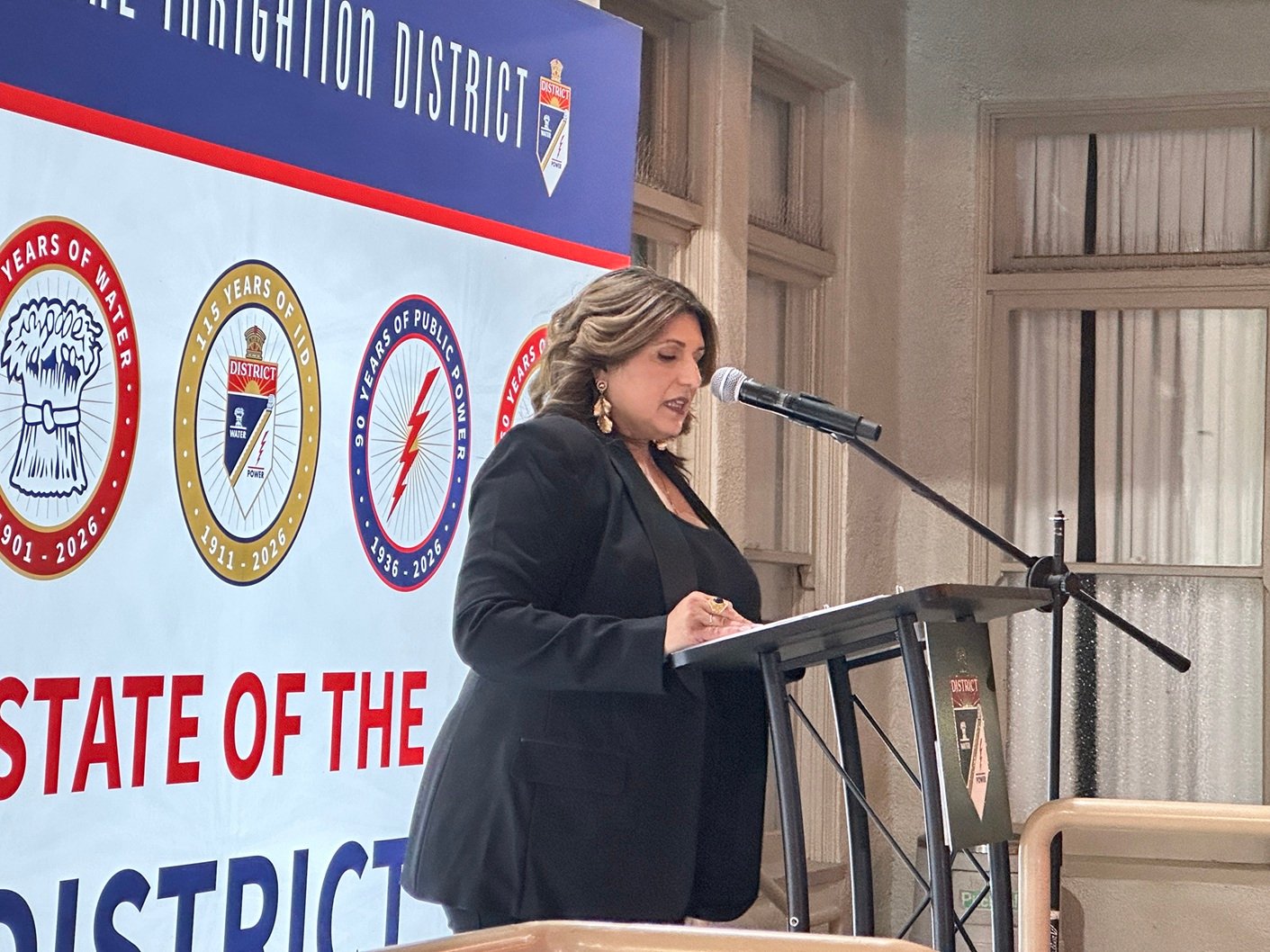
The Imperial Irrigation District highlighted its efforts to protect Colorado River water supplies, modernize electrical infrastructure, expand customer assistance programs, and invest in local communities during its inaugural State of the District celebration, Nov. 19, at IID headquarters in Imperial.
The event marked the first time the district hosted a State of the District address, providing an opportunity for residents, community leaders and employees to review the public utility’s accomplishments in 2026 and its priorities for the coming years.
The celebration also featured exhibits highlighting IID’s water and power operations, equipment, environmental programs and customer services. Historical displays featuring photographs, maps and artifacts offered visitors a look at the district’s development and its role in supporting agriculture, economic activity and communities throughout the Imperial Valley.
IID Board Chairwoman Karin Eugenio delivered remarks outlining the district’s major initiatives, financial investments and operational challenges, emphasizing the importance of maintaining reliable water and electricity services while preparing for future demands.
Eugenio also recognized IID employees for their work maintaining essential services and acknowledged General Manager Jamie Asbury, the first woman to lead the district.
A central focus of Eugenio’s address was the future of the Colorado River, which provides the Imperial Valley’s primary water supply.
“For us, the river is not an abstract policy debate. It is our lifeline,” Eugenio said. “It sustains our farms, supports thousands of jobs and helps feed families across the nation.”
Eugenio said IID submitted formal comments on federal Colorado River operating proposals and collaborated with Arizona, California and Nevada on a Lower Basin states proposal.
She emphasized the district’s position that future operating guidelines must recognize IID’s senior water rights, protect agricultural production and consider environmental consequences for the Salton Sea.
“We do not have another water source,” Eugenio said. “If the river’s future is uncertain, so is ours.”
The district also outlined its long-term electrical infrastructure modernization initiative, known as Powering Our Community Together, which includes more than 270 projects representing approximately $3.3 billion in investments over 15 years.
The projects are intended to replace aging equipment, modernize substations and transmission lines, and rehabilitate electrical generating facilities.
During 2026, IID approved refurbishment projects at the Drop Three and Pilot Knob hydroelectric plants and advanced plans to repower Unit 4 at the El Centro Generating Station and the Yucca Power Plant near Yuma, Arizona.
Eugenio noted that Unit 4 began operating in 1968, while Yucca’s steam generating unit dates to the late 1950s.
The district also secured approval for an $18.3 million federal contribution toward a grid management system designed to help operators identify electrical faults and restore service more quickly.
Eugenio cited IID’s response to major weather events as examples of the district’s operational priorities.
An August monsoon storm interrupted electricity service to more than 5,000 customers, with crews restoring power to more than 95% of affected customers by the following morning.
In October, Tropical Storm Rachel damaged electrical infrastructure and caused a breach in the West Side Canal. According to Eugenio, district crews restored electricity to affected residential customers and closed the canal breach in less than 12 hours.
Financial management and customer affordability were also highlighted during the address.
Eugenio said IID approved bond refinancing expected to generate $21 million in savings through 2038 and secured more than $22 million in state disaster assistance for repairs associated with storms in 2025.
The district also returned $48.4 million in fuel and purchased-power savings to customers through automatic bill credits, followed by additional credits for electricity consumption during August and September.
IID expanded several customer assistance programs during the year, including eligibility for READY and SHIELD, while increasing annual CARE emergency assistance from $450 to $500.
The district also extended the renewal period for EASE medical equipment assistance from two years to three years.
Additional initiatives included Energy Flex, the IID Power Store, expanded energy-efficiency programs, and Shift and Save, a time-of-use electricity program that reached 6,000 participants and offered eligible customers a $250 incentive.
Eugenio said IID employees also participated in more than a dozen community clinics to help customers understand available assistance programs and energy-saving opportunities.
Beyond its utility operations, IID reported investments in educational facilities, environmental improvements and community infrastructure.
According to Eugenio, the district awarded more than $2.5 million for school energy improvements, shade trees and energy-efficient outdoor lighting.
Through its Funding Local Opportunities for Water program, the IID Board of Directors approved $4.3 million for 13 projects proposed by nine local agencies.
Those projects are expected to leverage an additional $9.3 million from participating agencies, grants and private investment.
IID also developed a $2.5 million power grant program intended to help public agencies finance energy-saving improvements.
Eugenio said the district’s accomplishments reflect the combined work of employees, agricultural water users, customers and community organizations.
She also emphasized the responsibility of current district leadership to maintain and improve infrastructure originally developed by previous generations.
“They did not build only for themselves,” Eugenio said, referring to earlier generations of IID employees and community leaders. “They built systems that would serve people they would never meet.”
The inaugural event provided a broader public presentation of IID’s operations and long-term planning as the district continues addressing Colorado River uncertainty, aging infrastructure, electricity affordability and regional development.
Eugenio concluded by emphasizing that decisions involving water conservation, energy reliability and community investment will influence the district’s ability to serve future generations.
“This State of the District is more than a report on one year; it is a tribute to generations who made life in this valley possible,” Eugenio said.
The district plans to continue sharing its history and providing information about the employees, infrastructure, and programs supporting its water and power services.