


IID Board Approves Funding Water Conservation Programs
Share your love
 -Editorial
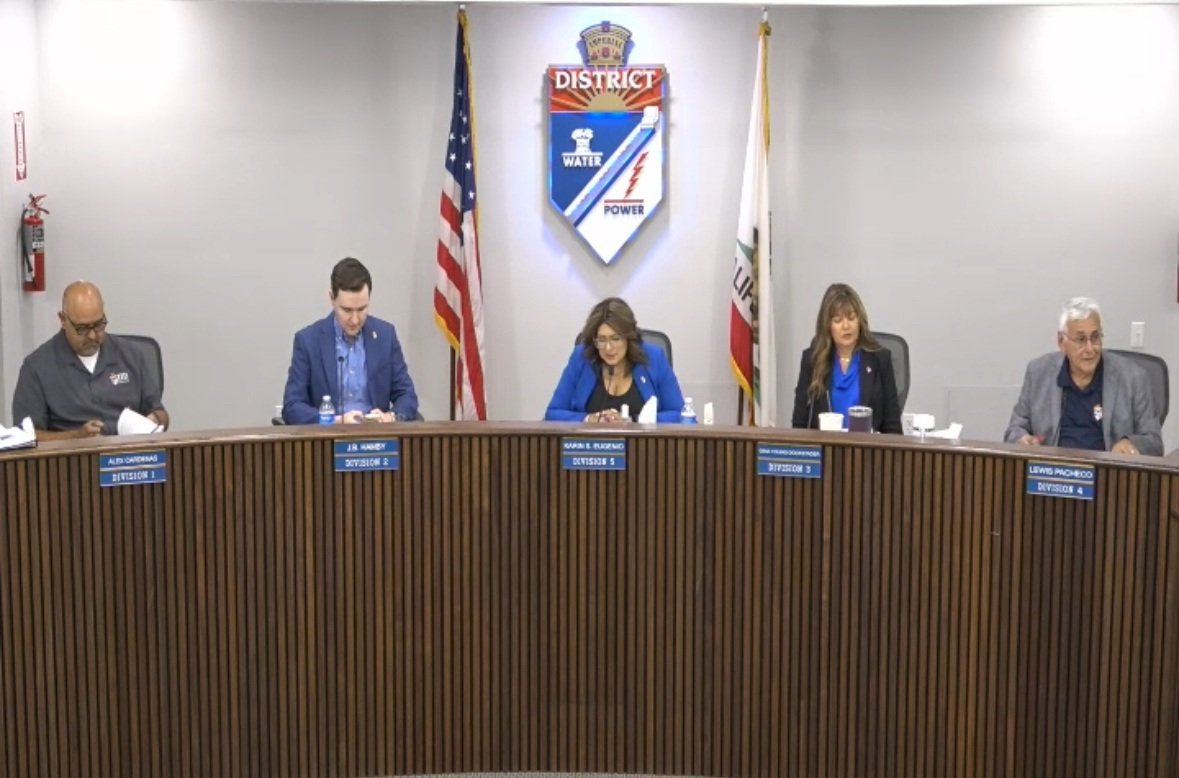
The Imperial Irrigation District (IID) Board of Directors approved a significant budget amendment on June 2, authorizing additional funding for agricultural water conservation programs linked to ongoing federal efforts to protect the Colorado River system and stabilize water levels in Lake Mead.
The action includes $36.9 million in supplemental funding for the 2025 On-Farm Efficiency Conservation Program and an additional $72.5 million for the 2026 Deficit Irrigation Program. Together, the investments underscore the district’s continued role in regional and national water conservation initiatives at a time when long-term drought conditions and increasing demands on the Colorado River remain pressing concerns.
According to IID staff, the district adopted a two-year budget cycle in 2024 to improve financial planning and provide greater budget certainty. However, when the 2025–2026 budget was initially developed, conservation activities and funding associated with the federal 2024–2026 System Conservation Implementation Agreement had not yet been finalized and therefore were not incorporated into the Water Department budget.
Water Department Manager Tina Shields told the board that the additional funding was necessary to support conservation activities completed under the 2025 On-Farm Efficiency Conservation Program, which has now concluded and is more than 85 percent contracted. The supplemental allocation will cover conservation water left in Lake Mead beyond the amounts required under the Quantification Settlement Agreement (QSA) water transfer program, while also funding incentive payments established through the federal conservation agreement.
To encourage greater participation among agricultural producers and maximize conservation yields, IID previously approved an additional incentive payment of $111 per acre-foot under the System Conservation Implementation Agreement. The enhanced payment structure was designed to reward growers for implementing water-saving practices and contributing to broader conservation goals throughout the Colorado River Basin.
Staff reported that the total estimated budget for the 2025 conservation program reached $94.5 million. Of that amount, approximately $57.6 million came from Quantification Settlement Agreement funding carried forward within the Water Department budget. The remaining balance was expected to be supported through revenues generated by conservation activities funded under the federal agreement.
As of May 15, roughly $1.7 million remained available within the program budget. More than $55.8 million in conservation payments had already been distributed to participating growers at a rate of $450 per acre-foot. District staff estimated that an additional $36.9 million would be required to satisfy the program’s remaining financial obligations and ensure all contracted conservation payments are fulfilled.
In addition to approving the supplemental funding for 2025, the board authorized financing for the 2026 Deficit Irrigation Program, which was approved earlier this year as part of IID’s participation in the federal conservation initiative. Preliminary estimates indicate the program could generate approximately 216,178 acre-feet of water conservation at the farm level, representing a substantial contribution toward regional conservation targets.
The program is expected to include approximately 160,009 acres of enrolled farmland, primarily involving growers of alfalfa, Bermuda grass, and Klein grass. Under the approved structure, participating farmers will receive conservation payments of $334 per acre-foot, resulting in an estimated program cost of $72.5 million.
IID staff noted that sufficient funding has already been received from the U.S. Bureau of Reclamation to support the requested amendment for the 2025 conservation program and a significant portion of the 2026 Deficit Irrigation Program. Additional funding is anticipated through Amendment No. 1 to the 2024–2026 System Conservation Implementation Agreement, which was recently approved.
Following the discussion, the board unanimously approved the budget amendment as recommended by staff.
The On-Farm Efficiency Conservation Program remains one of IID’s cornerstone water management initiatives. The voluntary program allows growers to adopt conservation measures such as reducing irrigation, improving water-use efficiency, or temporarily removing land from production in exchange for financial compensation. Water conserved through these efforts contributes directly to state and federal Colorado River conservation objectives, including programs aimed at preserving storage levels in Lake Mead and supporting the long-term sustainability of one of the West’s most critical water resources.
As water challenges continue to shape the future of the Southwest, IID’s conservation programs highlight the increasingly important partnership between agriculture, local water agencies, and federal stakeholders in addressing the region’s long-term water security needs.