


Exhibition “Past and Present” Highlights Decades of Artistic Collaboration
Share your love
 -Editorial
The exhibition Past and Present will open April 9 at the Steppling Art Gallery at San Diego State University Imperial Valley, bringing together works by founding and current members of the Mexicali-based nonprofit Cooperativa de Artistas Plásticos José García Arroyo. The show highlights the continuity of artistic production in the region while offering a platform for dialogue between generations of artists working along the U.S.-Mexico border.
Además de la exposición, los organizadores anunciaron el lanzamiento de la primera Semana del Arte en la región, programada del 14 al 18 de abril. El evento incluirá actividades en múltiples sedes del Valle Imperial y Mexicali, con el objetivo de promover la participación comunitaria y ampliar el acceso a las artes.
In addition to the exhibition, organizers announced the launch of the region’s first Art Week, scheduled for April 14–18. Programming will extend across multiple venues in the Imperial Valley and Mexicali, featuring workshops, exhibitions, and community-oriented activities designed to foster participation and broaden public access to artistic expression.
The multidisciplinary exhibition features nearly 30 works by approximately 20 artists from Mexicali and Calexico, representing more than three decades of sustained artistic production in the binational region. The collection includes paintings, mixed media, and other visual art forms that reflect the evolution of artistic language along the border, where identity, migration, and cultural hybridity often intersect.
Among the participating artists are Carlos Coronado, Rubén García Benavides, Mari Carmen Rodríguez, Viridia Lizardi, and Ariel Duarte, several of whom are widely recognized as pioneering figures in the development of Mexicali’s contemporary art scene. Organizers noted that the exhibition creates an opportunity for audiences to engage with both established and emerging voices, offering a comprehensive view of the region’s creative landscape.
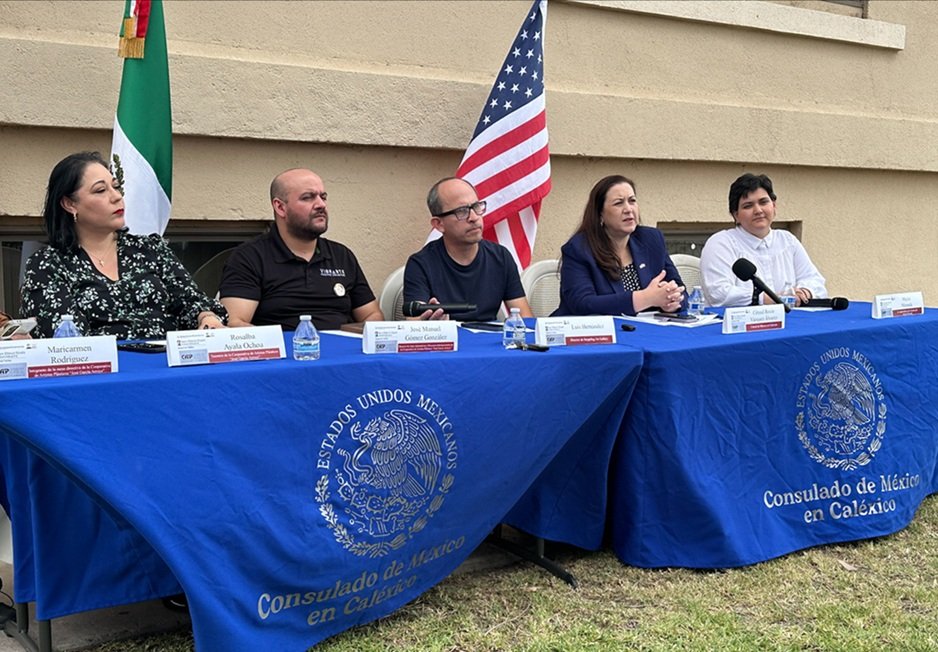
José Manuel Gómez González, director of alternative arts and international projects for the cooperative, said the exhibition seeks to showcase the depth and diversity of artistic talent in Baja California while strengthening cultural exchange across borders.
“This is a multidisciplinary exhibition featuring artists from across the region,” Gómez González said. “We are presenting close to 30 works by about 20 artists selected to exhibit at the Steppling Gallery. It is also an opportunity for audiences to connect with art, especially for those who may not have had much exposure to it.”
Organizers emphasized the collaborative nature of the initiative, which involved coordination among institutions on both sides of the border. The Mexican Consulate supported the transportation and promotion of the artworks, while SDSU Imperial Valley provided gallery space, installation assistance, and logistical coordination to bring the project to fruition.
Gómez González said the exhibition reflects ongoing efforts to strengthen cross-border relationships through art and sustained cultural dialogue.
“It is a collective effort and a demonstration of connection and dialogue between countries,” he said. “At a time when global challenges can create division, this project offers a way to build bridges through artistic expression.”
The roots of this artistic movement can be traced back to the founding of the José Clemente Orozco School of Plastic Arts in 1955, located in what is now the Casa de la Cultura in Mexicali. This institution marked the beginning of a sustained and organized cultural development in the region, laying the groundwork for future generations of artists. Over the following decades, the local cultural landscape expanded through the emergence of artist collectives and the organization of early exhibitions and competitions.
Notable groups formed during this period include Grupo Símbolo in 1965, CEPAC (Circle of Sculptors and Painters) in 1971, Grupo Yunque and Grupo PAVAC in 1975, and Grupo Lindero Norte in 1989. Together, these collectives helped shape a dynamic and collaborative artistic community not only in Mexicali, but also in neighboring cities such as Tijuana and Ensenada, contributing to a broader regional identity in the visual arts.
Building on this foundation, the José García Arroyo Plastic Artists Cooperative was established on March 15, 1992, as a nonprofit civil association formed by 18 visual artists from Mexicali, along with nine cultural promoters. The organization was formally incorporated before a notary on September 30 of that same year, solidifying its role as a structured platform for artistic collaboration and promotion.
Its founding artists included Manuel Aguilar Covarrubias, Carlos Coronado Ortega, Alma Cervantes de García, Ruth Hernández Ortiz, Ramón Carrillo Romero, Rubén García Benavides, Juana Valdez, Jaime Brambila, Carmen González Monjaraz, Andrés Jiménez Castillo, and Edgar Joel Meraz Pérez, among others. The group of cultural promoters featured figures such as Guadalupe Buitrón de López Moctezuma and Gabriel Trujillo Muñoz, whose support helped expand the cooperative’s reach and impact.
The cooperative was named in honor of painter and educator José García Arroyo (1934–1988), whose legacy continues to influence the artistic community. His passing inspired members to formally recognize his contributions and enduring connection to the group, ensuring that his vision would remain a guiding force for future generations.
Through Past and Present and the launch of Art Week, organizers aim not only to celebrate this legacy but also to reaffirm the role of art as a unifying force in a binational region defined by constant exchange, creativity, and shared cultural identity.