


Cuban President Confirms Talks with The United States Amid Escalating Pressure and Energy Crisis
Share your love
 -Editorial
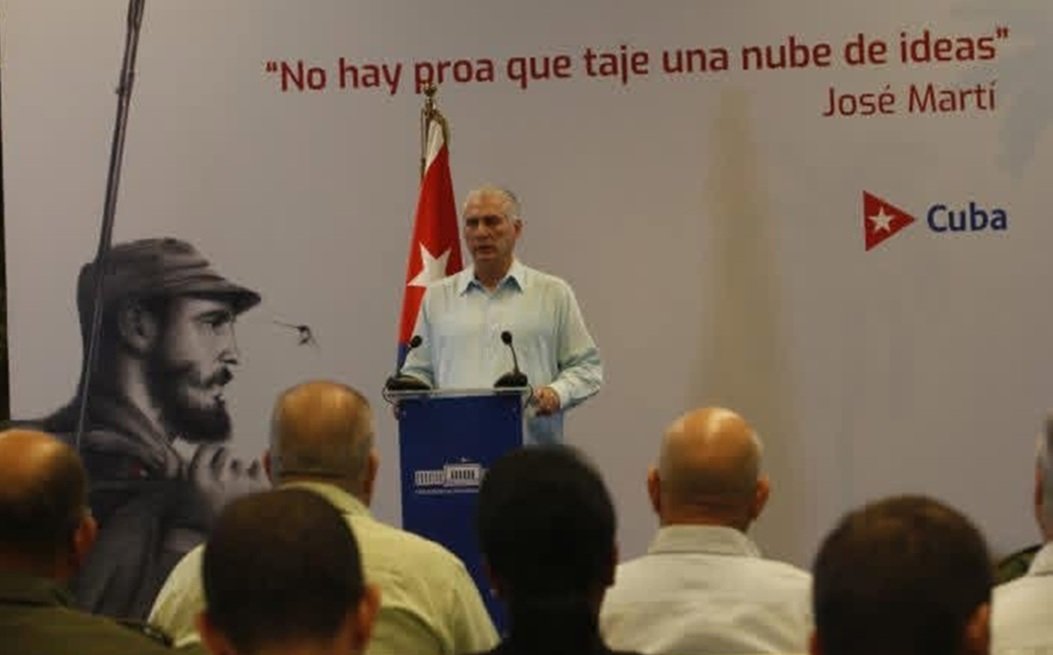
Cuban President Miguel Díaz-Canel said that Cuban officials have held discussions with representatives of the United States government, marking the first public acknowledgment of diplomatic contacts as tensions increase between the two countries.
In a televised address, Díaz-Canel said the discussions remain in an early stage and are focused on establishing an agenda for possible negotiations.
“Cuban officials have recently held talks with representatives of the United States government,” Díaz-Canel said. “We want to avoid manipulation and speculation,” he added, noting that negotiators are still working to define the scope of the discussions and that the talks are currently “in their first phase.”
The confirmation comes as the administration of President Donald Trump intensifies pressure on the Cuban government amid a deepening economic and energy crisis on the island.
A Trump administration official told ABC News that Washington believes a deal could be reached if Cuban leaders are willing to negotiate.
“As the president stated, we are talking to Cuba, whose leaders should make a deal, which he believes would be very easily made,” the official said.
Cuba is currently experiencing a severe fuel shortage that has disrupted transportation, electricity generation, and other basic services. The crisis has been exacerbated by U.S. actions targeting oil shipments bound for the island.
In February, the United States began blocking oil tankers headed to Cuba and warned countries and companies supplying fuel to the island that they could face tariffs or other penalties. The measures are part of a broader strategy by the Trump administration to increase economic pressure on the Cuban government.
The United States has maintained an economic embargo on Cuba since 1962 following Cold War tensions between the two countries. The restrictions have been tightened and loosened by successive administrations over the decades.
Relations briefly improved during the administration of former President Barack Obama, when the United States restored diplomatic relations with Cuba and eased some travel and trade restrictions. However, many of those policies were reversed during Trump’s first presidency and expanded again after he returned to office in 2025.
The Trump administration has framed its current policy toward Cuba as a “maximum pressure” strategy aimed at forcing political and economic reforms on the island. U.S. officials have said they want the Cuban government to reach an agreement with Washington.
In January, Trump called on Cuban leaders to “make a deal before it’s too late.” He later suggested the United States could pursue what he described as a “friendly takeover of Cuba,” though the administration has not provided details on what such a proposal would involve.
Cuba’s economic problems have deepened in recent years as the country struggles with declining foreign support and a fragile energy system. Historically, the island has relied heavily on imported fuel, much of it supplied by Venezuela through agreements with the Maduro government.
The situation worsened after political developments in Venezuela disrupted those supplies. The United States also expanded enforcement actions targeting oil shipments destined for Cuba.
The resulting fuel shortage has led to widespread blackouts and disruptions to daily life across the island. In February and March, several provinces experienced extended electricity outages, including a major power disruption following a shutdown at the Antonio Guiteras power plant, one of the country’s largest energy facilities.
Shortages have also affected transportation and public services. Cuban authorities have reduced public transit operations and temporarily closed some schools and universities as part of emergency measures to conserve fuel.
In Havana and other cities, garbage collection has slowed because many sanitation trucks lack fuel, leading to accumulating waste in some neighborhoods.
Fuel shortages have also affected aviation operations. Cuban authorities announced in February that airports would no longer be able to refuel some aircraft due to limited fuel supplies, prompting several international airlines to suspend flights to the island.
The crisis has raised concerns among international organizations about potential humanitarian impacts. According to the United Nations human rights office, the energy shortage threatens food production, water systems, and hospital operations.
Limited fuel supplies have also disrupted agricultural activity, making it more difficult for farmers to harvest crops and transport food to markets.
Despite the tensions, Díaz-Canel said Cuba remains open to dialogue with Washington.
Earlier this year, he said the Cuban government was prepared to discuss a broad range of issues with the United States without preconditions, although he emphasized that certain matters remain internal affairs of the country.
In a separate announcement in March, the Cuban government said it plans to release 51 political prisoners in the coming days. Officials described the decision as a gesture made “in a spirit of goodwill” following diplomatic engagement involving the Holy See.
Analysts say the prisoner release could signal an attempt by Havana to ease international pressure while negotiations remain in the early stages.
Reactions from other countries have varied. Some governments in Latin America have criticized the U.S. measures, while others have expressed support for increased pressure on the Cuban government.
As the situation continues to evolve, officials in both Havana and Washington have indicated that discussions are ongoing, though neither side has announced any concrete agreements.