

Imperial Valley Community Celebrates MLK holiday with March and Courthouse Ceremony
Share your love
 -Editorial
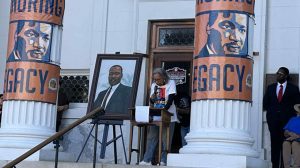
Members of the Imperial Valley community gathered on Jan. 19 at the Imperial County Courthouse to observe the federal holiday honoring the legacy of the Rev. Dr. Martin Luther King Jr., beginning with a march from the Martin Luther King Jr. Pavilion on Park Street. Once at the courthouse, there the reenactment of King’s “I Have A Dream” speech took place. The Imperial Valley Social Justice Committee organized the annual event.
Participants walked from the pavilion to the courthouse in downtown El Centro, chanting phrases including “When our community is attacked, we stand up” and “I am somebody.” The chants continued throughout the march until the group reached the courthouse steps, where the ceremony was held.
This event was a call for civil rights in today’s political and social climate, which they said is marked by discrimination and concerns about threats to democratic institutions. The gathering emphasized public participation as essential to preserving the legacy of the Rev. Dr. Martin Luther King Jr., urging community members to remain engaged through voting, jury service, and other forms of civic involvement. Speakers repeatedly framed the event as a call to action, encouraging residents not to allow King’s work and message to fade, but to carry it forward through continued advocacy and community engagement.
Activist Lupe Quintero delivered the most emotional remarks of the ceremony Monday, tracing the history of slavery, segregation, and the long civil rights struggle while urging the audience not to forget the realities of America’s past. Quintero began by referencing the Declaration of Independence and its promise that “all men are created equal,” noting that the vision did not include the hundreds of thousands of African Americans who were enslaved at the time. “They don’t want to hear it. They don’t want to accept it. They don’t want to own it, that slavery did, in fact, exist in this great United States,” Quintero said, criticizing what she described as current efforts to erase Black history.
Quintero recounted key moments in U.S. history, including the rise of Jim Crow laws, the Supreme Court’s 1896 Plessy v. Ferguson decision, widespread lynchings, and the work of civil rights figures such as Harriet Tubman, Ida B. Wells, W.E.B. Du Bois, Thurgood Marshall, and Rosa Parks. She described the Montgomery Bus Boycott, school desegregation battles, and the resistance that followed the 1954 Brown v. Board of Education ruling. “This was an assault on Black civil rights throughout the South,” she said. “Blacks were prevented from voting. They were required to pay poll taxes and take literacy tests before they could register.”
Quintero concluded by highlighting the leadership of the Rev. Dr. Martin Luther King Jr. and the importance of continued action. She recalled King’s rejection of waiting for change and his commitment to nonviolent resistance. “If you decide to wait, that is all you will end up doing,” she quoted. Emphasizing responsibility to carry forward King’s work, Quintero told the audience, “We have an obligation to Dr. King’s dream. The road was weary and hard, but those tired feet always moved forward. And that is what we have to do.”