


Yuma and Mexico Sign Agreement to Expand Binational Science and Technology Cooperation
Share your love
 -Editorial
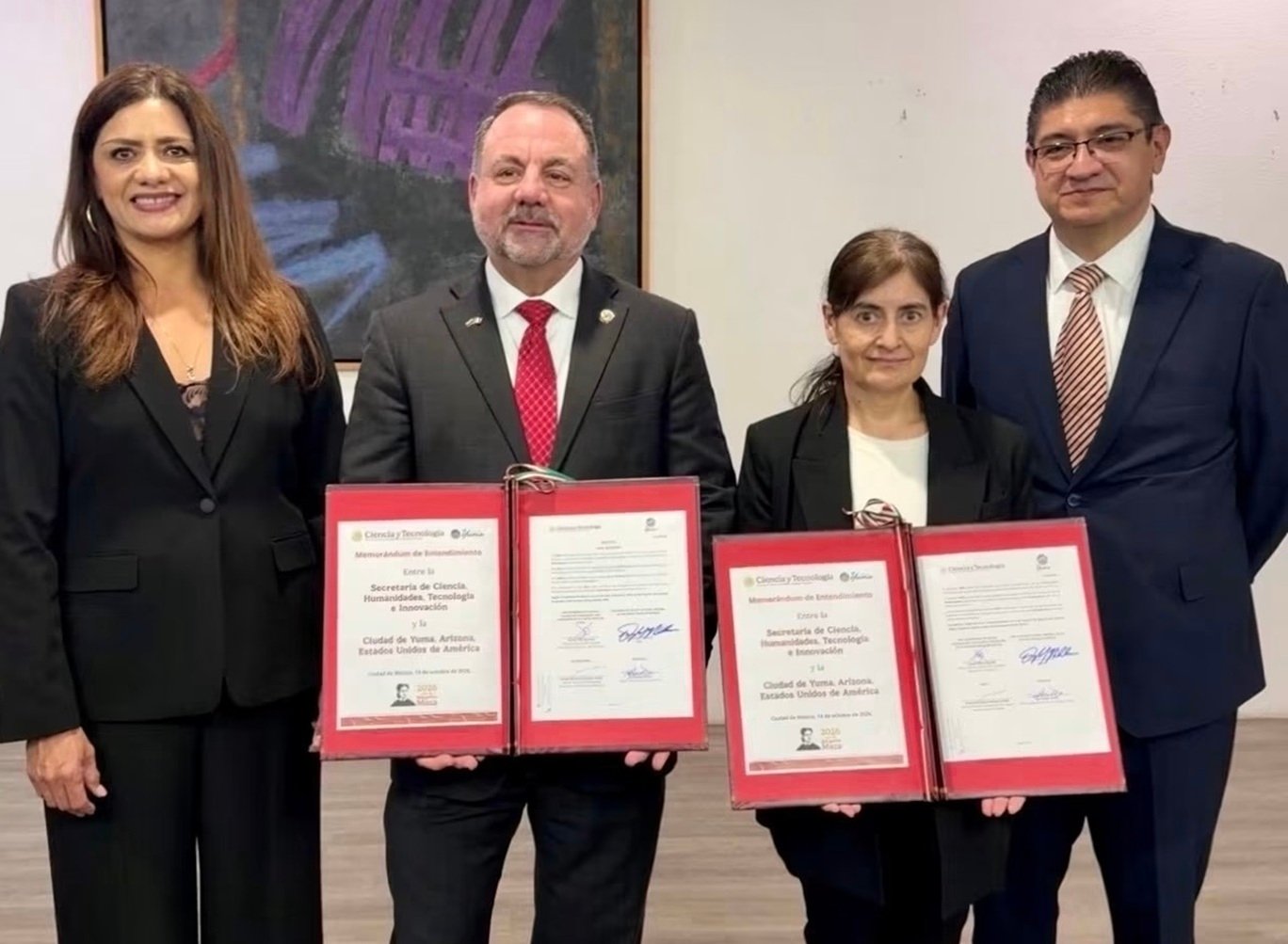
A delegation from the city of Yuma, Arizona, led by Mayor Douglas Nicholls, traveled to Mexico City on Oct. 14 to sign a memorandum of understanding with Mexico’s Secretariat of Science, Humanities, Technology and Innovation (SECIHTI), establishing a framework for binational cooperation in scientific research, technology and economic development.
The agreement is intended to promote collaboration in applied research, technology transfer, workforce development and innovation across the 4FrontED megaregion, which encompasses southwestern Arizona, southeastern California, northern Sonora and northeastern Baja California.
The initiative seeks to strengthen economic ties among communities along the U.S.-Mexico border by supporting partnerships between government agencies, educational institutions and private industries.
Mexicali, Baja California, is among the region’s major manufacturing and engineering centers, particularly in the aerospace and industrial sectors. The city maintains economic development partnerships with Yuma aimed at expanding investment opportunities and strengthening regional competitiveness.
During the visit, the Yuma delegation also met with representatives of Mexico’s Secretariat of Economy to discuss opportunities for aerospace development within the 4FrontED region.
The discussions focused on the proposed Yuma Spaceport project and the Sonora-Arizona Aerospace Corridor, two initiatives intended to support aerospace manufacturing, research, and related industries along the international border.
Officials discussed the possibility of developing a separate memorandum of understanding to establish additional cooperation involving the spaceport project and the aerospace corridor.
According to the city of Yuma, the proposed agreement would seek to strengthen cross-border supply chains, attract private investment and encourage the development of high-value industries in both countries.
Participants in the discussions included senior representatives of the Secretariat of Economy’s Global Economic Intelligence Unit, Mexican Air Force officers involved in national aerospace initiatives and representatives of the Mexican Federation of Aerospace Industries (FEMIA).
The meetings brought together government, military and private-sector representatives to examine opportunities for expanding aerospace-related economic activity in the border region.
The Yuma delegation also met with senior officials from the Directorate General for North American Diplomatic Strategy within Mexico’s Ministry of Foreign Affairs.
The meeting addressed the city’s regional development initiatives within the broader context of diplomatic and economic relations between the United States and Mexico.
The delegation included members of the Yuma City Council, Arizona state Rep. Nick Kupper and representatives from the Arizona Commerce Authority, the University of Arizona, the town of Wellton, 4FrontED, Elevate Southwest and several private companies.
Nicholls said cooperation among local governments, state agencies and Mexican institutions could create additional economic opportunities throughout the region.
“By working collaboratively, the greater Yuma region, statewide agencies and partners in Mexico can reach new opportunities for advancement in our shared economies and industries with greater potential than we can alone,” Nicholls said.
“Collaboration with Mexico’s federal institutions on the Yuma Space Port project puts Arizona at the forefront of a new chapter in science, technology and shared prosperity.”
The agreement with SECIHTI establishes a framework for future cooperation, while discussions involving the Yuma Spaceport and Sonora-Arizona Aerospace Corridor remain in the preliminary stages.
The city did not announce specific funding commitments, implementation schedules, or investment amounts associated with the agreements and discussions.
Yuma officials said they intend to continue working with Mexican federal institutions and regional partners to explore opportunities in aerospace, scientific research, technology development, and cross-border economic cooperation.