



U.S. and Japan Unveil Broad Economic, Defense, and Tech Agreements
Share your love
 -Editorial
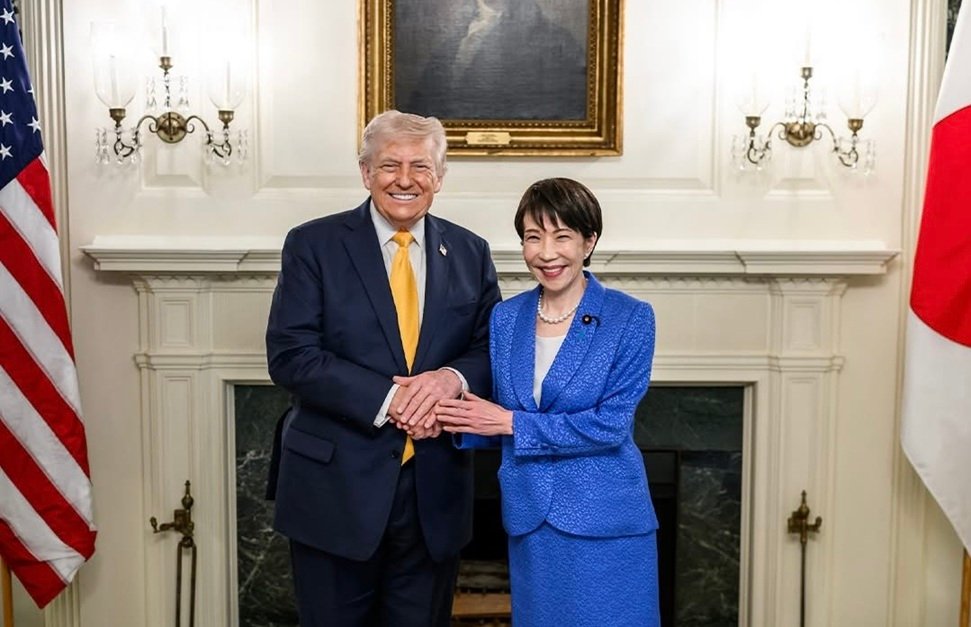
President Donald Trump and Prime Minister Sanae Takaichi met at the White House on Thursday and announced a wide-ranging set of initiatives aimed at strengthening the U.S.-Japan alliance, boosting economic investment, and reinforcing security cooperation across the Indo-Pacific region.
The announcements covered trade, energy, advanced technology, defense, and regional security, reflecting both countries’ efforts to address evolving geopolitical and economic challenges.
The leaders emphasized efforts to expand economic ties, including improving and accelerating market access for U.S. agricultural exports to Japan. The initiative is intended to benefit American farmers, ranchers, and producers seeking greater access to international markets.
Officials also highlighted continued Japanese investment in the United States under the 2025 U.S.-Japan Strategic Trade and Investment Agreement. In addition to an initial $36 billion tranche announced earlier this year, a second round of investments is expected to include up to $40 billion for small modular reactor projects in Tennessee and Alabama, along with up to $33 billion for natural gas generation facilities in Pennsylvania and Texas.
Both countries said they would continue coordinating on investment security. Japan indicated plans to strengthen its review mechanisms for inbound foreign investment tied to national security risks, while the United States signaled it would prioritize visa processing for temporary business travelers who contribute to investment, workforce training, or the transfer of specialized skills.
A separate memorandum of cooperation will also promote joint efforts in the use, conservation, and management of national parks.
The discussions also focused on strengthening supply chain resilience amid concerns about geopolitical competition and restricted access to key materials, including critical minerals.
The leaders welcomed the outcomes of the Indo-Pacific Energy Security Ministerial and Business Forum, which brought together ministers and business leaders from across the region and highlighted more than $50 billion in projects and investments.
Under a new agreement, the United States and Japan will expand joint research and development on commercially viable deep-sea mineral resources, including rare-earth deposits near Japan. Officials said such resources could play a significant role in meeting long-term industrial demand.
The two countries also agreed to a Critical Minerals Action Plan aimed at increasing production capacity and diversifying supply sources, including the potential development of a broader trade framework supported by pricing mechanisms or other safeguards.
The meeting produced several agreements aimed at advancing collaboration in science and technology. The U.S. Department of Energy and Japan’s Ministry of Education, Culture, Sports, Science and Technology signed a statement of intent to cooperate on artificial intelligence, high-performance computing, and quantum technologies.
Additional partnerships involving U.S. and Japanese research institutions and private-sector companies are expected to focus on developing next-generation computing systems and infrastructure.
In space exploration, the two nations reaffirmed their cooperation through NASA’s Artemis program, including plans for astronauts to return to the moon with the support of a Japanese-developed pressurized lunar rover. The countries also plan to expand collaboration in low-Earth orbit and future lunar base initiatives.
Officials confirmed upcoming joint efforts on space missions, including the launch of the Nancy Grace Roman Space Telescope and Japan’s Martian Moons Exploration mission.
The two countries are also continuing cooperation in biotechnology and pharmaceutical supply chains, building on a 2025 bilateral technology agreement. Public health collaboration has included sharing epidemic intelligence reports, which officials said contributed to earlier detection and response to multiple health events.
Defense cooperation was a central focus of the talks, with the United States welcoming Japan’s commitment to increase defense spending and expand its capabilities.
Both countries reaffirmed their commitment to strengthening deterrence in the region, including deploying advanced military capabilities in Japan. Officials said coordination would continue following the 2025 deployment of U.S. missile systems to mainland Japan.
The two sides also discussed expanding production capacity for advanced missile systems, including the AIM-120 Advanced Medium-Range Air-to-Air Missile and increasing production of Standard Missile 3 Block IIA interceptors in Japan.
Japan also committed to developing a secure, sovereign cloud platform for government data to enhance bilateral information sharing, planning, and operational coordination.
The leaders addressed broader regional security concerns, reaffirming their commitment to maintaining peace and stability in the Indo-Pacific.
Both countries reiterated their support for stability across the Taiwan Strait, emphasizing the importance of resolving cross-strait issues through peaceful dialogue and opposing unilateral changes to the status quo by force or coercion.
They also reaffirmed their commitment to the denuclearization of North Korea and to strengthening trilateral cooperation with South Korea. The United States expressed support for Japan’s efforts to resolve longstanding issues involving Japanese citizens abducted by North Korea.
In addition, the two countries said they would continue coordinating in third countries to address challenges posed by strategic competitors and other security threats.