


Supervisor Ryan Kelley Raises Concerns Over Political Discourse and Personal Attacks in Imperial County
Share your love
-Editorial
Imperial County Supervisor Ryan Kelley is calling for greater civility, accuracy and accountability in local political discourse, warning that criticism of government decisions is increasingly crossing into personal attacks against public employees, organizations and individuals.
In a Labor Day message, Kelley addressed what he described as a deterioration in the tone of local political debate, particularly on social media, where memes, AI-generated images, anonymous posts and misleading accusations increasingly shape conversations about county government.
“A meme is not evidence. An AI-generated image is not proof. And turning county employees into personal targets is not accountability,” Kelley said.
Kelley specifically referenced Mount Signal Media and an anonymous group he identified as the Calexico Coalition, arguing that those who criticize government also have a responsibility to provide accurate information and meaningful context.
“My concern is when criticism of county decisions becomes a personal attack on the people doing the work,” Kelley said. “Suggesting wrongdoing is not the same as establishing it, and presenting an accusation without the relevant context does not give residents the whole story.”
His comments come as Imperial County finds itself in one of its most contentious political debates in years, centered on Lithium Valley, large-scale energy development and proposed hyperscale data centers.
The debate has produced legitimate questions about water, energy, environmental review, land use, economic development and the future direction of the region. It has also produced increasingly aggressive political organizing, social-media campaigns, demonstrations and personal attacks.
And that is where Kelley’s warning takes on a larger significance.
The issue is no longer simply what people are saying about government. It is also about who is shaping the conversation, how certain voices gain influence, and whether the public has enough information to understand the interests, funding and relationships behind the messages being amplified.
Those questions have become particularly relevant in the increasingly heated opposition to proposed AI data centers.
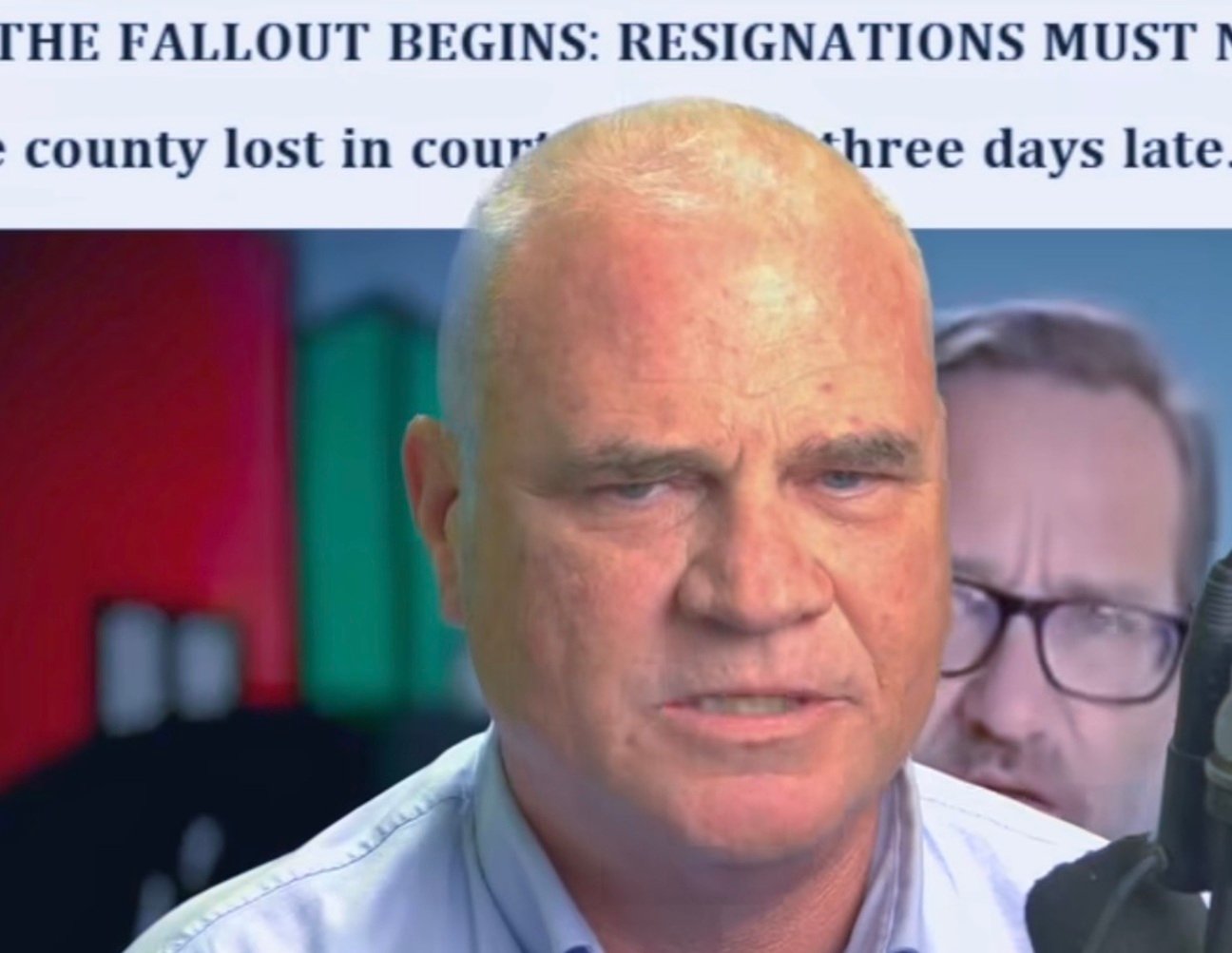
One of the most visible figures in that opposition is Jake Tison, a relatively recent resident of El Centro, apparently having lived there for only about seven months after moving from San Diego, and associated with Mt. Signal Media.
Tison has emerged as a prominent participant in the data-center debate, appearing at public meetings, producing online content, participating in demonstrations and supporting efforts to challenge local government decisions. Local reporting has also identified him as a member of Not In My Backyard Imperial, a group opposing the proposed data center.
There is nothing inherently improper about a resident organizing, criticizing elected officials or opposing a development project. Public participation is an important part of democratic government.
But when an individual becomes one of the most recognizable voices in a highly consequential political controversy, the public is entitled to ask who is supporting that influence, how the activity is financed and what organizational relationships may exist behind it.
That is especially true when activism, digital media, political organizing, fundraising and litigation begin operating within the same political battle.
This is not a question about whether Tison has the right to speak.
He does.
It is not a question about where he came from and that he is not originally from Imperial Valley, or has no verified background in journalism or activism.
Nor is opposition to data centers itself evidence of improper conduct.
The question is one of transparency.
When someone becomes simultaneously an activist, media producer, political participant and fundraising recipient in a contentious public-policy fight, the public should be able to distinguish between personal advocacy, organized political activity, independently verified information and messaging that may be coordinated with other interests.
And that brings us to the questions surrounding Tison’s growing role in the Imperial County debate.
Our Questions
Tison’s public professional profile links him to Mt. Signal Media and includes previous professional activity in the San Diego area as a producer of videos for private parties. His own legal-defense fundraising campaign identifies him as an Imperial Valley resident during recent months.
His GoFundMe campaign, launched in April 2026, sought $16,000 for legal defense, including attorney fees, court expenses and representation involving First Amendment and anti-SLAPP law. The campaign page reported $10,430 raised through 128 donations.
There is nothing inherently improper about raising money for legal defense.
But transparency becomes increasingly important when fundraising, political organizing and media activity converge around the same public-policy battle.
Who is financing political video production?
Who is supporting organizational activity?
Who pays for political communications?
What relationships exist between activists, organizations, attorneys, political groups and other interested parties?
And when a particular narrative is being aggressively amplified, who benefits from that narrative?
Those are not accusations. They are questions that can be answered with documentation.
And they should be.
 From Activist to Political Operator?
Tison’s participation has extended beyond simply expressing an opinion about data centers.
He has appeared at government meetings, spoken publicly against proposed projects and participated in broader opposition efforts. Reporting has documented calls for a data-center prohibition and recall activity involving Supervisor Peggy Price.
That level of civic engagement is legitimate.
But increased political influence also brings increased responsibility.
The public should be able to distinguish between personal opinion, organized advocacy, independently reported information and coordinated political messaging.
That distinction becomes particularly important when the same individual is functioning simultaneously as an activist, media producer, political participant and fundraising recipient.
The question is not whether Tison has the right to participate.
He does.
The question is whether the public has enough information to understand the full network of interests, funding and relationships surrounding the message.
At this point, there is no verified evidence establishing that an outside individual or interest group recruited Tison to Imperial County or is directing his activities. That claim should not be presented as fact without evidence.
But neither should questions about potential influence be dismissed simply because they are uncomfortable.
When the Target Becomes the Messenger
That issue became particularly relevant when Beyond Borders Gazette itself became the subject of online criticism connected to the data-center controversy.
Tison produced content questioning the publication’s relationship with Imperial County government and raising questions about payments allegedly received by the publication.
As a media organization that has operated in the region for more than a decade, Beyond Borders Gazette has maintained both editorial and commercial operations.
Like other professional media organizations in the region, the publication can provide advertising, promotional, translation and communications services to public agencies, businesses, nonprofits and other organizations.
Those commercial relationships are not, by themselves, evidence of editorial control.
Nor does publishing a cover featuring an elected official establish political allegiance.
A publication can report on a public official, interview that official, recognize an achievement or provide a paid professional service without surrendering editorial independence.
The relevant question is not whether a media organization has commercial relationships. The relevant question is whether those relationships improperly influence its journalism.
That distinction matters.
And it applies equally to activists.
The Larger Problem: Public Trust
This controversy is ultimately bigger than Jake Tison.
It is about what happens to a community when political disagreement becomes personal warfare.
Anonymous pages, edited videos, memes, AI-generated content, selectively chosen screenshots, and malicious accusations circulated without documentation can spread across social media far faster than the facts can be verified.
An allegation repeated often enough can begin to look like established fact.
It is not.
The data-center debate itself demonstrates how quickly political conflict can escalate. Imperial County adopted a temporary moratorium in June, later extended it, and the county says the Superior Court subsequently set that moratorium aside because its findings did not satisfy applicable legal requirements. The county is now developing a new proposed moratorium.
That is precisely why evidence matters.
Residents deserve facts about projects that could affect their water, energy system, environment, economy and quality of life.
They also deserve facts about the people and organizations attempting to influence those decisions.
Accountability Must Apply to Everyone
Tison was named in litigation brought by Imperial Valley Computer Manufacturing and attorney Sebastian Rucci over statements associated with the data-center controversy. Tison’s fundraising campaign describes the case as arising from his public speech concerning the proposed project.
The existence of litigation does not establish that either side’s broader claims are true.
Nor does the dismissal of a lawsuit automatically establish the truth of every statement made by a defendant.
The appropriate standard remains the same:
Show us the evidence.
If an elected official is accused of wrongdoing, produce the records.
If a government agency is accused of misusing public funds, produce the documents.
If a media organization is accused of being compromised, identify the transaction and explain the alleged conflict.
And if an activist or advocacy organization receives financial or organizational support that could reasonably affect its public messaging, disclose it.
Our Editorial Standard
The Imperial Valley deserves vigorous civic engagement.
It also deserves transparency.
Residents have the right to challenge government, developers and the media. Journalists have the responsibility to investigate. Public officials have the responsibility to explain their decisions. Activists have the right to organize.
But everyone participating in the public conversation has a responsibility to distinguish evidence from speculation and advocacy from established fact.
That standard must apply to elected officials.
It must apply to activists.
It must apply to developers.
It must apply to political organizations.
And it must apply to the media—including us.
Beyond Borders Gazette welcomes scrutiny of its reporting, its business relationships and its coverage. If we make an error, we should be held accountable and given the opportunity to correct it.
But accountability cannot mean turning an allegation into a fact simply because it is repeated loudly or frequently.
The same principle applies to Jake Tison.
He has every right to criticize government decisions, developers and media organizations.
But as his public profile and political involvement have grown, so too should the public’s ability to understand the funding, affiliations and organizational relationships surrounding his activism.
We cannot establish that Tison’s activities are being orchestrated by an undisclosed individual or interest group. We should not pretend otherwise.
But asking who funds political messaging, who coordinates campaigns and who benefits from particular narratives is not an attack.
It is a question of transparency.
And in a community facing consequential decisions about data centers, Lithium Valley and its economic future, those questions deserve answers based on records—not rumors, personalities or social-media warfare.
Because when political debate becomes dominated by anonymous accounts, fundraising campaigns, personal attacks and unverified accusations, the greatest casualty may not be any individual politician, activist or media organization.
It may be something much harder to rebuild:
public trust.
Imperial County deserves a political conversation in which people can disagree passionately without abandoning evidence, transparency and accountability.
The Question That Matters
Ultimately, this debate should challenge all of us—not to choose sides, but to demand better from ourselves and from those who seek to shape the future of Imperial County.
Question the information. Verify the claims. Follow the money. Examine the relationships. Listen beyond the headlines—and hold everyone to the same standard of accountability.
Because Imperial County does not need more division. It needs more facts, more transparency, more responsible dialogue and more people willing to work together.
Our future is too important to be reduced to political attacks, social-media battles or competing agendas.
The real question is not who wins the argument. It is whether we can work as a team, disagree with integrity and move Imperial County forward together.