


Newsom Outlines Achievements in His Last State of the State Address
Share your love
 -Editorial
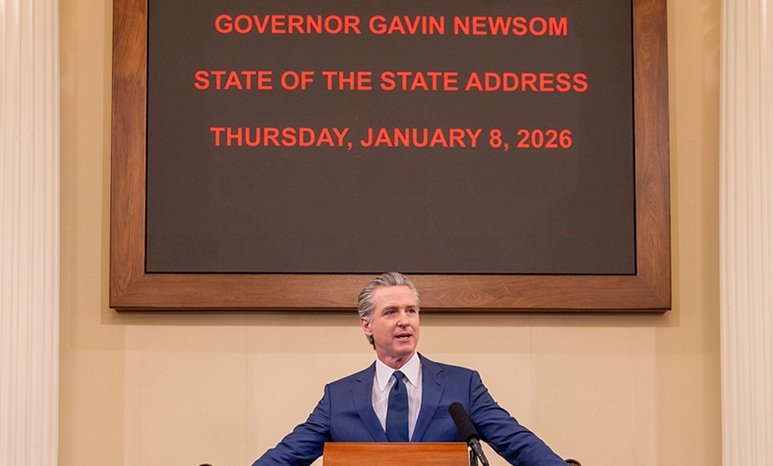
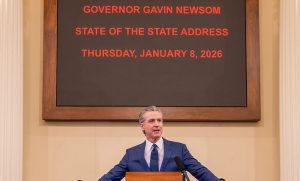
Gov. Gavin Newsom on Thursday delivered what he described as his final State of the State address, using the annual speech to highlight California’s economic position, major investments in education and infrastructure, and ongoing legal battles with the federal government, while laying out policy priorities for the coming year.
Speaking before a joint session of the Legislature, Newsom framed California as a national counterweight to Washington, criticizing recent federal actions and saying his administration has filed 52 lawsuits challenging executive authority. He said those efforts have preserved an estimated $168 billion in federal funds for California programs, including education, health care, and disaster response.
Newsom said the state would continue to pursue litigation to protect federal funding and civil rights, while also focusing on economic growth, affordability, and public services.
He pointed to California’s economic scale, noting it remains the world’s fourth-largest economy, and cited investments in manufacturing, clean energy, agriculture, and technology. He highlighted the state’s “Jobs First” economic blueprint, developed with regional input. He said his upcoming budget would seek to extend the CalCompetes tax credit program and expand incentives for industries such as advanced manufacturing, biotechnology, aerospace, and film production.
The governor emphasized artificial intelligence and emerging technologies as both economic opportunities and regulatory challenges. He referenced legislation adopted last year establishing statewide rules for AI development and use, calling them the first of their kind in the nation.
On fiscal policy, Newsom said his administration would propose a General Fund budget of $248.3 billion, citing revenues exceeding earlier projections. He said the budget would include rebuilding reserves, paying down long-term pension liabilities, and what he called the largest education investment in state history.
Newsom said per-pupil spending would reach a record $27,418, fully funding universal transitional kindergarten, maintaining class-size reduction efforts, and continuing statewide free school meals. He also announced plans to expand community schools, increase before- and after-school programs, and pursue changes to unify governance between the State Board of Education and the Department of Education.
Addressing workforce development, Newsom said California has surpassed its goal of creating 500,000 apprenticeships by 2029, reporting more than 600,000 “earn-and-learn” opportunities statewide. He also highlighted a new master plan for career education and the expansion of service programs, including the California Service Corps and College Corps.
On housing, Newsom said the state would continue implementing housing reforms enacted in recent years and signaled new proposals to reduce construction costs and address the growing role of institutional investors in the housing market. He said his administration would work with lawmakers on potential oversight measures and tax policy changes targeting large-scale corporate homebuyers.
Newsom also focused on homelessness and behavioral health, pointing to expanded conservatorship laws, the CARE Court program, and voter-approved Proposition 1, which authorized $6.38 billion for mental health housing and treatment facilities. He said early data show a 9% decline in unsheltered homelessness statewide in 2025, including larger drops in several major counties.
Public safety was another theme. Newsom cited state grants to local law enforcement, deployment of crime suppression teams, and additional California Highway Patrol officers, saying recent data show declines in violent and property crime in several cities.
The governor also highlighted major infrastructure projects, including water storage, renewable energy facilities, broadband expansion, and high-speed rail construction in the Central Valley. He said more than $100 billion in infrastructure projects are underway statewide.
Climate policy featured prominently. Newsom said California is generating about two-thirds of its electricity from clean sources and ended coal-fired power last year. He emphasized wildfire mitigation, home-hardening programs, and insurance market reforms aimed at stabilizing coverage in high-risk areas.
He marked the first anniversary of the destructive Los Angeles-area wildfires, citing state-funded debris removal, recovery programs, and more than 2,500 building permits issued. Newsom criticized the federal government for not yet submitting a disaster relief funding request to Congress for the region.
Throughout the speech, Newsom characterized California as a national leader on economic development, environmental policy, education, and social services, while acknowledging ongoing challenges related to housing costs, homelessness, mental health, and disaster recovery.
The address comes as Newsom prepares to release his proposed budget and begins what he indicated would be his final legislative year in office.