



Newsom Highlights California Wildfire Technology Investments at McClellan Air Park
Share your love
 -Editorial
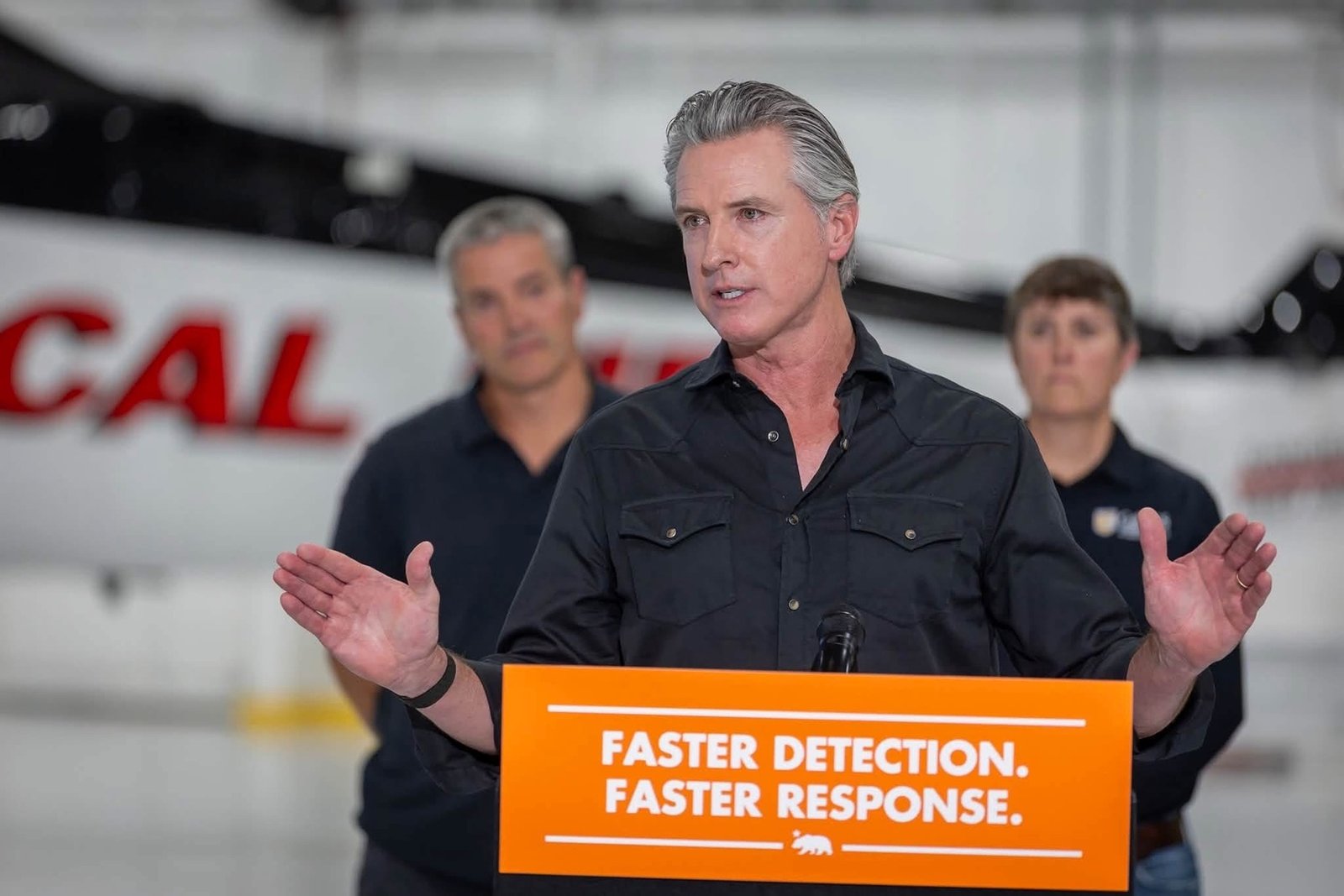
Gov. Gavin Newsom highlighted California’s investments in wildfire prevention and emergency response technology during an event at McClellan Air Park, pointing to the state’s use of drones, satellites, artificial intelligence and advanced camera networks to detect and track wildfires.
Newsom said changing wildfire conditions have required new approaches to emergency management and firefighting.
“Wildfires are burning hotter, moving faster and hitting harder,” Newsom said. “California leads with science, innovation and grit.”
According to the governor’s office, California has increased spending on wildfire preparedness and response since 2019, including investments in firefighting personnel, equipment and training. The state’s fire protection budget has grown from $2 billion to $3.8 billion, with more than $2.5 billion dedicated to wildfire resilience and forest health projects.
California has also invested more than $350 million in wildfire safety projects on federal lands, which account for approximately 58% of the state’s forestlands. Funding for the California Governor’s Office of Emergency Services (Cal OES), which coordinates disaster response and recovery efforts, increased from $1.8 billion to $4.5 billion, according to the governor’s office.
During the event, California officials highlighted several wildfire technology initiatives, including the expansion of California’s aerial firefighting capabilities. The state operates four C-130H airtankers for wildfire suppression and plans to expand the fleet to seven aircraft.
California has also partnered with the Earth Fire Alliance on wildfire detection satellites. The first three FireSat satellites launched from Vandenberg Space Force Base in June, providing additional monitoring capabilities for firefighters.
Another initiative, ALERTCalifornia, is a statewide network developed through a partnership between UC San Diego and California. The system includes more than 1,000 cameras used to detect and monitor wildfires. The governor’s office said artificial intelligence-assisted cameras have detected more than 900 fires on state lands before 911 calls were placed.
Cal OES also manages the Fire Integrated Real-Time Intelligence System (FIRIS), which provides aerial intelligence, fire mapping and predictive analysis during wildfire incidents. Agency representatives said the program has completed more than 2,000 missions since 2019.
California officials also highlighted other wildfire management efforts, including statewide LiDAR mapping technology that provides three-dimensional data on vegetation and wildfire risks, as well as research into artificial intelligence-guided drones for firefighting operations.
CAL FIRE Director and Fire Chief Joe Tyler said new technology is intended to provide firefighters with better information and resources.
“Investments in advanced technology like drones, satellites and AI-powered detection are giving our firefighters the tools they need to protect California’s communities more effectively and safely,” Tyler said.
The state has expanded its firefighting workforce in recent years, adding an average of 1,800 full-time positions and 600 seasonal positions annually over the past five years, according to the governor’s office. Additional hiring is planned for firefighters, natural resource professionals and support personnel.
California officials also discussed the state’s mutual aid system, which allows firefighting resources to be shared with other states and jurisdictions. Cal OES manages more than 270 state-owned fire engines assigned to more than 60 local agencies statewide.
California has participated in wildfire cooperation agreements with other states, Canadian provinces and international partners, including the Northwest Wildland Fire Fighting Compact and agreements with British Columbia, Brazil and France.
The event was held nearly six years after Newsom met with then-President Donald Trump at McClellan Air Park to discuss climate change and major wildfires affecting California.
California Natural Resources Secretary Wade Crowfoot said wildfire response requires cooperation among governments and communities.
“When disaster strikes, our first instinct should be to lend a hand,” Crowfoot said.
California officials encouraged residents to prepare for wildfire emergencies by creating evacuation plans, preparing emergency supply kits and signing up for local emergency alerts.