


Mexican Government Reaffirms Long-Term Security Presence in Sinaloa Amid Ongoing Violence
Share your love
 -Editorial
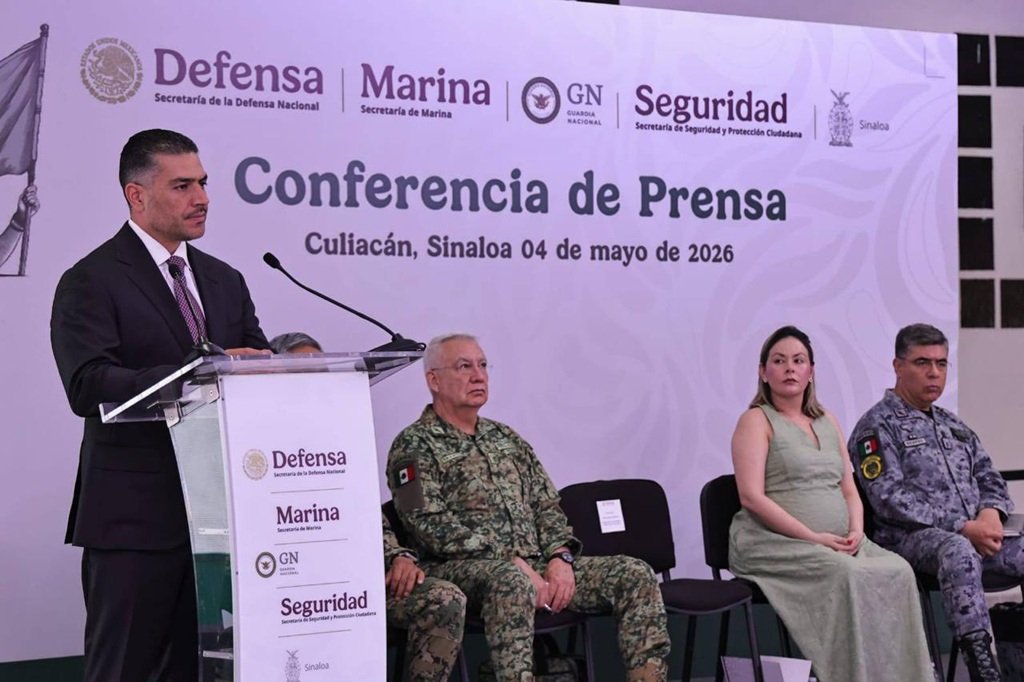
Federal and state authorities have reiterated their commitment to maintaining a permanent security presence in the state of Sinaloa, as part of a broader strategy to reduce violence, dismantle organized crime networks, and strengthen public safety institutions. The announcement came during a high-level security briefing in Culiacán, where top officials outlined ongoing operations and coordination efforts across multiple levels of government.
Mexico’s Secretary of Security and Citizen Protection, Omar García Harfuch, stated that the federal government—under the leadership of President Claudia Sheinbaum—will not scale back its presence in Sinaloa, a state long considered a stronghold of organized crime. Instead, authorities will continue daily enforcement actions aimed at protecting residents and restoring stability.
Joining García Harfuch at the briefing were Defense Secretary Ricardo Trevilla Trejo, Navy Secretary Raymundo Pedro Morales Ángeles, National Guard Commander Guillermo Briseño Lobera, and interim Sinaloa Governor Yeraldine Bonilla Valverde. The presence of senior military and civilian leadership underscored the federal government’s emphasis on coordinated, multi-agency action.
Following a morning session of the federal Security Cabinet, officials convened a regional security meeting with representatives from the Defense Ministry, Navy, National Guard, Attorney General’s Office, and state and municipal authorities. The goal, officials said, is to ensure uninterrupted coordination and unified enforcement strategies across jurisdictions.
Authorities outlined three central objectives guiding current operations in Sinaloa: reducing overall crime rates, targeting individuals identified as key generators of violence, and strengthening institutional capacity through expanded intelligence, investigative work, and prevention efforts. Reinforcing local police forces remains a critical pillar of the strategy.
As part of these efforts, federal authorities have delivered 100 patrol vehicles to the state police and expanded training programs with military support. Additional personnel have also been deployed to reinforce operations, reflecting what officials describe as a sustained, rather than temporary, federal commitment.
According to official figures, between October 1, 2024, and April 15, 2026, authorities have detained nearly 2,400 individuals linked to high-impact crimes. During the same period, security forces seized more than 68 metric tons of drugs, including over 2 million fentanyl pills—a substance at the center of a growing public health crisis in both Mexico and the United States.
Authorities also reported the confiscation of 5,457 firearms, more than 1.13 million rounds of ammunition, and approximately 27,000 magazines. In addition, 2,183 clandestine drug laboratories were dismantled, highlighting the scale and sophistication of drug production operations in the region.
Defense Secretary Trevilla noted that approximately 13,300 military personnel are currently deployed in Sinaloa, including around 2,700 members of elite special forces units. These operations are supported by more than 2,000 vehicles and 48 aircraft, enabling patrols, surveillance, targeted arrests, and the destruction of illicit production sites.
In Culiacán alone, authorities reported the seizure of roughly 26 tons of drugs and the detention of 1,506 individuals. Fourteen high-priority targets have also been apprehended through intelligence-driven operations. While Trevilla indicated that homicide rates have declined, officials did not provide specific data, making it difficult to independently assess the scope of the improvement.
The Mexican Navy continues to play a significant role in supporting public security efforts. Secretary Morales reported that 1,628 naval personnel and 169 operational units are currently active in Sinaloa. Naval operations have led to the arrest of more than 1,000 individuals and the seizure of over 1,000 firearms, along with substantial quantities of ammunition and narcotics.
Beyond enforcement, federal authorities are working to strengthen local institutions. The Defense Ministry is assisting in the recruitment, vetting, and training of new state police officers, including conducting background checks and evaluations. Officials say this initiative is designed to improve the long-term effectiveness and integrity of local law enforcement agencies.
Interim Governor Bonilla Valverde emphasized that her administration will continue implementing the current security strategy and maintain close coordination with federal authorities. Her remarks come amid political changes in the state following the temporary leave of Governor Rubén Rocha Moya, a development that has added complexity to governance during a period of heightened security concerns.
Sinaloa has long been associated with powerful criminal organizations, most notably the Sinaloa Cartel, which has played a central role in global drug trafficking networks for decades. The state’s geographic location, infrastructure, and historical dynamics have made it a strategic hub for the production and distribution of narcotics, including fentanyl and methamphetamine.
In recent years, internal fractures within criminal groups, combined with intensified government operations, have contributed to periods of increased violence, particularly in urban centers such as Culiacán. Analysts note that while high-profile arrests and seizures can disrupt operations, they may also trigger short-term instability as rival factions compete for control.
The security situation in Sinaloa carries significant implications for the bilateral relationship between Mexico and the United States, particularly in the context of drug trafficking and migration.
Fentanyl, much of which is trafficked through Mexico, has become a leading cause of overdose deaths in the United States, prompting increased pressure on Mexican authorities to curb production and distribution. In response, both countries have expanded intelligence sharing, law enforcement coordination, and joint efforts under frameworks such as the Bicentennial Security Agreement.
At the same time, the relationship remains complex. U.S. officials have called for stronger enforcement and accountability, while Mexican leaders have emphasized sovereignty and the need to address root causes of violence, including poverty and demand for drugs in the United States. This dynamic underscores the delicate balance between cooperation and national priorities.
Despite ongoing security challenges, officials pointed to signs of economic resilience in parts of the state. In the port city of Mazatlán, cruise ship arrivals have continued to increase, with more than 229,000 passengers recorded in 2026. Authorities estimate that this influx has generated approximately 361 million pesos in economic activity.
While such figures suggest a degree of stability in key tourism areas, public perception of safety remains uneven. Business leaders and residents alike continue to monitor whether sustained security efforts will translate into lasting improvements in daily life.
The Mexican government’s decision to maintain a long-term security presence in Sinaloa reflects both the scale of the challenge and the strategic importance of the region. By combining enforcement with institutional strengthening, authorities aim to weaken organized crime while building more resilient local systems.
However, experts caution that lasting progress will depend not only on arrests and seizures, but also on broader structural reforms, transparency, and continued binational cooperation. As operations continue, the effectiveness of this approach will likely be measured by its ability to deliver sustained reductions in violence and restore public trust.