

Sheinbaum Concludes China Visit With New Cooperation Agreements Following APEC Summit
Share your love
 -Editorial
Mexican President Claudia Sheinbaum concluded her visit to China on Nov. 19 after the 2026 Asia-Pacific Economic Cooperation summit, announcing a series of cooperation agreements on energy, environmental protection, scientific research, and international education.
Sheinbaum described the visit as a significant step in strengthening relations between Mexico and China, citing newly signed memorandums of understanding and discussions with international leaders on trade, economic development, and regional cooperation.
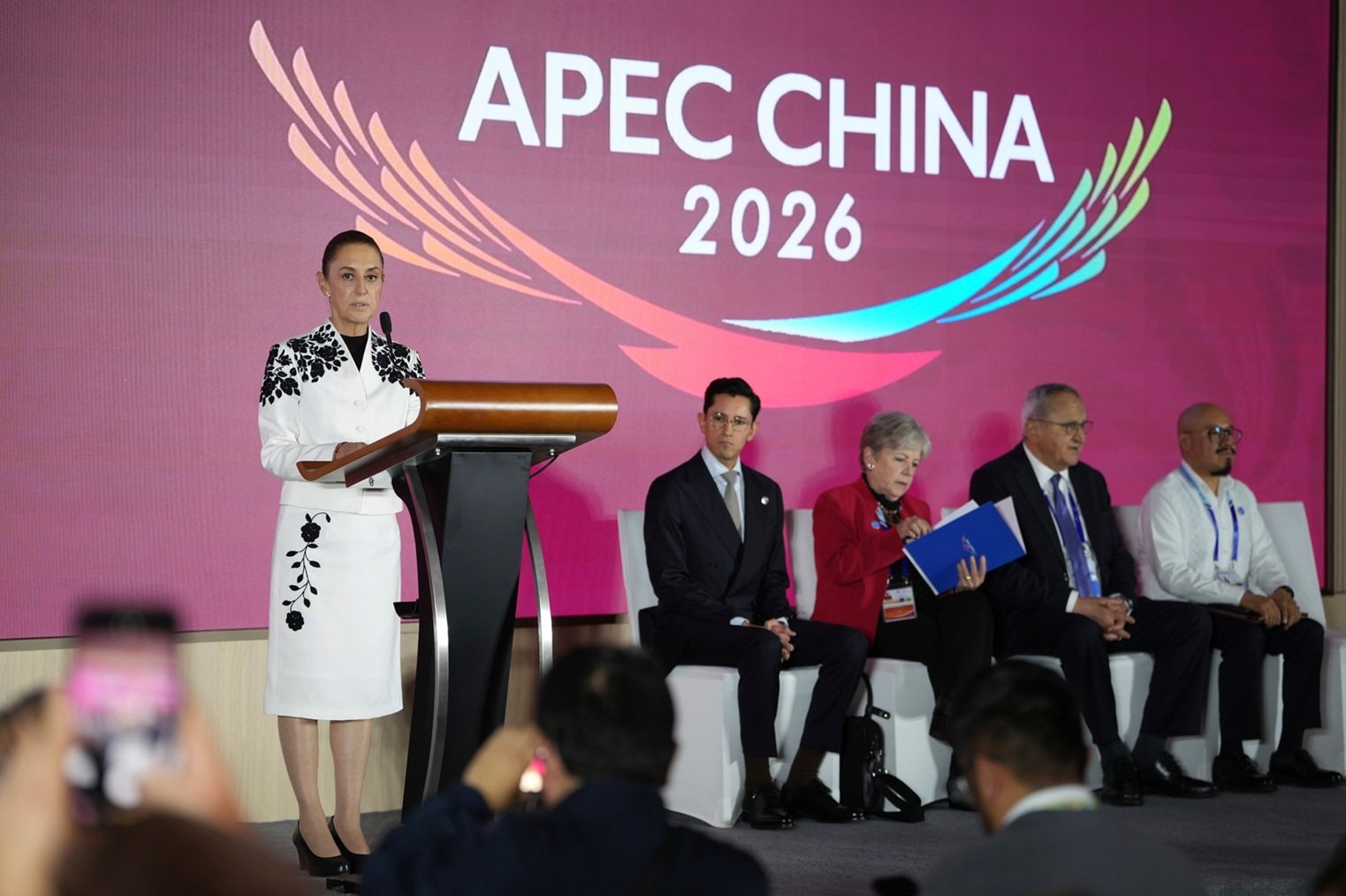
At a news conference in Shenzhen, Sheinbaum said the agreements marked a new phase in bilateral relations and highlighted Mexico’s role in discussions on the future of economic cooperation across the Asia-Pacific region.
The president participated in the APEC CEO Summit and the 33rd APEC Economic Leaders’ Meeting, where she presented Mexico’s approach to international cooperation and economic development.
She also held bilateral meetings with Chinese President Xi Jinping, Vietnamese President Tô Lâm, Australian Prime Minister Anthony Albanese, Canadian Prime Minister Mark Carney, and U.S. President Donald Trump.
According to the Mexican government, discussions with Trump focused on bilateral trade relations, particularly non-tariff barriers affecting commerce between the two countries.
Sheinbaum also met with International Monetary Fund Managing Director Kristalina Georgieva to discuss Mexico’s economic performance.
Economy Secretary Marcelo Ebrard said Mexico’s participation provided an opportunity to present its priorities concerning trade, investment and economic cooperation throughout the Asia-Pacific region.
Among the agreements announced, Mexico and China signed a memorandum establishing cooperation in education, science and innovation.
Foreign Relations Secretary Roberto Velasco said the agreement includes plans to establish a joint fund supporting student exchanges and collaborative research projects.
Energy Secretary Luz Elena González said a separate agreement will promote technical cooperation in electricity generation, particularly concentrating solar thermal technology and geothermal energy.
The arrangement includes technical assistance and exchanges of expertise to support the development of a solar thermal power plant in Mexico and improve the use of geothermal resources.
Environmental Secretary Alicia Bárcena said cooperation with China’s Ministry of Ecology and Environment will focus on river restoration, solid waste management and biodiversity conservation.
Science Secretary Rosaura Ruiz announced plans for a one-year exchange program allowing young Mexican and Chinese researchers to collaborate on artificial intelligence and supercomputing projects.
In the health sector, Health Secretary David Kershenobich said both countries are preparing an additional memorandum of understanding that would facilitate professional training in traditional medicine, along with applications of artificial intelligence in health care.
The health agreement has not yet been signed, and officials did not announce a timeline for its completion.
Tourism Secretary Josefina Rodríguez said Mexico and China also reaffirmed their existing tourism cooperation, including 36 tourism partnerships between destinations in both countries.
Officials are considering designating 2027 or 2028 as a Mexico-China Tourism Year as part of activities recognizing 55 years of diplomatic relations.
Sheinbaum characterized the overall visit as successful and said Mexico’s participation strengthened its relationships with China and other APEC economies.