


Election Disinformation Threatens to Discourage Voters Ahead of Midterms
Share your love
 -Editorial
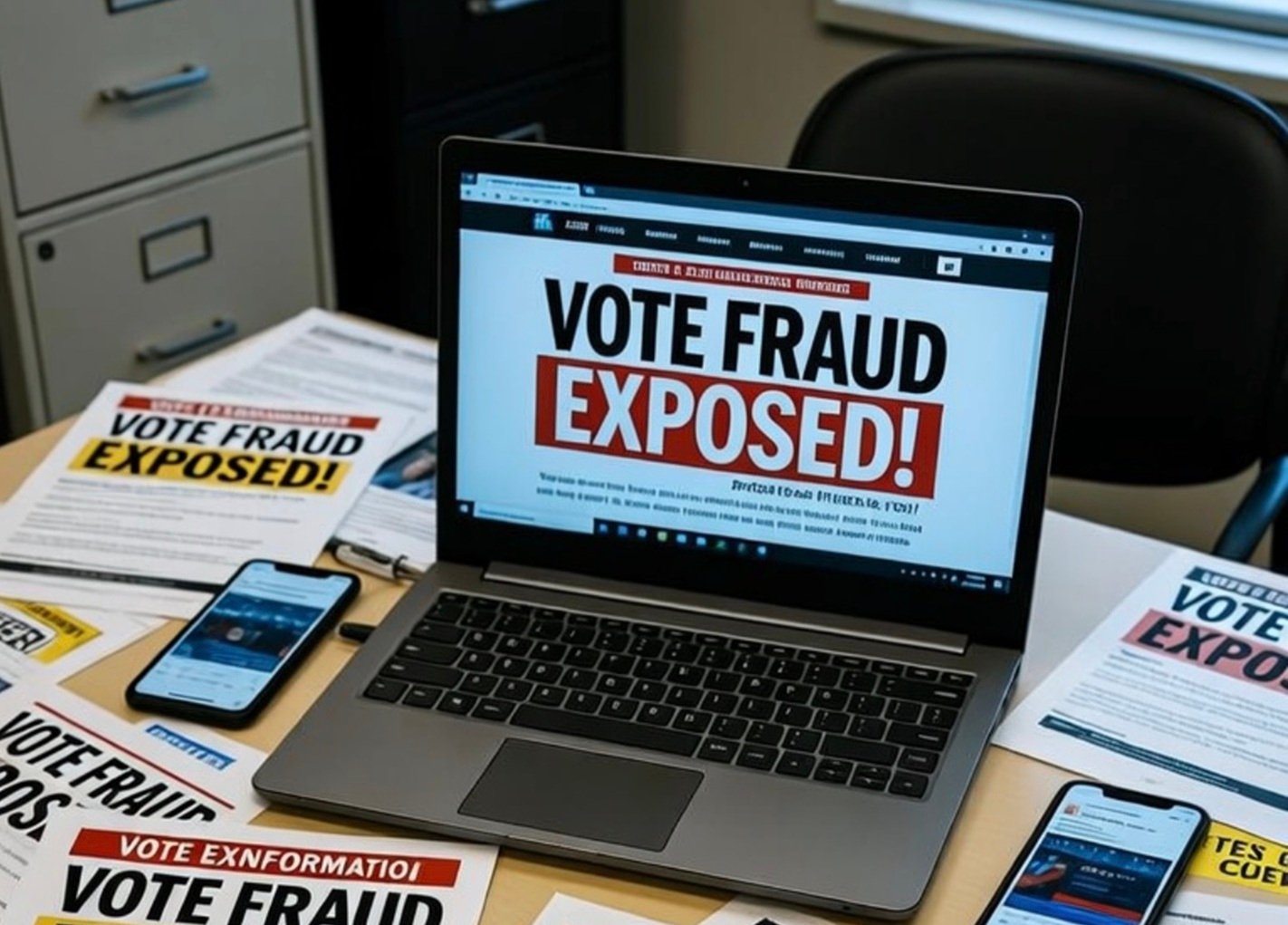
As the Nov. 3 midterm elections approach, researchers and community advocates are warning that false information about voting procedures, immigration enforcement, and election security could discourage eligible voters from participating, particularly within immigrant and multilingual communities.
During a briefing organized by American Community Media, the discussion focused on the influence of trusted community networks, the increasing use of AI-generated political content, and differences in the accuracy of election information provided by chatbots in English and Spanish.
Cameron Hickey, CEO of the National Conference on Citizenship, said misinformation is not a new phenomenon, but digital technology has significantly accelerated its distribution.
“People have always spread rumors, they’ve always embellished stories, and occasionally lied outright,” Hickey said.
He explained that social media and generative AI now allow misleading claims to reach large audiences almost immediately, compared with the slower spread of rumors through traditional communication.
Hickey distinguished between misinformation, which involves inaccurate information regardless of intent, and disinformation, which is deliberately created or distributed to mislead.
He said both can affect public confidence in elections and other democratic institutions.
“This isn’t just a media problem. This is a civic health problem,” Hickey said.
Among the concerns discussed were AI-generated images depicting immigration enforcement officers intimidating voters near polling locations, as well as claims about noncitizen voting and voter eligibility.
Hickey said misleading information about immigration enforcement could create uncertainty among eligible voters, particularly naturalized citizens concerned about their legal status or potential encounters with federal authorities.
He also questioned how information from federal voter verification systems is interpreted and presented publicly, warning that discrepancies involving recently naturalized citizens could contribute to inaccurate allegations about voter registration.
Hickey encouraged journalists and community organizations to emphasize reliable election information and help residents evaluate the credibility of online claims.
Jinxia Niu, who leads the Chinese Digital Engagement Project at Chinese for Affirmative Action, described how election-related misinformation travels through Chinese-language digital networks.
The San Francisco-based civil rights organization monitors misleading narratives and operates Chinese-language fact-checking and news initiatives.
Niu said her organization’s research has tracked more than 600 pieces of disinformation and identified a shift in the platforms where misleading election narratives originate.
While WeChat previously played a central role, she said X has become an increasingly prominent source of political content that is subsequently translated and distributed through WeChat groups and other platforms.
According to Niu, approximately 60% of the Chinese-language disinformation examined by her organization originated from English-language right-wing sources, although translations sometimes introduced additional interpretations or claims.
She identified allegations of election fraud, concerns about noncitizen voting and partisan attacks as recurring themes.
Niu said differences between American and Chinese electoral systems can complicate efforts to explain voting requirements to immigrant communities.
For example, voters accustomed to identification requirements in China may be unfamiliar with the different identification and registration procedures used across U.S. states.
Misleading claims suggesting that the absence of a universal voter identification requirement allows anyone to vote can exploit that unfamiliarity, she said.
Federal law prohibits noncitizens from voting in federal elections, while voter identification and registration requirements vary by state.
Niu also said immigration-related misinformation can create anxiety among naturalized citizens who are legally eligible to vote.
Her organization has observed similar narratives affecting Chinese, Indian, Filipino and Vietnamese communities, particularly when election-related claims are connected to immigration enforcement.
Laura Zommer, co-founder and CEO of Factchequeado, a nonprofit organization that combats Spanish-language misinformation in the United States, discussed the growing influence of artificial intelligence on political campaigns and voter information.
Factchequeado works with a network of 151 media outlets and grassroots organizations to distribute fact checks, explanatory reporting and media literacy resources.
Zommer said AI-generated political content has become more sophisticated since the 2024 election, with video increasingly replacing simpler AI-generated images.
According to figures she cited from the Wesleyan Media Project, researchers had identified at least 169 political advertisements using artificial intelligence by early September, representing approximately $80 million in advertising spending.
She said 69% of those advertisements did not disclose their use of AI.
Zommer also noted that 31 states had enacted laws addressing AI-generated political content, although requirements and enforcement mechanisms differ.
The absence of a comprehensive federal disclosure requirement, she said, creates challenges for voters attempting to determine whether campaign materials have been manipulated or artificially generated.
Another concern involves the reliability of AI chatbots used to obtain election information.
Zommer cited research by the Institute for Strategic Dialogue that tested six major AI chatbots using election-related questions in English and Spanish.
According to the findings she presented, 30% of English-language responses were incorrect, incomplete or outdated, compared with 45% of Spanish-language responses.
The research also found that Spanish-language answers generally included fewer cited sources than their English-language counterparts.
Zommer described an example in which a Meta chatbot twice provided Nov. 4 as the date of the 2026 U.S. midterm elections when asked in Spanish. The correct election date is Tuesday, Nov. 3.
Zommer said Factchequeado is conducting additional research in Texas to examine how chatbot responses change when election-related questions are presented in different languages and with varying political framing.
Preliminary observations suggest that the wording of questions can influence the responses generated by AI systems, she said.
The researchers emphasized that misleading election information does not circulate exclusively through public social media posts. Private messaging groups, personal relationships and community networks can also play a role in distributing claims that recipients may consider trustworthy.
Zommer said addressing the problem requires more than technological monitoring. Her organization also relies on community engagement, in-person discussions, and partnerships with local media to identify the questions and concerns circulating among Spanish-speaking residents.