

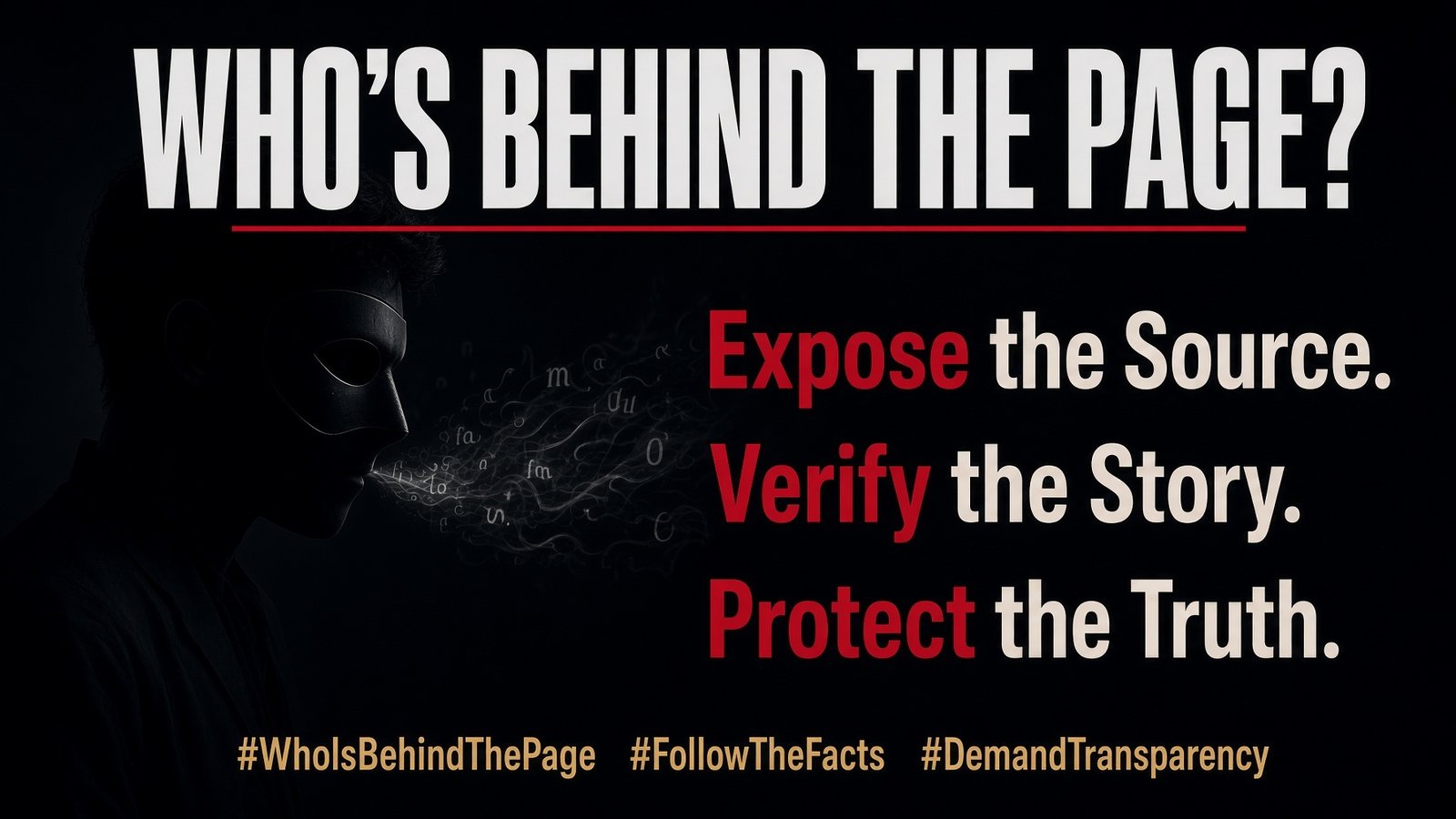

WHO’S BEHIND THE PAGE? Expose the Source. Verify the Story. Protect the Truth.
Share your love
 By: Ellie Burgueño, Journalist and Writer
In more than 20 years in communications and journalism, I had never found myself in a position where I felt compelled to publicly defend my professional reputation against allegations that are false and damaging.
That experience has forced me to reflect on something I have believed since childhood: words have power. They can build, educate and inspire—or they can destroy.
My path to journalism was not conventional.
Before entering the media industry, I worked in the legal field, as an immigration consultant and as a certified translator. I spoke with people who came to our office after experiencing what they believed was an abuse of power at ports of entry, including people who had lost visas or faced immigration consequences they did not understand. Many lacked the education, resources or knowledge necessary to defend themselves.
Those experiences affected me deeply.
I began writing for newspapers and magazines in my spare time and was invited to participate in radio programs by colleagues in the media. Eventually, I became a regular columnist for a regional newspaper.
What began as a hobby became a calling.
Writing had always been part of my life. I began writing poems and songs when I was six or seven, and by the age of 10, I was already telling people that I wanted to become an author. Literature captivated me, particularly the work of Patrick Süskind and Gabriel García Márquez, some of my favorite authors.
When I began writing my first published book, Second Chance, journalism became another opportunity to connect with readers.
I wrote my columns without compensation because I loved writing. They were not legal columns; they focused on inspiration, encouragement, values and everyday life. My column was called “Articulated Muse.”
That passion eventually led to the creation of Beyond Borders Gazette.
The Beginning of Beyond Borders Gazette
In 2013, I developed the original business plan with the support of the SBDC and its then director, Carlos Figari, for what would become Beyond Borders Gazette.
The concept initially began as a legal publication designed to provide educational articles written by attorneys, judges and other professionals in the legal field. I wanted it to be free to the community and distributed throughout the region in both print and digital formats.
But the vision quickly became broader.
I eventually removed the word “legal” from the name because the publication was intended to address far more than law.
Beyond Borders Gazette was designed to provide positive stories, verified information, expert contributions and coverage of the issues affecting our binational region—including law, medicine, economics, education, tourism, travel, food, community affairs, events, industry and agriculture.
We recruited volunteers and developed partnerships with universities, government offices, chambers of commerce, attorneys, businesses and community organizations on both sides of the border.
One of the journalists I approached during that early stage was Arturo Bojórquez, a communications graduate and experienced journalist whom a friend in Mexicali referred to me. At the time, he was working with a Spanish-language newspaper in Imperial County. I shared my vision with him and explained that I wanted Beyond Borders Gazette to be binational from the beginning. He was enthusiastic about the concept and appeared interested in becoming part of the project.
Around that same time, however, I became pregnant with my second child. It was a high-risk pregnancy that kept me on bed rest throughout much of the pregnancy, and the launch had to be postponed.
By the time I was ready to move forward, circumstances had changed. When we were preparing the first edition, I attempted to reconnect with Bojórquez, who was then working with the Imperial Valley Press, but he was no longer available to join the project. He had already begun developing his own venture on the side.
That did not stop us.
We continued building our team and looking for people with journalism experience, professional ethics and a genuine understanding of the craft.
After several years of preparation, Beyond Borders Gazette launched its first print and digital edition on May 1, 2016.
From the beginning, the objective was clear: to build a reliable source of information and fact-checked news while creating a bridge of communication between two countries I love.
Bridging Borders. Uniendo Fronteras.
Our launch brought together representatives of the Mexican Consulate in Calexico, CETYS University, attorneys, business leaders, community leaders, media colleagues and public officials. Then-State Senator Ben Hueso’s office presented us with a California Senate certificate recognizing the launch of the binational publication, which happened in an official launching event with one of our then regional partner, Hotel Araiza Mexicali.
That was our beginning.
Journalism Is Also a Business
There is another part of this conversation that is often deliberately ignored:
Professional journalism is also a business.
Like any legitimate business, a media organization has operating costs—printing, technology, personnel, distribution, insurance, professional services, equipment, marketing and many other expenses.
Media organizations traditionally sustain themselves through advertising, subscriptions, sponsorships, grants, special projects, legal advertising, public-information campaigns and other legitimate forms of revenue.
That does not make journalism less legitimate.
Advertisers pay for advertising. Governments and organizations purchase public-information campaigns. Sponsored content can be purchased and identified as such. Grants may support specific projects or investigations.
The distinction matters.
Beyond Borders Gazette has covered local, state and federal governments since its inception. We cover meetings, programs, events, announcements and activities because they are part of the public record and part of the community we serve.
We have a media kit.
We work with advertising agencies.
We sell advertising space.
That is not a secret. It is how legitimate media organizations operate.
Our professional affiliations and training are equally public. I have been involved with organizations including the News Media Alliance, National Association of Hispanic Publishers, National Press Club, Society of Professional Journalists, San Diego Press Club, California Community Media Network, CUNY Border Media Network, Imperial County-Mexicali Press Club, Asociación de Profesionales de Radio, Prensa y Televisión de Mexicali and FAPERMEX in Mexico, among others.
My professional education includes journalism, writing, communications, public relations, strategic branding and investigative journalism.
Our credentials can be verified.
Our work can be examined.
Our journalism can be questioned.
That is part of a free press.
But questioning journalism is very different from manufacturing allegations about it.
Recently, local self-proclaimed activist Jake Tison has made allegations concerning Beyond Borders Gazette, including claims that our publication receives improper or undisclosed payments from Imperial County.
Those allegations are false.
Beyond Borders Gazette recently entered into a contract of less than $2,000 per month with the County for specific public-information campaigns. These are paid communications services—not payments for favorable editorial coverage.
That distinction is fundamental.
The County, like other governmental entities, works with multiple newspapers, broadcasters, agencies and media organizations to communicate information to the public.
A public-information contract is not, by itself, evidence of corruption, favoritism or editorial control.
Yet an invoice showing several payments in one invoice for contracted services was presented publicly in a way that was intended to create outrage without providing the broader context.
That is not responsible journalism.
It is also important to understand that Beyond Borders Gazette has covered Imperial County since 2016. Our relationship with this community did not begin when we received a contract.
I live here. I own property here. My family has deep roots here. I have operated businesses here since I was 22, and my children were born here.
Our coverage of Imperial County predates any current contract by many years.
If someone wants to investigate public spending, then investigate it thoroughly.
Look at all media contracts.
Look at advertising expenditures across newspapers, television, radio, public-relations firms and other publications.
Look at the contracts, the services provided and the amounts paid.
That is legitimate scrutiny.
Selecting a single invoice from one publication and presenting it without the broader context is an entirely different matter. When information is selectively presented in a way that falsely damages someone’s reputation, it can cross the line into what the law recognizes as defamation.
So Why Am I Being Targeted?
That brings me to a question I have asked myself repeatedly:
Why us?
I had never met Jake Tison before Beyond Borders Gazette became the subject of his public attacks. I had never had a personal disagreement with him, never worked with him and never competed with him.
Frankly, I had never given him much thought before my publication became the subject of his criticism.
So why would a relatively recent activist in Imperial County take such an interest in a media organization that has been operating in this region since 2016?
I can only speak about what I have personally experienced, what has been publicly published and what people have told me.
Several people who have interacted with Tison have independently told me that he has expressed personal hostility toward me—that he does not like me, believes I think too highly of myself and would like to see me and my publication damaged professionally or pushed out of business.
Those statements were not made directly to me. They were relayed by people who say they heard them from him.
But they are relevant to the question of why Beyond Borders Gazette suddenly became a target.
If the objective is truly public accountability, then the public deserves to examine not only the message, but also the messenger and the context surrounding it.
Tison has every right to disagree with me.
He has every right to criticize our publication.
He has every right to oppose data centers, Lithium Valley or any other development project.
Those are legitimate forms of civic participation.
But disagreement does not justify presenting insinuations as facts, selectively displaying documents to provoke outrage or attempting to undermine the credibility of a professional media organization without providing the complete context.
I also find it troubling when someone who has recently entered a community’s public debate begins presenting himself as an authority while simultaneously attacking people and organizations that have been serving that community for years.
It is not about where someone was born or where they previously lived. Anyone has the right to become involved in Imperial County.
But with public influence comes responsibility, and with public accusations comes an obligation to substantiate them.
And if political actors are using individuals or anonymous platforms to attack others, the public has a right to ask who is behind the messenger and who benefits from the message.
 And Then There Is the Anonymous Page
The same questions become even more important when we look at the anonymous social-media page Calexico Coalition.
The page has falsely attacked a range of local news organizations, public officials, candidates and community figures, including Beyond Borders Gazette, The Desert Review, Maritza Hurtado, Javier González, Blanca Morales, Dihana García Ruiz, Claudia Camarena, John Hawk, Bari Bean, Eric Rodríguez, Ryan Kelly, Tim Kelly and more recently Assemblymember Jeff Gonzalez and others.
Its coverage has not been consistent across political figures, however. Karin Eugenio, who faced criticism from the page during an earlier election, was not similarly targeted when she faced Rodríguez in the 2026 Imperial Irrigation District Division 5 race. The page has also expressed support for Ida Obeso while largely avoiding criticism of IID Director Alex Cardenas.
According to a review of its posts, the page was initially focused heavily on Javier González after he defeated former IID Director Erik Ortega in a 2020 election before expanding its criticism to other individuals.
There are serious allegations circulating in the community regarding the origins of this page.
Several community members have come forward alleging that Alex Cardenas and Erik Ortega originally created the page and that it was initially used as part of an effort to politically target then-Imperial Irrigation District Board member Javier Gonzalez.
We contacted Alex Cardenas seeking an interview and an opportunity to respond to these allegations. At the time of publication, he had not responded.
I want to be very precise here:
I am not presenting the allegation that Cardenas and Ortega created Calexico Coalition as an established fact. I am reporting that community members have made that allegation and that we sought a response.
That distinction matters.
Alex Cardenas is a current IID Division 1 director. IID’s official biography states that he was first elected to the board in 2018, reelected in 2022 and served as board president for two consecutive years. It also identifies his service with the Salton Sea Authority and other regional organizations, like director of CASA in Imperial County.
Erik Ortega previously served on the IID Board of Directors; IID records identify him as a Division 4 director and board president in 2019.
Those are verifiable public facts.
The allegation concerning Calexico Coalition is a separate matter.
And if community members are independently coming forward with the same account, the appropriate journalistic response is not to dismiss the information simply because it is uncomfortable.
One thing, however, is indisputable: a defamatory post was published about us in which a private text exchange between Jake Tison and me was shared publicly. The fact that a private conversation between us was obtained and published by an anonymous page raises legitimate questions about the relationship between Tison and the individuals managing the page.
At minimum, it establishes that someone with access to that private exchange chose to provide it to the page or otherwise facilitate its publication. That is a significant fact that deserves scrutiny.
So, follow the evidence.
Start at the beginning: when an anonymous page begins influencing public opinion, especially during an election season, basic questions deserve answers: Who created the page? When was it created? Who originally administered it, who had access to the account, and who produced its content? Was it financed by anyone? What was its original purpose? And, perhaps most importantly, was that purpose connected to efforts to undermine Javier Gonzalez?
These are not unreasonable questions. They are the kind of questions that should be asked whenever anonymous platforms become part of a political conversation.
If the people alleged to be behind the page have nothing to do with it, they have every right to say so and provide evidence. If the allegations are substantiated, the public deserves to know. Transparency resolves questions. Secrecy multiplies them.
Why Does This Matter?
Because anonymous political pages can become powerful tools for shaping public opinion while leaving the audience with no clear understanding of who is actually speaking.
A page may present itself as an independent community voice, but who is creating the content? What interests are involved? What candidates are being supported? Who decides what gets published—and what does not? Is the material simply the expression of an individual, or is it part of a broader political effort?
And if evidence establishes that a political candidate knowingly supported or participated in illicit conduct through an anonymous political operation, that should not simply be dismissed as campaign politics. It should be subject to the appropriate legal and electoral consequences under the law—including, where applicable, removal from office, recall, or disqualification from future candidacy.
Those questions become even more important during an election season, when information—accurate or otherwise—can influence how members of a community understand candidates, public officials and controversial issues.
The public should not have to guess who is speaking.
And this is not a partisan argument. The same standard should apply whether an anonymous page supports a Republican, Democrat, independent candidate, government official, activist or political movement.
Transparency should not belong to one political side. It should belong to everyone.
If Calexico Coalition is simply an independent community page, then identifying its operators should not be a problem. If it was created as a political vehicle to target Javier Gonzalez, then the public deserves to know that history. And if the allegations about who created it are wrong, those accused deserve the opportunity to demonstrate that with evidence.
That is the difference between journalism and social-media warfare.
Journalism asks questions. Journalism verifies. Journalism gives people an opportunity to respond. And journalism does not confuse an allegation with a fact.
We Can Do Better
I believe people who genuinely care about this community should be willing to identify themselves, explain their positions and stand behind their words.
That does not mean everyone must agree. It means we should have the courage to participate in the public conversation openly.
Imperial County has enormous potential.
Yes, it is rural. Yes, it has challenges. And yes, people have sometimes described it as isolated, forgotten or lacking opportunities.
I see something different.
I see a community capable of creating opportunities with a different mentality.
Instead of asking, “How can I tear this down?” we should be asking, “How can I make it better?”
How can I contribute? How can I serve? How can I create opportunity? How can I become part of the solution instead of part of the problem?
I did not remain in journalism for more than two decades because it was the easiest way to make money. I have other professional credentials, businesses and skills that could have taken me in many different directions.
I stayed because I believe in the power of words.
I believe responsible journalism can change a community for the better. I believe information can empower people. And I believe the Imperial Valley deserves journalism that informs rather than manipulates, questions rather than assumes, and verifies rather than sensationalizes.
People have the right to disagree with me.
They have the right to criticize Beyond Borders Gazette.
They have the right to challenge our reporting.
And we have the right to ask: Who is behind the people challenging us and what is their hidden agenda?
So before believing the next viral post, dramatic video or anonymous accusation, stop.
Ask who created it. Ask where the information came from. Ask what evidence exists. Ask what has been left out. Ask who benefits.
Then verify.
Because in an age when anyone can create a page, produce a video and present themselves as an authority, the responsibility ultimately belongs to all of us. Us who decide to believe, follow, like or share.
WHO IS BEHIND THE PAGE?
Expose the source. Verify the story. Protect the truth.
Imperial County deserves nothing less. Let us make this place better, lift one another up, and let God bless us along the way—because that is what true success is really about.