



San Quintín Sees New Momentum as Sheinbaum Advances Justice Plan for Agricultural Workers
Share your love
 -Editorial
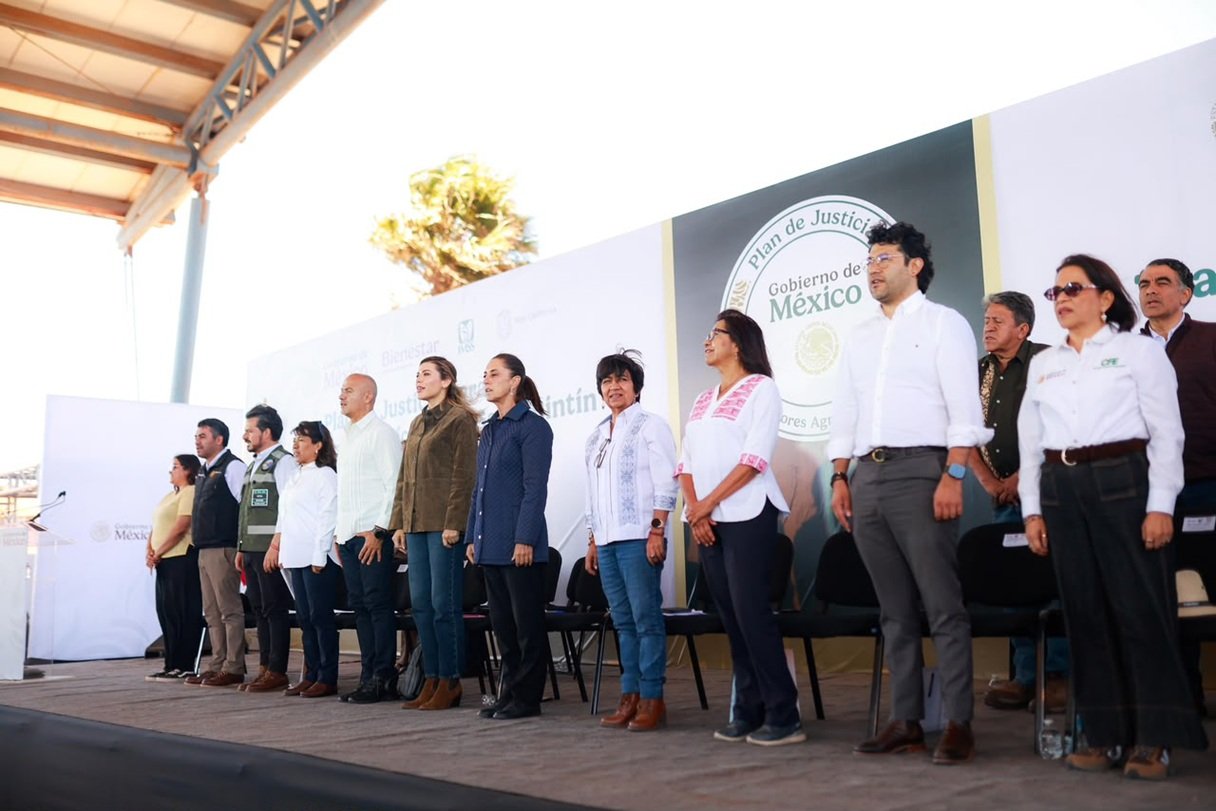
SAN QUINTÍN, Baja California — President Claudia Sheinbaum and Baja California Governor Marina del Pilar Avila Olmeda visited San Quintín this week to review progress on the federal government’s Justice Plan for Agricultural Workers, a comprehensive initiative aimed at addressing long-standing social and infrastructure challenges in one of Mexico’s most important agricultural regions.
The visit highlighted ongoing efforts to improve housing, healthcare, education, public services, and labor protections for thousands of agricultural workers and their families who have historically faced significant disparities despite their critical role in sustaining the region’s economy.
During the tour, Sheinbaum reaffirmed her administration’s commitment to ensuring that projects included in the plan move forward efficiently and transparently. The president announced that she intends to return to San Quintín within six months to personally evaluate the progress of the initiatives and verify that commitments are being fulfilled.
“I am making a promise, and I am accustomed to keeping my commitments,” Sheinbaum said. “I will return in six months to make sure these projects are advancing and to continue monitoring their implementation.”
The Justice Plan represents one of the federal government’s most ambitious efforts to address decades of social neglect in San Quintín, a region known for its agricultural production and its large workforce of farm laborers. For years, local communities have advocated for improved access to basic services, housing, healthcare, and labor rights.
Governor Marina del Pilar emphasized the significance of the initiative, describing it as a transformative effort for communities that have historically been overlooked.
“This plan marks a turning point for a region that for decades was forgotten and made invisible,” the governor said. “The Justice Plan represents dignity for agricultural workers and their families.”
One of the most significant components of the program focuses on housing improvements. Under the plan, approximately 36,000 families are expected to receive financial assistance of 40,000 pesos through the Banco del Bienestar to upgrade and improve their homes. Officials believe these investments will help address overcrowding and inadequate living conditions that continue to affect many households in the region.
Healthcare infrastructure is also receiving major attention. Authorities confirmed plans for the construction of a new 80-bed General Hospital in San Quintín, which will provide free medical care and medications. The project is expected to expand access to healthcare services for residents who currently face limited options and often travel long distances for specialized treatment.
Education and childcare are additional priorities. Federal and state authorities announced that resources will continue to be directed to local schools through community-based committees responsible for identifying and addressing campus needs. The plan also includes the construction of two new free childcare and early education centers designed to support working families, particularly women employed in the agricultural sector.
Access to essential public services remains another critical focus. The Federal Electricity Commission (CFE) is advancing electrification projects in underserved neighborhoods, while the National Water Commission (Conagua) is working on plans to expand desalination infrastructure to improve water availability across the municipality.
Water security has emerged as a growing concern throughout Baja California, particularly in rapidly expanding communities such as San Quintín. Officials indicated that the expansion of desalination capacity is intended to help guarantee a stable supply of potable water before the end of the current federal administration.
Labor rights also remain at the center of the initiative. Government representatives reiterated their commitment to ensuring that agricultural employers comply with legal requirements regarding social security enrollment and worker protections. Authorities said oversight efforts will continue to verify that farmworkers have access to formal benefits and healthcare coverage.
The Justice Plan reflects a coordinated effort between federal and state agencies to address structural inequalities while promoting long-term economic and social development. For many residents, the success of the initiative will be measured not only by new infrastructure projects but also by tangible improvements in quality of life.
As construction projects move forward and funding begins reaching local communities, the federal government’s promise of continued oversight may prove crucial in determining whether San Quintín’s agricultural families finally receive the services and opportunities they have sought for generations.