



The Blueprint for Prosperity: What Regions Like Imperial Valley Must Rethink to Thrive
Share your love
 -Ellie Burgueño, Journalist & Writer.
Prosperous towns are not accidents of geography or luck. They are engineered—sometimes intentionally, sometimes through decades of disciplined decisions about governance, education, infrastructure, and how money moves through a local economy. Across the United States, research on regional development consistently shows that thriving communities share one defining trait: they keep wealth circulating locally instead of allowing it to concentrate or leak outward through extractive systems. This principle, documented in studies on local multipliers and regional economic resilience, is one of the strongest predictors of long-term prosperity in small and mid-sized regions.
For regions like California’s Imperial Valley—long shaped by agriculture, cross-border trade, and persistent unemployment and poverty challenges—the question is not whether prosperity is possible, but what structural changes are required to unlock it.
Imperial Valley, as I’ve said in the past, has even been described in harsh colloquial terms as the so-called “Devil’s armpit,” a phrase once used by a San Diego State University, Imperial Valley Campus instructor, Mr. Reyes. While the expression is exaggerated and unfair, it reflects a long-standing perception of economic hardship that often emerges in regions where structural investment has lagged behind demographic and geographic potential.
Yet Imperial Valley is far from insignificant. With a population of just under 180,000 residents across seven cities—El Centro, Calexico, Heber, Brawley, Imperial, Holtville, and Calipatria—the region is small in size but strategically positioned. Approximately 85% of its population identifies as Hispanic or Latino, making it one of the most culturally unified regions in California. This identity is deeply connected to its binational reality and its daily economic interaction with northern Mexico.
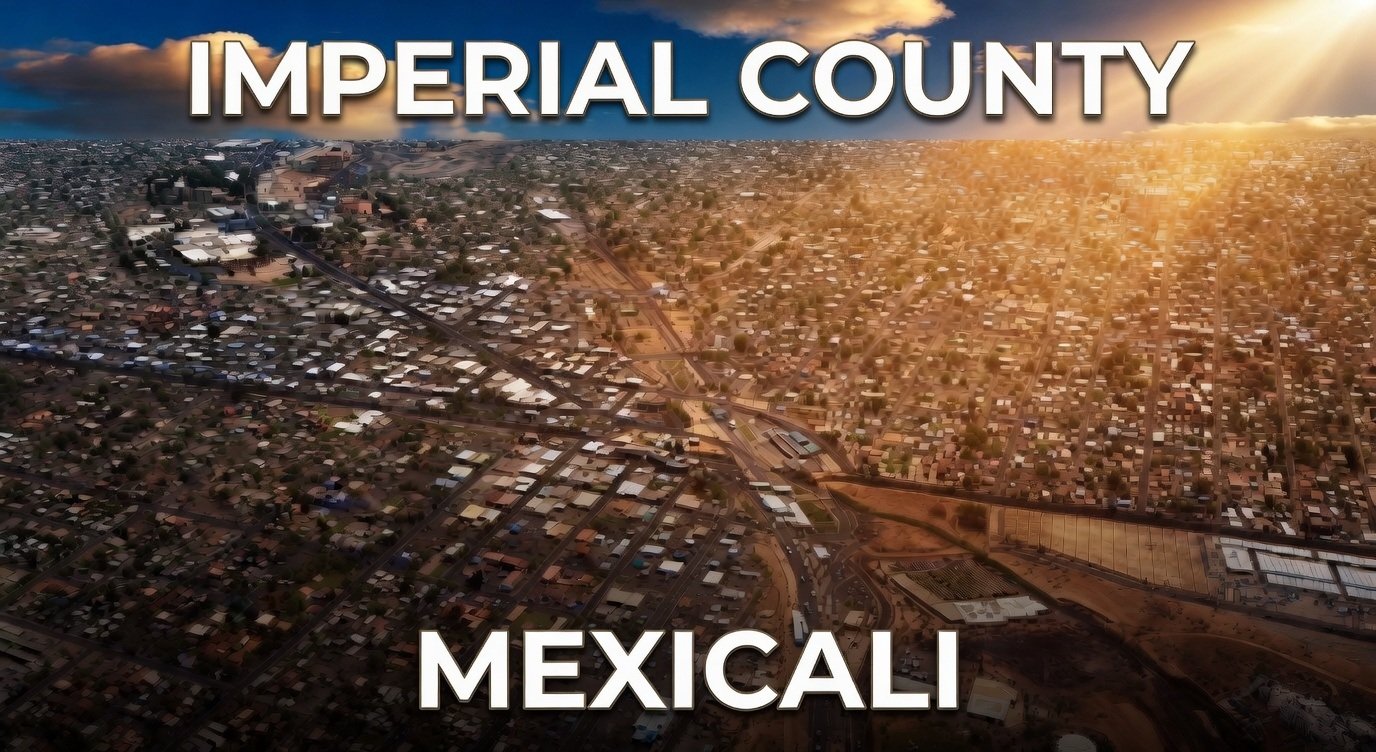
What is often overlooked is that Imperial Valley is not functioning as an isolated rural economy, but as part of a much larger cross-border system that directly connects it to Mexicali, the capital of Baja California, a metropolitan area of nearly one million people. This proximity places Imperial Valley inside one of the most active binational economic corridors in North America. In practice, this means that goods, labor, services, and consumer spending move continuously across the border, creating a shared economic environment where daily transactions are influenced by both sides of the international boundary. Studies of the Cali-Baja mega-region have documented this integrated system as a binational economic zone of more than 7 million people and over $250 billion in combined economic activity, where cross-border trade and mobility play a defining role in regional development. In this context, Imperial Valley benefits from an underutilized structural advantage: it sits adjacent to a major Mexican capital city whose population functions as both a labor force and a consumer base, generating constant economic interaction that could be further leveraged for regional growth.
At the center of this discussion, however, is a civic responsibility that cannot be ignored. We must avoid—and do everything within our reach—to not elect individuals who pursue public office simply as a stable job, a source of influence, or as a post-retirement occupation. These are often the least effective decision-makers because they are not driven by urgency, innovation, or accountability. Public office is not a placeholder for personal comfort; it is a responsibility to design systems that allow others to prosper. The strongest leaders are those who are not motivated by power or money because they already have stability, success, and purpose outside of politics. That independence is what protects public interest.
The Core Principle: Wealth Must Circulate, Not Concentrate
At the heart of every prosperous town is a functioning “local loop economy.” Money earned in the region is re-spent locally through wages, services, small businesses, housing, and reinvestment. Economists refer to this as the “local multiplier effect,” where each dollar spent locally generates additional rounds of economic activity when communities have strong local ownership structures and supply chains.
When economies fail, the opposite happens: wages leave the region through external ownership, limited reinvestment, or lack of local enterprise capacity. The result is visible in many rural and agricultural zones—wealth is produced, but not retained.
Imperial Valley’s challenge is not production; it is retention and reinvestment.
- Fighting Corruption and Restoring Trust in Governance
No town becomes prosperous without trust in its institutions. Corruption—whether overt or subtle—breaks the economic chain by diverting resources away from public benefit and discouraging investment.
International governance research, including World Bank transparency frameworks, consistently shows that corruption increases costs for businesses, reduces public service efficiency, and lowers long-term economic growth.
Detecting corruption is less about scandal and more about patterns:
- Repeated sole-source contracts without competitive bidding
- Politically connected hiring rather than merit-based recruitment
- Infrastructure spending that does not match community priorities
- Weak or inaccessible public financial reporting
Eradicating it requires systems, not slogans: digital transparency, independent audits, whistleblower protections, and civic participation in budget planning.
- Public Service Leadership, Not Political Stagnation
Effective municipalities are led by public servants who are active builders of systems, not passive holders of office. Research in public administration consistently shows that governance quality improves when leadership is performance-driven and measurable.
Prosperous towns prioritize leaders who have real-world economic or civic experience, who remain actively engaged in local development ecosystems, and who focus on execution rather than political survival. Public office, in strong systems, is not retirement—it is responsibility.
- Government as an Economic Facilitator, Not a Gatekeeper
Bureaucratic friction is one of the strongest inhibitors of small business growth.
Prosperous towns design governments that act as facilitators: fast permitting systems, clear zoning laws, predictable taxation, and support programs for startups and small enterprises. The role of government is not to control opportunity, but to expand access to it.
- Training, Opportunity, and Economic Circulation
Regions that invest in workforce development grow faster and more equitably, according to OECD and U.S. Economic Development Administration research.
Prosperous towns treat training as infrastructure through vocational education aligned with industry needs, school-to-work pipelines, adult retraining systems, and entrepreneurship access programs. Opportunity must circulate as widely as capital.
- The Export Base: Bringing External Wealth In
Sustainable economies require outside income sources, whether through agriculture, energy, logistics, tourism, or cross-border trade. Imperial Valley already participates in a dynamic binational economy shaped by its proximity to Mexicali and the broader Cali-Baja region, but the challenge remains moving beyond raw production toward higher-value industries that retain more wealth locally.
- Infrastructure That Builds Wealth, Not Debt
Incremental infrastructure development creates stronger long-term returns than oversized, debt-heavy projects.
Key priorities include water and energy resilience, diversified housing, walkable commercial corridors, and community-scale public spaces. Growth is not measured in size, but in sustainability.
- Quality of Life as Economic Strategy
People move before jobs do. In today’s economy, livability is a primary driver of regional competitiveness.
Safe environments, clean public spaces, cultural vitality, and strong community identity all function as economic magnets that attract both talent and investment.
 Imperial Valley’s Crossroads
Imperial Valley is not an isolated rural county—it is a binational economic corridor directly connected to Mexicali and the broader Cali-Baja mega-region, where daily cross-border movement of people, commerce, and services forms part of a deeply integrated regional economy. Its proximity to a Mexican metropolitan area of nearly one million residents places it within one of North America’s most active transnational labor and consumer systems, a structural advantage that remains significantly underleveraged in long-term planning.
The transformation toward prosperity will not come from a single policy but from coordinated change: transparent governance systems, workforce alignment, local business expansion, infrastructure modernization, and leadership focused on measurable outcomes. Most importantly, it requires redefining prosperity not as concentrated success, but as shared circulation of opportunity.
One of the most persistent barriers to sustainable prosperity is the breakdown of transparency in how public and economic resources are managed, which often results in wealth becoming concentrated in the hands of a few decision-makers, contractors, or intermediaries instead of circulating broadly throughout the community. When systems lack clear accountability, oversight, and open access to opportunity, informal “gatekeeping” can emerge—whether through excessive bureaucratic control, preferential access to contracts, or opaque decision-making structures that limit fair participation. Over time, this does more than slow growth; it distorts it. Capital that should be reinvested into local businesses, workforce development, and infrastructure becomes trapped or redirected, while communities experience artificial scarcity, inefficiency, and dependency. In such environments, economic activity does not flow naturally; it is filtered, delayed, or selectively distributed, creating conditions where opportunity feels restricted and uneven.
The result is a cycle in which growth is interrupted, public trust is weakened, and long-term development is replaced by short-term concentration of benefit—undermining the very foundation of a healthy, self-sustaining local economy.
Conclusion: Prosperity as a System, Not an Event
Prosperous towns are not created by chance or isolated reforms. They emerge from systems that reinforce each other: accountable governance, skilled populations, strong local enterprise, and economies that recycle wealth rather than extract it.
Imperial Valley’s future will depend not on discovering new geography—but on fully activating the value of the geography it already has.
When opportunity circulates widely, prosperity becomes not only possible, but structural.
Ellie Burgueño is an award-winning binational journalist, editor, author, speaker, and media entrepreneur with more than 18 years of experience in journalism, public relations, and strategic communications. She is the Founder and Editor-in-Chief of Beyond Borders Gazette and Imperial Valley Insight, publications focused on business, politics, culture, and regional development across the U.S.-Mexico border. Burgueño is a member of prominent journalism and media organizations in both Mexico and the United States, including FAPERMEX (Federación de Asociaciones de Periodistas Mexicanos), the National Association of Hispanic Publications (NAHP), where she serves as a board member, and the National Press Club’s PR and Communications Team in Washington, D.C. She has received multiple national journalism awards, including recognition from the San Diego Press Club and the Ricardo Flores Magón Journalism Award in Mexico. In addition to her media work, she is an author, conference speaker, and advocate for economic empowerment, leadership, and cross-border collaboration.