



IID Board Moves on Release of Proposed Large Load Tariff for Public Review
Share your love
 -Editorial
The Imperial Irrigation District is considering a proposed Large Load Tariff aimed at establishing a standardized framework for evaluating and providing electric service to large-scale energy users within its service territory.
The proposal comes amid increased interest from prospective customers with significant power demands that could require substantial upgrades to transmission, distribution, generation, and other critical system infrastructure. IID notes that current tariff structures do not specifically address the technical, financial, and operational complexities associated with serving these types of large-load customers.
Under the proposed framework, IID would establish clear guidelines governing the evaluation, interconnection, and service requirements for large-load projects. The intent, according to the utility, is to create a transparent and non-discriminatory process while also safeguarding existing ratepayers from bearing costs associated with serving new and potentially high-impact energy users.
A central component of the proposal is cost responsibility. Large-load customers would be required to cover expenses tied to infrastructure upgrades, system studies, collateral requirements, and long-term service commitments. The tariff would also define minimum demand and energy obligations, along with mechanisms for cost recovery and structured operational planning to ensure system stability.
In addition, the tariff would allow IID to evaluate operational impacts, transmission constraints, infrastructure requirements, and long-term power supply considerations tied to each large-load service request. The proposal incorporates milestone-based funding and contractual obligations intended to reduce speculative project development risks and to support more accurate engineering, planning, and resource allocation.
IID officials stated that the framework is designed to support potential economic development opportunities while preserving system reliability and maintaining financial protections for existing customers. The district emphasized that the structure aims to ensure fairness in how large energy users are integrated into the grid, particularly as demand profiles become more complex.
Officials also noted that there is no anticipated adverse financial impact to current ratepayers, as all costs associated with serving large-load customers would be borne by the requesting customers themselves, rather than being shifted onto the broader customer base.
The item was presented to the IID Board of Directors for informational purposes. Staff requested direction from the board to move forward with releasing the proposed tariff for a 30-day public comment and stakeholder review period. This phase is intended to gather input from industry stakeholders, community members, and other affected parties.
Following the review period, IID staff plan to evaluate public feedback, consider potential revisions, and return to the board at a future meeting with a finalized version of the proposed tariff for consideration and possible approval.
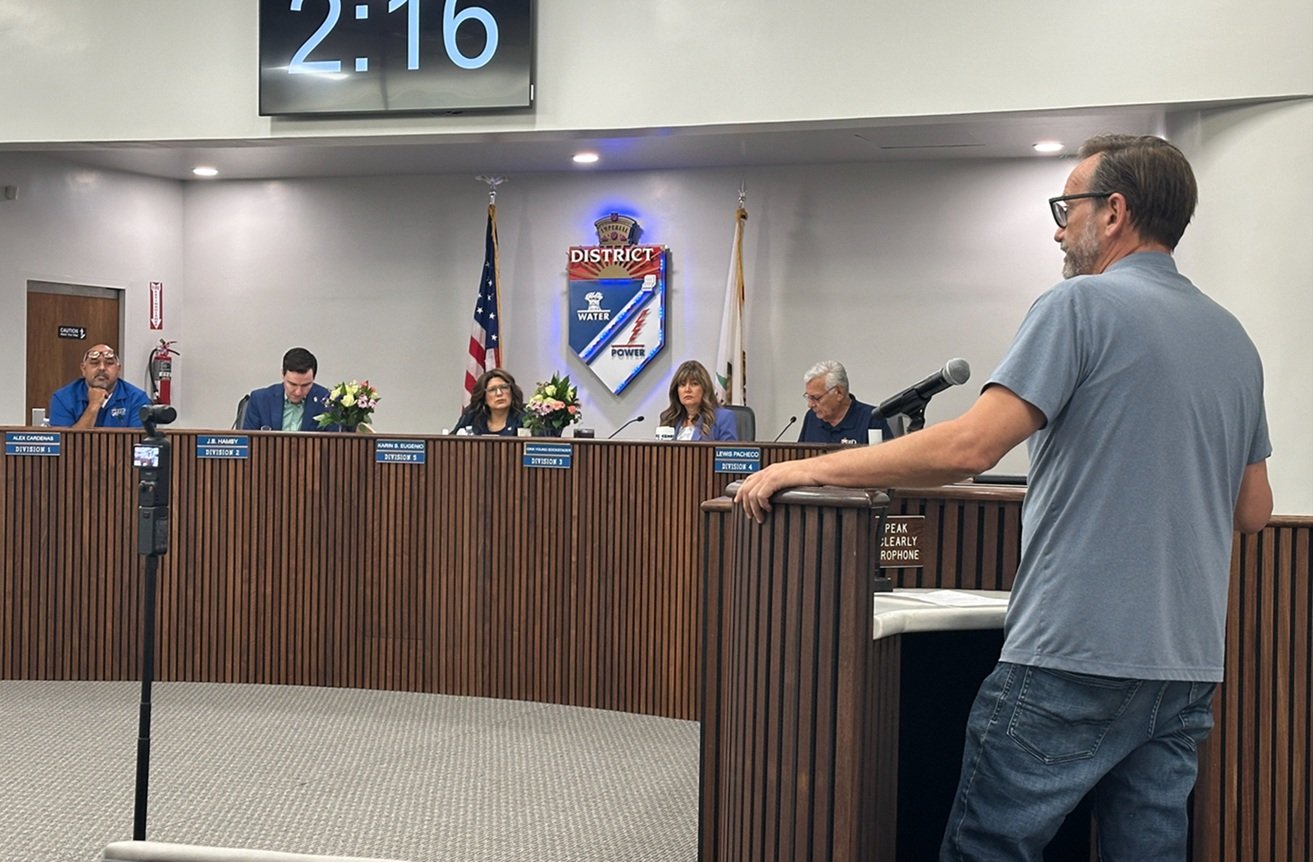
During public comments, data center critic Jake Tison argued that the proposed Large Load Tariff validates longstanding concerns raised by opponents of hyperscale industrial development in the Imperial Valley. He described the framework as resembling a de facto moratorium, stating that IID’s own language acknowledges the extensive infrastructure demands associated with data centers and large-scale artificial intelligence facilities.
Tison further asserted that the utility’s proposal confirms such projects may require significant upgrades to transmission, distribution, generation capacity, and broader power supply systems, while also introducing potential risks that could ultimately affect ratepayers.
He also criticized what he characterized as efforts by some county officials to downplay or minimize concerns surrounding large-load development. In addition, he pointed to interruptible power provisions within the draft tariff, raising questions about whether future projects could lead to additional generation assets, battery storage installations, and expanded industrial infrastructure within local communities.
Tison further warned against what he described as “back-room politics” connected to data center expansion, urging voters and stakeholders to closely evaluate whether future IID leadership will prioritize residential ratepayers and community interests or align more closely with private industrial development priorities.
In other action, the IID Board also approved CEQA findings related to Amendment No. 1 of the 2024–2026 System Conservation Implementation Agreement with the U.S. Bureau of Reclamation. The amendment increases the agreement’s cumulative conservation cap from 700,000 acre-feet to 800,000 acre-feet of conserved Colorado River water to remain in Lake Mead through 2026.
IID stated that the additional conservation efforts are intended to help protect critical reservoir elevations amid ongoing drought conditions across the Colorado River Basin. The board determined that the amendment falls within the scope of environmental analysis previously completed under both CEQA and NEPA requirements, and therefore does not require additional environmental review.