



Residents Demand Revote on Lot Merger Tied to Data Center Project
Share your love
 –Editorial
The Imperial County Board of Supervisors convened for its regular April 14 session, just one week after a contentious public hearing that resulted in the approval of a lot merger tied to a proposed data center project. The aftermath of that decision continued to reverberate throughout the chambers, dominating public comment and underscoring lingering concerns among residents regarding transparency, leadership, and the overall handling of the process.
During the meeting, multiple speakers revisited issues raised at the previous hearing, pointing to what they described as deficiencies in transparency, public safety concerns, and the conduct of both elected officials and law enforcement during last week’s proceedings. The tone of public comment reflected a community still grappling with the implications of the board’s decision and the manner in which it was reached.
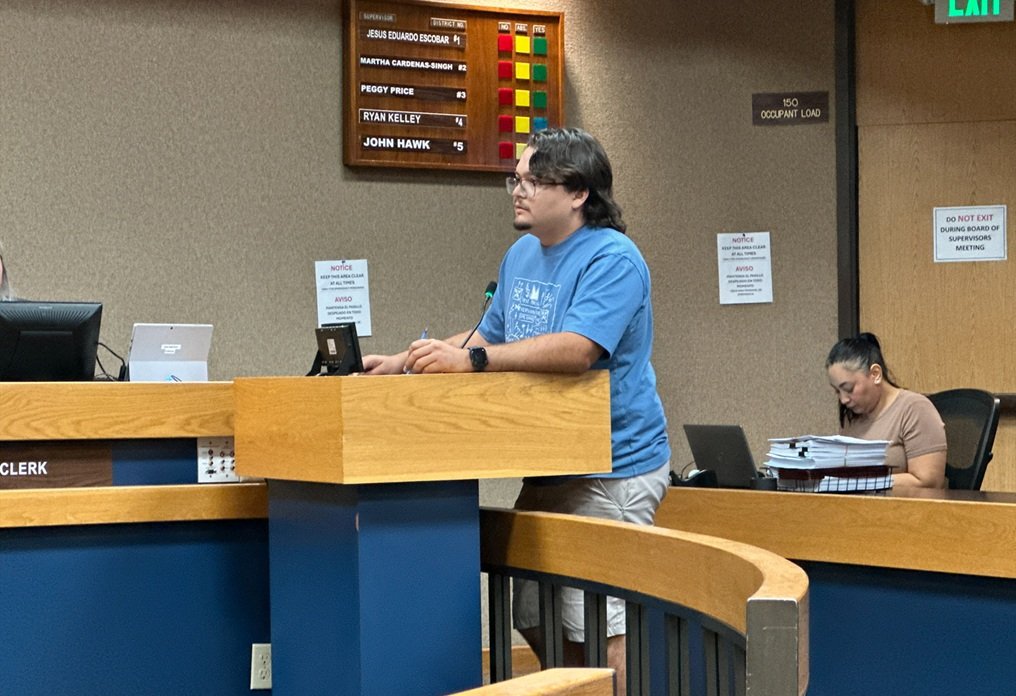
One of the most closely watched moments came when Ismael Arvizu returned to address the board. Arvizu had been arrested during the prior week’s meeting as debate intensified over the proposed development. Following his removal from the chambers, he was taken to the El Centro Police Department and later transferred to the county jail.
Speaking before supervisors, Arvizu recounted spending several hours in custody.
“I was six hours in the county jail,” Arvizu said. “In those six hours, I met three people—one who was there because they couldn’t pay their bills during the pandemic, another there for a ticket during the pandemic, and a third, a homeless man who was released in the middle of the night and had to walk to In-N-Out, where he was eventually picked up.”
Arvizu said the experience left him troubled not only by his own arrest but by what he described as broader implications for civic participation.
“If you allow these strategies of keeping community members out of the Board of Supervisors when you don’t want to listen, it’s going to be a slippery slope,” he said. “I have a constitutional right to be here, to clap whenever I want. I was not disrupting the peace.”
He also described his interaction with law enforcement officers at the time of the incident.
“I told the officers, ‘I’m quiet. You don’t have to worry about me. I know my rights,’” Arvizu said. “They were hesitant because, in their minds, this wasn’t that big of a deal.”
Arvizu noted that he is scheduled to appear in court on May 7 in connection with the incident. “I don’t think anything is going to stick, but I’m not a threat,” he said.
Directing part of his remarks to District 1 Supervisor Jesus Escobar, Arvizu expressed disappointment in what he perceived as a lack of representation.
“Escobar, I wish you had stood up for me. You’re my representative. You’re my neighbor,” he said. “I want to knock on your door and ask what happened. Where were you when I needed you?”
Arvizu also voiced strong opposition to the proposed data center project, framing it as a long-term risk to the community.
“The data center is the danger,” he said. “You are in danger as well—your children, your grandchildren. Generations to come will look back and say, ‘Remember when they voted for that?’”
Another speaker, Jake Tison, announced that he is formally challenging the board’s April 7 vote, alleging violations of California’s open meeting laws under the Brown Act. Tison called for the decision to be voided and reheard with full public participation.
“Today, I am formally submitting a demand to cure and correct under the Brown Act regarding your April 7 vote on agenda item 17, part three,” Tison said. “At that meeting, the public was repeatedly told we could not speak about the data center, only the lot merger. However, your own record tells a different story.”
Tison pointed out that agenda item 17, part three explicitly references a 330-megawatt data center project—the same topic the public was instructed not to address.
“You cannot rely on a project in your official record and then silence the public when they speak about it,” he said. “That is not transparency. I am formally demanding that this board void that vote and rehear the item with full public participation.”
Tison also raised concerns regarding labor representation at the previous meeting and described confusion surrounding enforcement actions inside the chambers.
“It was a little strange seeing individuals from unions who weren’t even from here,” he said. “We are being told that jobs will be local, but the people present didn’t reflect that. What you see and what you hear were two different things.”
He added that he remains unclear about why he was escorted out of the meeting.
“I had zero idea what was happening,” Tison said. “I’ve never had an issue with law enforcement, but I will likely submit an incident report with the ACLU.”
El Centro resident Peter Rodriguez also criticized the board’s handling of last week’s meeting, calling for stronger leadership and clearer direction.
“I did not see the decorum of leadership from you,” Rodriguez said. “You asked us to play our roles, and we tried.”
Using a sports analogy, Rodriguez emphasized the importance of leadership in maintaining order.
“A whistle controls players on a field. Once you blow it, everything stops,” he said. “I wish you would use your voice. Leadership requires common sense.”
Rodriguez further argued that the board’s actions could negatively impact the county’s reputation.
“You have experience, and you failed the test of leadership last Tuesday—badly,” he said. “It was recorded. It’s not a good look. If I were an investor, I would hesitate to come here because it appears there is a lack of leadership. You set the tone, and it was a bad example. I don’t know how you fix it. To be honest, an apology is not enough.”
While the majority of public comment reflected criticism and concern, at least one speaker voiced support for the board’s decision.
Shelby Trimm, Executive Director of the Imperial Valley Economic Development Corporation (IVEDC), expressed support for the approval of the lot merger, describing it as a step toward clarity and consistency in land-use decision-making.
Trimm said the action helps advance economic growth, job creation, and infrastructure investment in Imperial County while respecting private property rights. She added that the decision sends a message to developers that the county is open to responsible growth and fair evaluation of projects.
Despite the contentious atmosphere of the previous meeting, Trimm also commended the board for maintaining professionalism.
As public comment concluded, the divide within the community remained evident. For some, the April 7 decision represents a necessary step toward economic development and future investment. For others, it raises serious concerns about transparency, public trust, and the role of community voices in shaping decisions that may have lasting impacts for generations.
The April 14 meeting made clear that the conversation surrounding the proposed data center—and the process by which it is being considered—is far from over.