


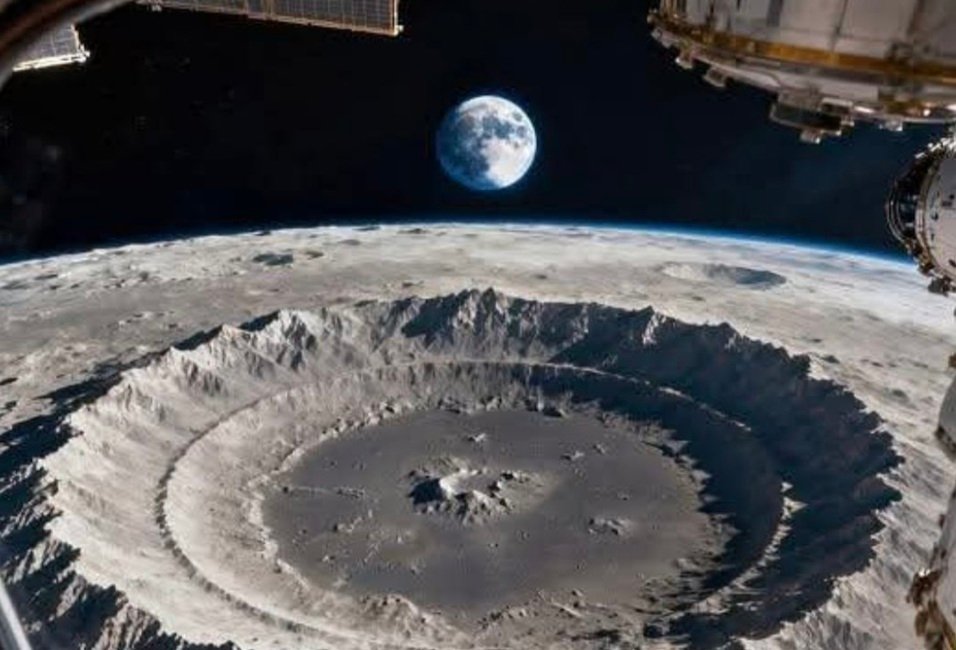

Artemis II Astronauts Break Historic Record by Traveling Farther into Space Than Any Humans Before
Share your love
 -Editorial
Four astronauts aboard NASA’s Artemis II test flight around the Moon made history April 6, setting a new record for the farthest distance traveled by humans in space and surpassing a milestone established during the Apollo 13 mission in 1970.
At 12:56 p.m. CDT, the crew reached a distance of 248,655 miles from Earth, exceeding the previous record. According to NASA, the Orion spacecraft will travel as far as approximately 252,756 miles before looping back toward Earth, marking the farthest point ever reached by a human spaceflight mission.
The crew, NASA astronauts Reid Wiseman, Victor Glover, and Christina Koch, along with Canadian Space Agency astronaut Jeremy Hansen, are now more than halfway through the six-day mission, which is the first crewed flight of NASA’s Artemis program. The mission is intended as a critical test of systems that will support future lunar exploration.
The Orion spacecraft launched on April 1 aboard a Space Launch System rocket from Kennedy Space Center in Florida. After reaching orbit, the spacecraft performed a series of engine burns to break free of Earth’s gravitational pull and set a trajectory toward the Moon. Since then, the crew has been conducting system checks, capturing images, and collecting data during the outbound journey.
NASA officials said the primary objectives of the mission include evaluating the spacecraft’s life support systems, navigation capabilities, and communication performance in deep space. The data collected during the flight will help inform future Artemis missions, including those aimed at returning astronauts to the lunar surface and establishing a long-term human presence.
Following the record-setting moment, Hansen addressed mission control, referencing the legacy of earlier space missions and the importance of continued exploration. He said the milestone reflects both past achievements and future ambitions in human spaceflight.
In addition to operational tasks, the astronauts have been documenting their journey with high-resolution photography of the Moon and deep space. NASA said the crew’s direct observations, described as one of the most valuable tools available, are contributing to scientific understanding of the lunar surface, including variations in light, texture, and terrain.
During the mission, the crew also proposed names for two lunar craters observed during their flight. One is intended to honor the spacecraft, named Integrity, while the other would commemorate Wiseman’s late wife. The proposed names will be submitted to the International Astronomical Union, the body responsible for naming celestial features, for formal review after the mission.
As Orion approaches the Moon, it is expected to come within about 4,067 miles of the lunar surface at its closest point. During the flyby, astronauts will observe portions of the Moon’s far side that are not visible from Earth. The crew is also expected to witness a solar eclipse as the Moon passes between the spacecraft and the Sun.
Mission control anticipates a communications blackout lasting approximately 40 minutes as the spacecraft passes behind the Moon. During this period, the Moon will block signals between Orion and Earth through NASA’s Deep Space Network. Communication is expected to resume shortly after the spacecraft emerges from behind the lunar surface.
NASA said a suite of onboard cameras, along with handheld digital equipment used by the astronauts, is capturing imagery and video throughout the mission. In addition to visual data, telemetry and communications information are being recorded to support analysis after the flight.
The Artemis II astronauts are scheduled to conclude their mission with a splashdown in the Pacific Ocean off the coast of San Diego at approximately 5:07 p.m. PDT on April 10. Recovery teams will retrieve the crew using helicopters and transport them to the USS John P. Murtha, where they will undergo initial medical evaluations before returning to shore.
The Artemis program will continue with increasingly complex missions designed to expand human exploration of the Moon. The long-term goal includes establishing sustainable operations on the lunar surface and using that experience to prepare for future crewed missions to Mars.