

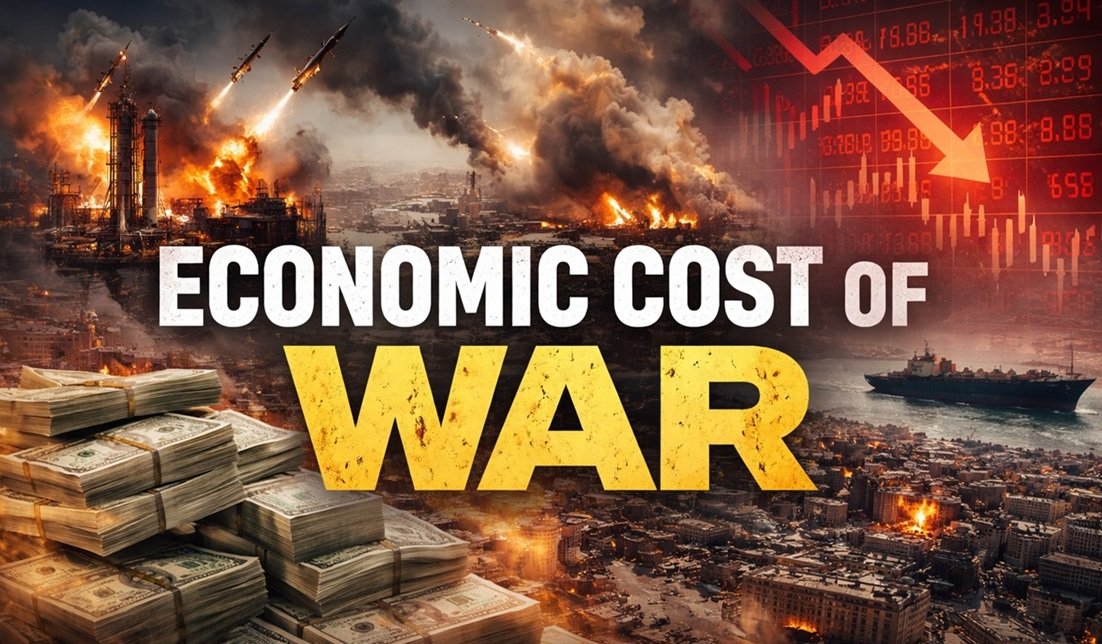

The Economic Cost of the Iran, Israel, and United States War 2026
Share your love
 By: Dr. Alejandro Diaz-Bautista, Economist and Research Professor (PhD).
Talking about the “cost of the war in Iran in 2026” involves working with estimates, since there are no consolidated official accounts yet. Direct costs (military operations) are only part of the picture; indirect costs (recession, infrastructure destruction, displaced populations, risk premiums, etc.) are often even greater.
Let us take as a reference a high-intensity conflict between the United States and its allies against Iran, similar in scale to the early phases of Iraq (2003) but with more expensive technology and a more sensitive energy environment. A recent war cost tracker for a conflict with Iran estimates a direct operational expense for the United States on the order of 1 billion dollars per day during the first weeks of conflict.
The daily cost of military operations for the United States and its allies is approximately 1 billion dollars per day on average, considering naval deployment, air operations, precision missiles, logistics, intelligence, and support.
The internal cost for Iran (military spending and immediate damages) can be estimated at tens of millions of dollars per day in ammunition, mobilization, and material losses, not including the destruction of civilian infrastructure.
If the war lasts one year, the costs for the United States and its allies (operations only) would amount to approximately 365 billion dollars, comparable to the annual GDP of a medium-sized country. For Iran, the loss would be between 10% and 20% of GDP due to destruction, sanctions, and collapse of investment, which could represent between 40 and 80 billion dollars in lost GDP over one year, plus reconstruction costs, which could easily double that figure in the medium term.
 The macroeconomic and financial impact on the United States and its allies would include an increase in the fiscal deficit. The opportunity cost of these resources could have been allocated to infrastructure, education, health, energy transition, or tax reductions, implying a sacrifice of future productive investment with negative effects on potential growth.
A conflict in Iran would almost always imply tension in the Strait of Hormuz. A sustained increase in oil prices (20%–40%) would translate into higher inflation, reduced household purchasing power, and possible tightening of monetary policy.
In Iran, the destruction of physical capital such as refineries, pipelines, ports, industrial plants, and electrical grids would be significant. Replacing this capital could take years and require tens of billions of dollars. The country risk premium would surge, the rial would depreciate, and the financial system would become fragile, leading to an economic contraction and increased informality.
Beyond the figures, the true economic cost is the loss of future productive capacity, financial instability, and the deterioration of the well-being of millions of people. Modern wars are, above all, a massive destruction of present and potential wealth in the world.
Dr. Alejandro Díaz-Bautista, Research Professor in International Economics at El Colef. Distinguished member of the National System of Researchers. He has also been a professor at Universidad Iberoamericana, CISE, a “fellow” and “guest scholar” at UCSD, and a visiting professor at UC Irvine.