


U.S. Airstrikes in Venezuela Result in Maduro’s Capture as Washington Signals Interim Governance During National Rebuilding
Share your love
 -Editorial
The United States launched airstrikes early Jan. 3 on multiple targets across northern Venezuela, including areas in and around the capital, Caracas, marking one of the most dramatic escalations in the decades-long confrontation between Washington and Caracas.
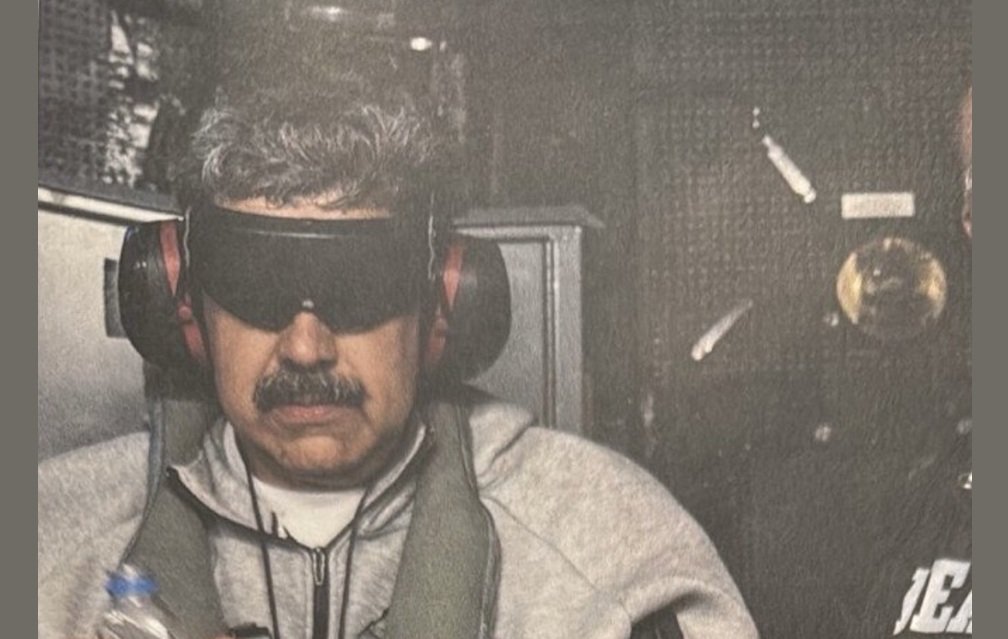
President Donald Trump said the United States carried out what he described as a “large-scale strike” against Venezuela and its leadership, asserting that President Nicolás Maduro and his wife, Cilia Flores, were captured during the operation and transported out of the country by U.S. law enforcement authorities. In subsequent remarks, Trump said the United States is “going to run” Venezuela following Maduro’s capture, though he did not provide specific details on what that would entail or how long such involvement would last.
Trump said additional information about the operation would be released as the situation developed.
U.S. Attorney General Pam Bondi later announced that Maduro and Flores had been indicted in the Southern District of New York on charges related to narcoterrorism and would face prosecution in the United States. The indictments build on long-standing U.S. accusations that the Venezuelan government has been involved in large-scale drug trafficking operations.
Venezuelan Vice President Delcy Rodríguez confirmed that Maduro and Flores were missing, demanding “proof of life” during a televised address. Venezuelan officials denounced the U.S. strikes as an act of aggression and accused Washington of seeking regime change. In response, Maduro declared a national state of emergency and called for an emergency meeting of the United Nations Security Council.
Explosions were reported shortly after 2 a.m. local time in several locations, including La Guaira, Higuerote, Baruta, El Hatillo, and Charallave—areas largely in or near Caracas. Witnesses described low-flying aircraft and at least seven explosions over a 30-minute period. Venezuelan and opposition sources said several military installations were struck, including communication antennas, active bases, and airport facilities. Smoke was seen rising from at least one military hangar in Caracas, and parts of the capital reportedly experienced power outages.
Venezuelan Defense Minister Vladimir Padrino López said U.S. helicopters fired rockets and missiles in urban areas and that authorities were assessing casualties and damage. Venezuela’s attorney general, Tarek William Saab, claimed civilians were killed and wounded, though those figures could not be independently verified. Trump said in a media interview that no U.S. troops were killed, though some were injured when a helicopter was struck during the operation.
In response to the unfolding military activity, the Federal Aviation Administration issued an immediate prohibition on U.S. aircraft operating in Venezuelan airspace. The U.S. Embassy in Caracas ordered American citizens to shelter in place, citing security concerns.
The strikes followed months of escalating U.S. military and diplomatic pressure. Beginning in August 2025, the United States deployed warships and additional personnel to the southern Caribbean and later conducted targeted strikes on vessels it alleged were involved in drug trafficking linked to Venezuela. U.S. officials said those actions were part of “Operation Southern Spear,” an initiative aimed at dismantling criminal networks allegedly connected to the Maduro government.
The Trump administration has repeatedly accused Maduro of presiding over what it calls a “narco-state” and of committing electoral fraud in Venezuela’s disputed 2024 presidential election. While Venezuela’s electoral authority declared Maduro the winner, the opposition claimed its candidate, Edmundo González, won decisively. The United States previously designated Venezuelan criminal groups, including Tren de Aragua and the Cartel de los Soles, as foreign terrorist organizations, alleging Maduro played a leadership role in the latter.
In November 2025, the United States deployed the aircraft carrier USS Gerald R. Ford to the region and later began intercepting oil tankers, effectively imposing a naval quarantine. U.S. officials have also acknowledged authorizing covert operations inside Venezuela, though details remain classified.
According to U.S. officials, elite forces carried out the operation targeting Maduro. Some Venezuelan opposition figures described the capture as a “negotiated exit,” though no evidence supporting that characterization was provided. Opposition leader María Corina Machado, speaking from exile, said events were unfolding that would allow the opposition to claim the mandate it says it won in 2024.
Reaction within the United States was divided. Democratic Sen. Brian Schatz of Hawaii warned against deeper military involvement, arguing that the United States has no vital national interests justifying war in Venezuela. Republican Sen. Mike Lee of Utah initially questioned the constitutional authority for the strikes but later said the action likely fell within the president’s authority to protect U.S. personnel abroad. Vice President JD Vance defended the operation, stating Maduro was a wanted fugitive and arguing that Venezuelan oil seized by the government should be returned to the people.
Secretary of State Marco Rubio emphasized the administration’s broader message following the operation. “This president is not a game player,” Rubio said. “When he says something, he means it. The message should be for the world. We’ll talk and meet with anybody, but don’t play games. A message was sent to the world last night.”
International reaction was sharply critical. France’s foreign minister said the operation violated international law and the principle of non-use of force. China’s Foreign Ministry condemned the strikes as a violation of Venezuela’s sovereignty and warned they threatened regional stability. Other governments and legal experts also questioned the legality of the U.S. action under international law.
Trump, however, framed the operation as a decisive turning point. “The people of Venezuela are free again,” he said, adding that the strikes should serve as a warning to any nation threatening American lives.
Defense Secretary Pete Hegseth praised the operation, calling it “flawlessly executed” and commending U.S. forces involved. “American warriors are second to none—the best in the world,” Hegseth said. “This was about the safety, security, freedom, and prosperity of the American people. This is America First. This is peace through strength.”
As the situation continues to unfold, uncertainty remains over the fate of Venezuela’s leadership, the humanitarian impact of the strikes, and the broader consequences for regional and global stability. What is clear is that the events of Jan. 3 have fundamentally altered the trajectory of U.S.-Venezuela relations, ushering in a new and highly volatile chapter as 2026 begins.