


Mexico to Raise Minimum Wage 13% in 2026, Northern Border Sees Higher Increase
Share your love
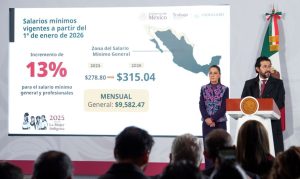 -Editorial
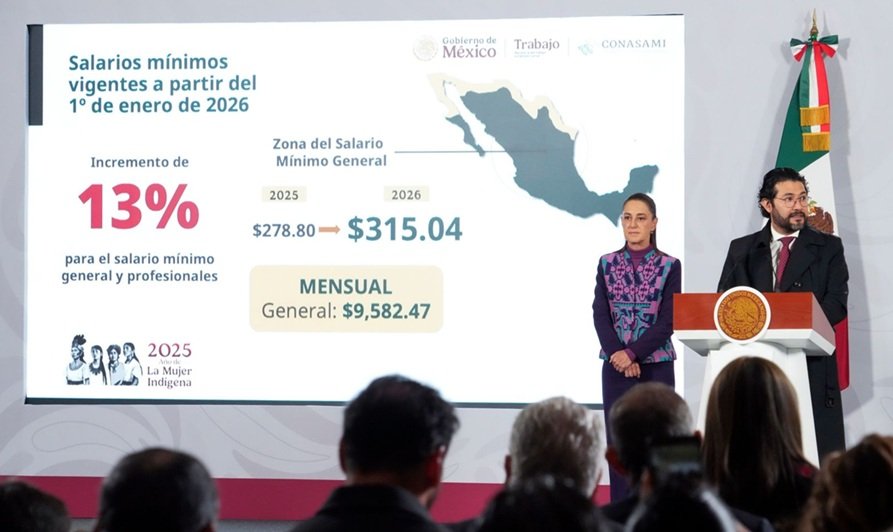
Mexican President Claudia Sheinbaum announced a 13% increase in the general minimum wage, effective Jan. 1, 2026, in a move expected to benefit 8.5 million workers nationwide. The general daily minimum wage will rise to 315.04 pesos, or approximately 9,582.47 pesos per month. Workers in the Northern Border Free Zone (Zona Libre de la Frontera Norte, ZLFN) will see a 5% increase, raising the daily wage to 440.87 pesos, or about 13,409.80 pesos monthly.
Sheinbaum said the decision was reached through consensus with both labor and business representatives. She also highlighted plans to gradually reduce the workweek to 40 hours. Speaking at her morning press conference, known as “las mañaneras del pueblo,” she emphasized that the wage increase is not expected to trigger inflation and noted that the minimum wage’s purchasing power has increased by 154% since 2018.
Marath Baruch Bolaños López, Secretary of Labor and Social Welfare, said the rise will improve access to basic goods for workers. Nationwide, access to basic food baskets will increase from 1.8 in 2025 to 2.0 in 2026, while in the Northern Border Free Zone, it will rise to 2.8, maintaining levels above previous records.
Francisco Cervantes Díaz, president of the Business Coordinating Council (CCE), praised the collaborative effort between the government and business sectors. He said the negotiations demonstrate a willingness to implement policies that benefit diverse groups of the population, particularly vulnerable workers.
The wage increase forms part of broader social and economic measures by the Mexican government under the Fourth Transformation (Cuarta Transformación) aimed at improving worker conditions and strengthening domestic purchasing power. Sheinbaum stressed that the agreement reflects a balance between supporting workers’ livelihoods and maintaining economic stability.
The last decade marks a significant shift in Mexico’s minimum wage policy, moving away from decades of stagnation toward concerted, high-impact increases aimed at recovering workers’ purchasing power. Until the mid-2010s, the real value of the minimum wage had plummeted, losing approximately 75% of its buying power since the 1970s and remaining artificially low to ostensibly boost international competitiveness.
This began to change in 2016 when the minimum wage was successfully separated from other indices, paving the way for real increases. However, the most dramatic and sustained changes began with the administration of President Andrés Manuel López Obrador, starting in 2019, which ushered in a policy of significant double-digit percentage hikes annually in both the general minimum wage and the separate, higher rate for the Northern Border Free Zone.
The shift saw the general daily minimum wage rise from 88.36 pesos (approximately $4.89 USD) in 2018 to 278.80 pesos (approximately $15.23 USD) by January 2025, representing a cumulative nominal increase of roughly 215% over seven years (Playroll, 2025; Start-Ops, 2025). The most aggressive increases — 20% or more — were implemented in 2020, 2022, 2023, and 2024, signaling the government’s commitment to prioritizing wage recovery. A key feature of this new policy was the creation of the Northern Border Free Zone (ZLFN), a defined strip of municipalities bordering the U.S., where the minimum wage was initially doubled in 2019 and has been maintained at a substantially higher rate, reaching 419.88 pesos (approximately $22.94 USD) per day by 2025,
These consecutive, large-scale increases have successfully reversed the long-term erosion of the minimum wage’s value. Analysis by organizations like the employers’ association COPARMEX indicates that the policy has led to a recovery of about 148% of the minimum wage’s purchasing power over the recent years, contributing to a significant decrease in poverty and inequality (Mexico Business News, 2025). The measure is generally achieved through consensus among the tripartite National Commission on Minimum Wages (CONASAMI), which includes representatives from labor, business, and the government. Despite initial concerns from critics regarding potential inflationary pressure, the government and business groups have largely maintained that the hikes have been absorbed without destabilizing the economy, allowing the minimum wage to meet or exceed the national “well-being line.”