


Imperial–Mexicali Alliance Highlights Lithium Valley as Catalyst for Binational Growth
Share your love
 -Editorial
The Imperial-Mexicali Binational Alliance (IMBA) convened its 78th meeting on March 12 at the San Diego State University Imperial Valley Campus in Brawley, California. Attendees included representatives from the Imperial County Transportation Commission, the Consejo de Desarrollo Económico de Mexicali, the Imperial Valley Economic Development Corporation, and several Baja California government agencies involved in urban planning and economic development.
During the meeting, participants toured the new $80 million SDSU Science Building and received an overview of regional lithium development, including projects within the Lithium Valley area. The tour highlighted the region’s potential for innovation in energy storage and economic growth, as well as cross-border collaboration on infrastructure and industry development.
Eric Reyes of Los Amigos de la Comunidad highlighted the region’s high winds and desert location as issues, while emphasizing the importance of meeting California environmental standards.
Reyes noted that while lithium development faces scrutiny and regulatory requirements, the projects have the potential to attract substantial investment. “This allows moving quickly and looking for investors,” he said, adding that other states, including North Carolina, Texas, and Nevada, have been able to advance similar projects faster due to streamlined permitting processes.
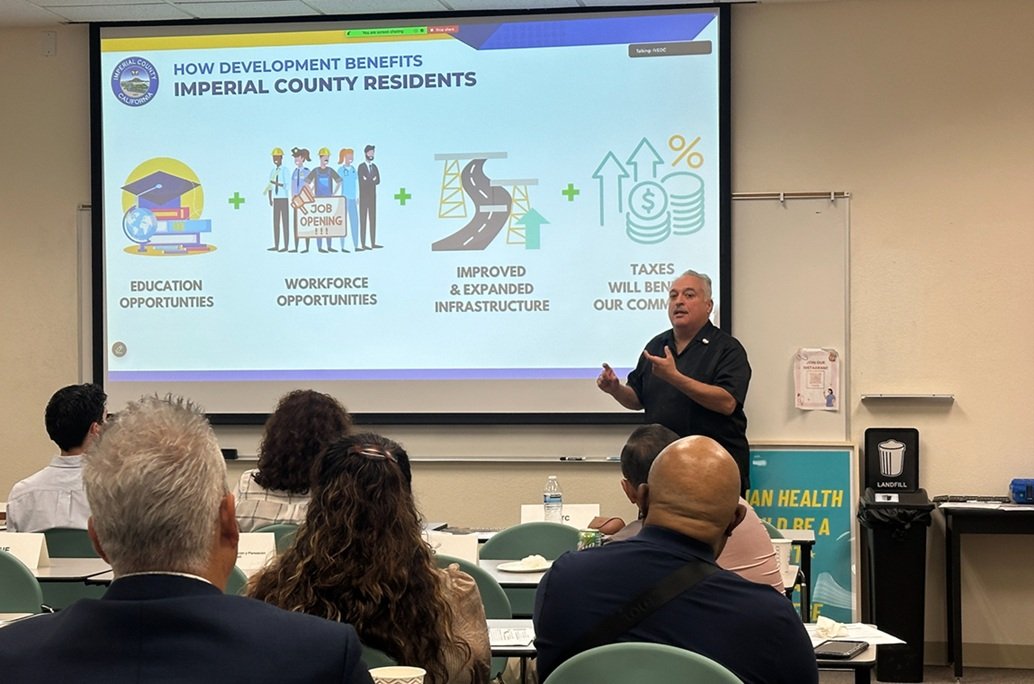
He stressed that Imperial Valley could benefit directly through workforce development and local hiring. Programs at Imperial Valley College and SDSU, including STEM initiatives and lithium plant operator training, are designed to produce qualified engineers and technicians for local projects. “We now have homegrown engineering students who can work here rather than leaving the region,” Reyes said. He highlighted that the first cohort of plant operators already has significant job placement, with many working in municipal water and energy operations.
Reyes also discussed infrastructure and economic impacts. Lithium projects will require substantial construction and ongoing maintenance, creating long-term opportunities for electricians, laborers, and other trades, while prioritizing the employment of residents. Infrastructure improvements, including roads, bridges, and utilities, are expected to accompany development, supported in part by mitigation and tax funds. Reyes said 80% of revenues from the lithium industry would be returned to Imperial County for infrastructure and community programs, while 20% would support environmental mitigation efforts.
He described the projects as a rare chance for Imperial Valley to grow local industry, improve education and workforce capacity, and strengthen the regional economy. “This is a world-class economic development opportunity in a region that has historically lacked infrastructure and investment,” Reyes said. He emphasized that careful planning, compliance with environmental regulations, and community engagement will be essential to ensure that the benefits reach residents and that Imperial Valley can compete with other states in the growing global lithium market.
Reyes concluded that lithium development represents not only an energy and economic opportunity but also a catalyst for broader workforce development, infrastructure investment, and educational growth in the region.