

IID Hosts Public Workshop Amid Rising Concerns in Imperial Data Center Proposal
Share your love
 -Editorial
The Imperial Irrigation District held a public workshop on Dec. 9 to address concerns about a proposed data center in the city of Imperial, as residents question the project’s viability and potential impacts.
The proposal calls for a roughly 950,000-square-foot, 330-megawatt data center, an emergency 330-megawatt backup generator building, and an 862-megawatt-hour energy storage system on about 74 acres at the southeast corner of Aten and Clark roads. No construction permits have been given to developers yet.
The IID has seen a rise in inquiries from data-center developers interested in locating in the Imperial and Coachella Valleys, prompting the agency to outline potential benefits and challenges associated with the projects.
Data centers are large facilities that operate continuously to support cloud computing, artificial intelligence, and digital storage. They require stable, high-volume electricity — often upwards of 100 megawatts, comparable to the demand of a small city — along with extensive cooling systems that may use significant amounts of water. These projects typically occupy 40 to 80 acres and require long-term reliability guarantees and customized grid infrastructure.
Developers have shown interest in the region due to available land, relatively low power and water costs, and proximity to major metropolitan areas. IID officials say the projects could bring private investment, temporary construction jobs, and potentially attract additional technology-sector activity.
However, district leaders note several concerns. Large electricity loads may require new substations, transmission lines, and system upgrades, which are generally the developer’s responsibility. Water use for cooling, added stress on the electric grid, and possible environmental impacts are also under review. IID cites additional risks, including stranded assets if projects fail, long-term ratepayer exposure, and financial imbalance if a single data center becomes a disproportionately large customer.
IID evaluates all proposals on a non-discriminatory basis to ensure system reliability, confirm that water and power demands are feasible, and prevent cost-shifting to existing customers. The district requires developers to pay for infrastructure, meet environmental standards, prove financial viability, and commit to firm interconnection agreements.
District officials said no project will be expedited without thorough analysis and due diligence intended to protect reliability and shield ratepayers from undue costs or risks.
Imperial County Supervisors Hear Concerns
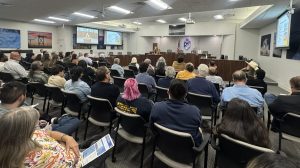
The discussion on Dec. 9 gained momentum during the Imperial County Board of Supervisors meeting, where several residents voiced concerns about the proposed data center project.
Neighbors living near the proposed site said they wanted clearer information about the facility’s potential impacts and urged county officials to improve public outreach as the project moves forward.
Tom DuBose of DuBose Design Group, speaking on behalf of the developer, described the project as a “badly needed” economic opportunity at a time when Imperial County is losing jobs. DuBose said the $10 billion investment would generate significant revenue for local governments and provide long-term financial benefits for the Imperial Unified School District. He also emphasized that the developer has not required anyone to sign nondisclosure agreements, addressing a concern raised by a resident speaking at the board of supervisors meeting.
DuBose noted that the project includes a proposal to install water-reuse equipment at the expense of the developer for both Imperial and El Centro, saying the systems would reduce water discharge and create new revenue streams for the cities. He argued the project aligns with the region’s renewable-energy capacity, adding that IID energy managers have long said the Valley needs more electrical load to utilize the renewable power generated locally.
Francisco Leal, who identified himself as a nearby resident, father, and neighbor, told the Imperial County Board of Supervisors that families only began learning “piece by piece” about the project after Nov. 26 — and not from county officials. “I’m genuinely heartbroken that our community has been left in the dark while billion-dollar corporations move quietly toward transforming our neighborhoods,” Leal said.
He criticized what he described as a lack of formal communication from the county.
“There are still no official statements, no workshops, no community meetings, and not even a single agenda item,” he said, adding that residents received most of their information from the city of Imperial, which he said “understood that transparency is not optional when people’s lives and homes are at stake.”
Leal also questioned why the project is being evaluated in segments rather than as a single industrial complex. He pointed to a grading permit already issued despite ongoing assessments related to power, water, wastewater, environmental risks, public safety, and national security.
“Why approve grading unless someone has already decided that this project will be approved no matter what?” he said. “What is the point of future studies if the ground is already being prepared?”
Leal challenged assurances that the facility will rely solely on reclaimed water, saying there are “no agreements, no binding documents” guaranteeing that commitment. Without such contracts, he said, “farmers, residents, and the entire valley could end up competing for the same limited water resources.”
He also raised concerns about long-term costs, noting that even if the developer pays for initial infrastructure such as power lines, water, sewer, and roads, residents could face higher rates later. “After that, we’re going to pay for the long-term maintenance, upgrades, and operational strain on those systems,” he said. “Will the million-dollar company, or us — the ratepayers?”
Leal cited examples of fires, explosions, and evacuations at other data centers in the United States, arguing that similar risks must be taken seriously locally. He also said the proposed site’s proximity to U.S. Customs and Border Protection’s El Centro Sector headquarters raises national security questions.
“Placing a privately controlled, data-intensive, power-heavy industrial facility directly beside CBP demands federal-level review,” he said, adding that foreign ownership changes could trigger scrutiny under federal oversight bodies such as the Committee on Foreign Investment in the United States (CFIUS).
State Sen. Steve Padilla called for greater transparency and public input after Imperial County granted a proposed data center project an exemption from environmental review under the California Environmental Quality Act. In a letter to county supervisors, Padilla said residents deserve clarity on the project’s water use, energy demands, and potential cost impacts, noting that similar developments nationwide have raised utility rates and strained local resources. He also said he plans to introduce legislation in January to establish energy and resource efficiency standards for data centers.