


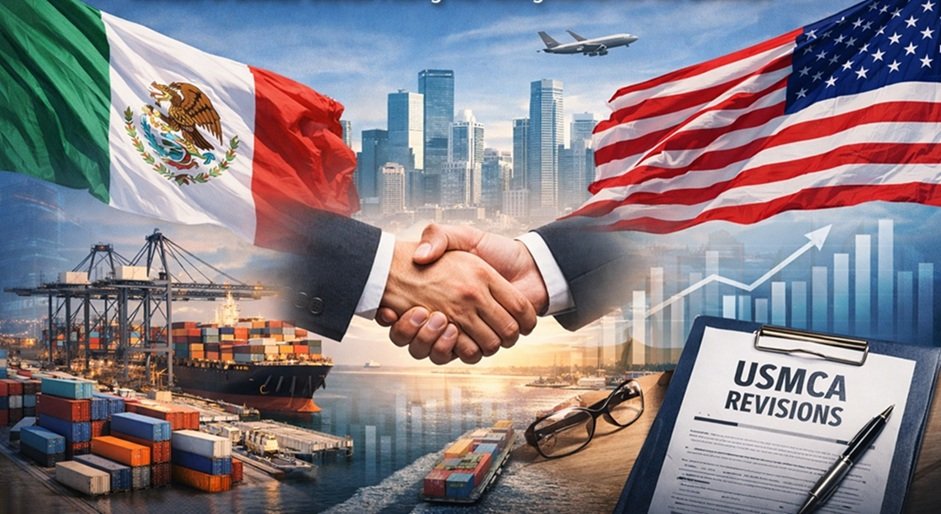

Economic and Trade Outlook 2026: Mexico and the United States Facing the Renegotiation of the USMCA
Share your love
 By: Dr. Alejandro Díaz-Bautista, Economist and Researcher (PhD)
The year 2026 marks a critical turning point in the economic relationship between Mexico and the United States due to the mandatory review of the USMCA, scheduled for July 1, 2026, when the three countries must assess its performance and decide whether to extend it for an additional 16 years. This review does not necessarily imply a full renegotiation, but it does open the door to pressures, adjustments, and potential trade tensions.
The economic and trade outlook for 2026 will be shaped by three main factors: the political dynamics in the United States, Mexico’s negotiating stance, and the strategic sectors that could be affected.
An environment of intense pressure is anticipated, particularly on issues such as automotive rules of origin, labor conditions, production within North America, and compliance with environmental commitments.
Washington will seek to reduce its trade deficits and strengthen regional production, which could translate into stricter demands on Mexico. Although the likelihood of a breakdown is low, the risk of tariff threats or unilateral measures during the negotiations is real, as part of the U.S. strategy to secure concessions.
President Claudia Sheinbaum has expressed optimism regarding progress in the review with the United States and Canada, noting that diplomats view the process favorably.
 The Mexican government has also emphasized the importance of broad public participation, allowing productive sectors to voice concerns and proposals during the review process.
Despite the tensions, trade between Mexico and the United States will continue to grow. Mexico has been one of the United States’ leading trading partners in recent years, and the depth of productive integration makes any rupture highly costly for both countries.
The USMCA review creates temporary uncertainty, but it can also attract new investment if the regulatory framework is strengthened, encourage the relocation of Asian companies to Mexico, and consolidate the country as an export platform to the United States.
The economic and trade outlook between Mexico and the United States in 2026 will be marked by a complex renegotiation, but with significant potential to strengthen the USMCA. While pressures and tensions will arise, economic interdependence and the need for regional stability make it likely that the agreement will be maintained and modernized. Mexico must combine strategy and diplomacy to protect its interests, leverage nearshoring, and consolidate its role as a key partner of the United States in the future North American economy.
Dr. Alejandro Díaz-Bautista is a Research Professor of International Economics at El Colef and a distinguished member of Mexico’s National System of Researchers. He has also served as a professor at Universidad Iberoamericana and CISE, as well as a fellow and guest scholar at UC San Diego and a visiting professor at UC Irvine.