


Calexico City Council in a Familiar State of Chaos
Share your love
 -Editorial
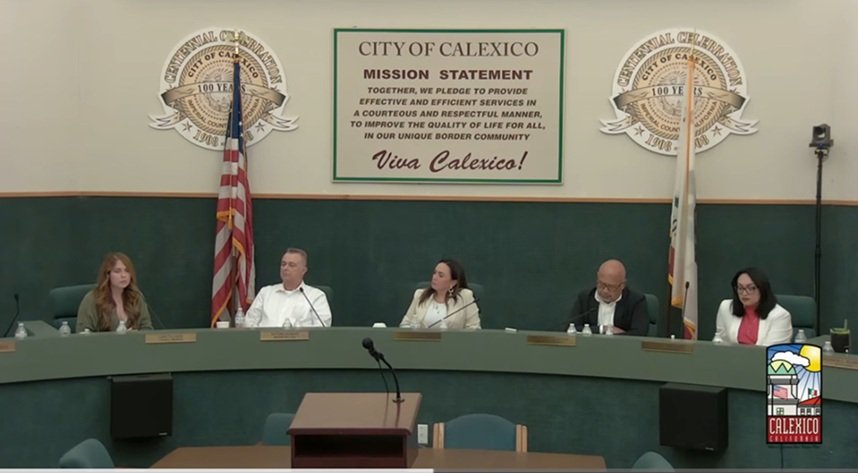
Politics in Calexico have long been described as “challenging.” That may be the polite version. The current City Council, however, has elevated dysfunction into something closer to performance art. Meetings are tense, alliances are rigid, and consensus feels like a relic of a forgotten era.
The council is now firmly divided into two camps. On one side: Team Calexico, composed of Councilmembers Lisa Tylenda and Diana Nuricumbo. On the other: Mayor Victor Legaspi, Councilwoman Adriana Marquez, and Mayor Pro Tem Lorenzo Calderon. The divide is so entrenched that holiday card exchanges between these factions appear unlikely for the foreseeable future — unless they’re addressed “Return to Sender.”
The dysfunction does not end at City Hall. It has spilled onto social media, where commentary, podcasts, and anonymous pages amplify every disagreement. Team Calexico operates a weekly podcast dissecting city decisions and council actions. Meanwhile, supporters of the opposing camp respond online with equal vigor. What was once a dais debate has become a digital tug-of-war.
Tensions intensified when Mayor Legaspi assumed office and appointed Lorenzo Calderon as mayor pro tempore instead of Tylenda — despite her strong vote count in the last election. That decision triggered waves of criticism and deepened suspicions about political alliances. In Calexico, the so-called “compa system” — loyalty over logic — continues to shape perception, whether fairly or not.
Then came the viral video.
Councilmember Adriana Marquez was filmed asking permission to cut the line to cross into Mexicali for what she described as an emergency dental visit. Anyone who has waited in that line — sometimes exceeding two hours — understands the frustration. Residents juggle work schedules, school pickups, and family obligations. The rules apply to everyone. Or so they thought.
Marquez later stated the situation was urgent and that she was not rude to the officer. But perception matters in public office. The image of an elected official attempting to bypass a line that ordinary citizens patiently endure did not sit well with many residents. It raised a simple question: When did public service begin to resemble preferential treatment?
Perhaps the most striking aspect of this episode is not the line itself, but the transformation it symbolizes. Adriana Marquez was once known as a humble educator — approachable, grounded, a teacher serving her community. Yet somewhere between the classroom and the council dais, there appears to have been a shift. A City Council seat in Calexico — in Imperial County, no less — is an honorable responsibility. It is not a coronation. It does not come with a crown, a motorcade, or diplomatic immunity at the border.
Still, observers across the county have noted a new presence: Marquez increasingly seen at the most influential and upscale events, projecting an air that critics describe as distant, even arrogant. Public servants are expected to serve, not ascend. Leadership is measured by humility, not exclusivity.
The online reaction has been fierce. Pages like “Rants and Raves of Imperial Valley” have reignited the familiar pattern of anonymous attacks and political mudslinging. Longtime residents may recall a similar climate a decade ago, when the “Calexico Blue Flame Society” targeted officials it opposed. Different names, same playbook.
More than a year has passed since the recall of Raul Ureña and Gilberto Manzanares, yet unity remains elusive. The faces change. The drama does not.
Meanwhile, the real issues persist. Calexico continues to grapple with job creation gaps, underdeveloped parks, uneven city services, and a downtown corridor that needs sustained investment. These challenges require collaboration, not camps. Strategy, not spectacle.
Mayor Legaspi faces the difficult task of bridging a council that appears comfortable in conflict. Working closely with city administration is only part of the equation; council-wide cooperation is essential if tangible progress is to be made.
Calexico voters, for their part, have demonstrated a recurring appetite for “change.” New candidates promise transparency, unity, and reform. Yet too often, change feels cosmetic. Budgets expand. Promises contract. Frustrations grow. The question remains: are voters truly elevating leadership, or simply rotating personalities while the underlying culture stays intact?
High stakes loom ahead. Two council seats will be up for election in November. Whether incumbents seek reelection or new contenders emerge, tensions are likely to intensify. Campaign season in Calexico rarely cools tempers; it tends to inflame them.
As podcasts roll on, social media sparring continues, and viral moments overshadow policy discussions, the city’s political theater shows no signs of closing night.
In Calexico, chaos is not an interruption. It is tradition.
And apparently, so is business as usual.