


U.S.-Mexico Border Mayors Summit Strengthens Binational Cooperation
Share your love
 -Editorial
Government officials, municipal leaders and policy experts from the United States and Mexico gathered Oct. 29-30 at UC San Diego for the U.S.-Mexico Border Mayors Summit, focusing on binational cooperation in trade, border security, education, environmental management and economic development.
Organized under the U.S.-Mexico Border Mayors Association, the two-day summit brought together representatives from both countries to discuss shared challenges and opportunities affecting communities along the international border.
The event opened Oct. 29 with a welcome reception hosted by the UC San Diego Center for U.S.-Mexican Studies. Catheryn Camacho, associate director of the center, and Denice García, chief binational affairs officer for San Diego County, delivered welcoming remarks.
The summit continued Oct. 30 with policy discussions addressing cross-border commerce, workforce development, water management and cultural cooperation.
Tijuana Mayor Ismael Burgueño Ruiz participated in a panel examining trade, security and border innovation, alongside representatives from U.S. Customs and Border Protection, the San Diego Regional Chamber of Commerce and the Smart Border Coalition.
Burgueño emphasized the importance of maintaining a coordinated binational agenda to improve mobility, strengthen economic ties and expand educational opportunities between Tijuana and San Diego.
He highlighted initiatives supporting students who pursue educational opportunities on both sides of the border, allowing them to exchange academic experiences and strengthen regional connections.
The mayor also cited improvements in border transportation infrastructure, including the opening of a SENTRI lane in 2025, which he attributed to coordination between municipal authorities and U.S. Customs and Border Protection.
Burgueño described the initiative as an example of how cooperation between government agencies can produce improvements in cross-border mobility.
“The binational agenda is growing stronger, and we continue to deliver great results,” Burgueño said.
He also discussed Tijuana’s tourism industry, including its gastronomy and medical tourism sector, and highlighted what he described as improvements in the city’s public safety perception.
The opening policy panel included Mariza Marin, director of the San Ysidro Port of Entry for U.S. Customs and Border Protection; Kenia Zamarripa, vice president of international and public affairs for the San Diego Regional Chamber of Commerce; and Joaquín Luken, executive director of the Smart Border Coalition. Chula Vista Councilmember Carolina Chávez moderated the discussion.
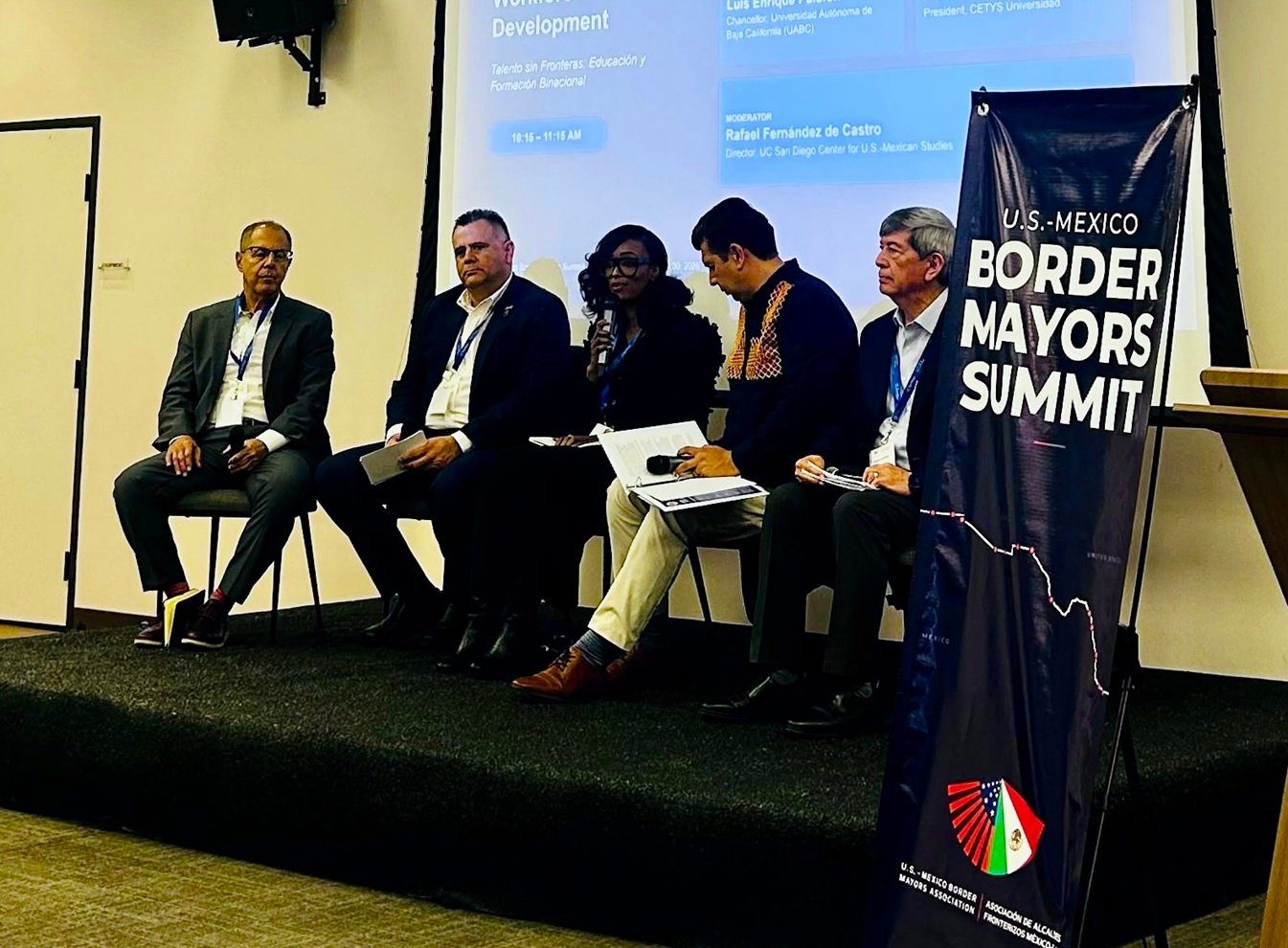
A second panel examined binational education and workforce development, focusing on academic collaboration and the development of a skilled workforce across the border region.
Participants included California Assemblymember David Álvarez, UC San Diego Associate Vice Chancellor Tamara Cunningham, Universidad Autónoma de Baja California Chancellor Luis Enrique Palafox, and CETYS Universidad President Fernando León García.
Rafael Fernández de Castro, director of the UC San Diego Center for U.S.-Mexican Studies, moderated the discussion.
Environmental cooperation was another major topic, with a panel examining shared governance of water resources and environmental challenges affecting border communities.
Representatives from the North American Development Bank, the International Boundary and Water Commission and other organizations participated in discussions on water management, sustainability and binational coordination.
The panel included Salvador López, chief environmental officer of the North American Development Bank; Sally Spener, secretary of the U.S. section of the International Boundary and Water Commission; and Luis Antonio Rascón Mendoza, principal engineer for engineering with the commission’s Mexican section.
Carlos de la Parra, founder and managing partner of the Luken Center for Strategies on Water and Environment, and David Moreno, director of sustainability and environmental, social, and governance initiatives at Arca Continental, also participated.
The afternoon program featured a keynote address by Theresa Cardinal Brown, founder of Cardinal North Strategies and a former Department of Homeland Security official with nearly three decades of experience in immigration and border policy.
Another panel explored the role of arts and culture in strengthening the shared identity of communities along the U.S.-Mexico border.
Speakers included Baja California Secretary of Culture Alma Delia Ábrego Ceballos, Tijuana Innovadora Vice President Claudia Basurto, U.S.-Mexico Border Philanthropy Partnership Executive Director Andy Carey, and Prebys Foundation Vice President of Programs Emily Young.
The summit concluded with an invitation-only mayoral roundtable focused on municipal issues and the experiences of local governments serving border communities.