


Imperial County Supervisors Recognize Visually Impaired Residents
Share your love
 -Editorial
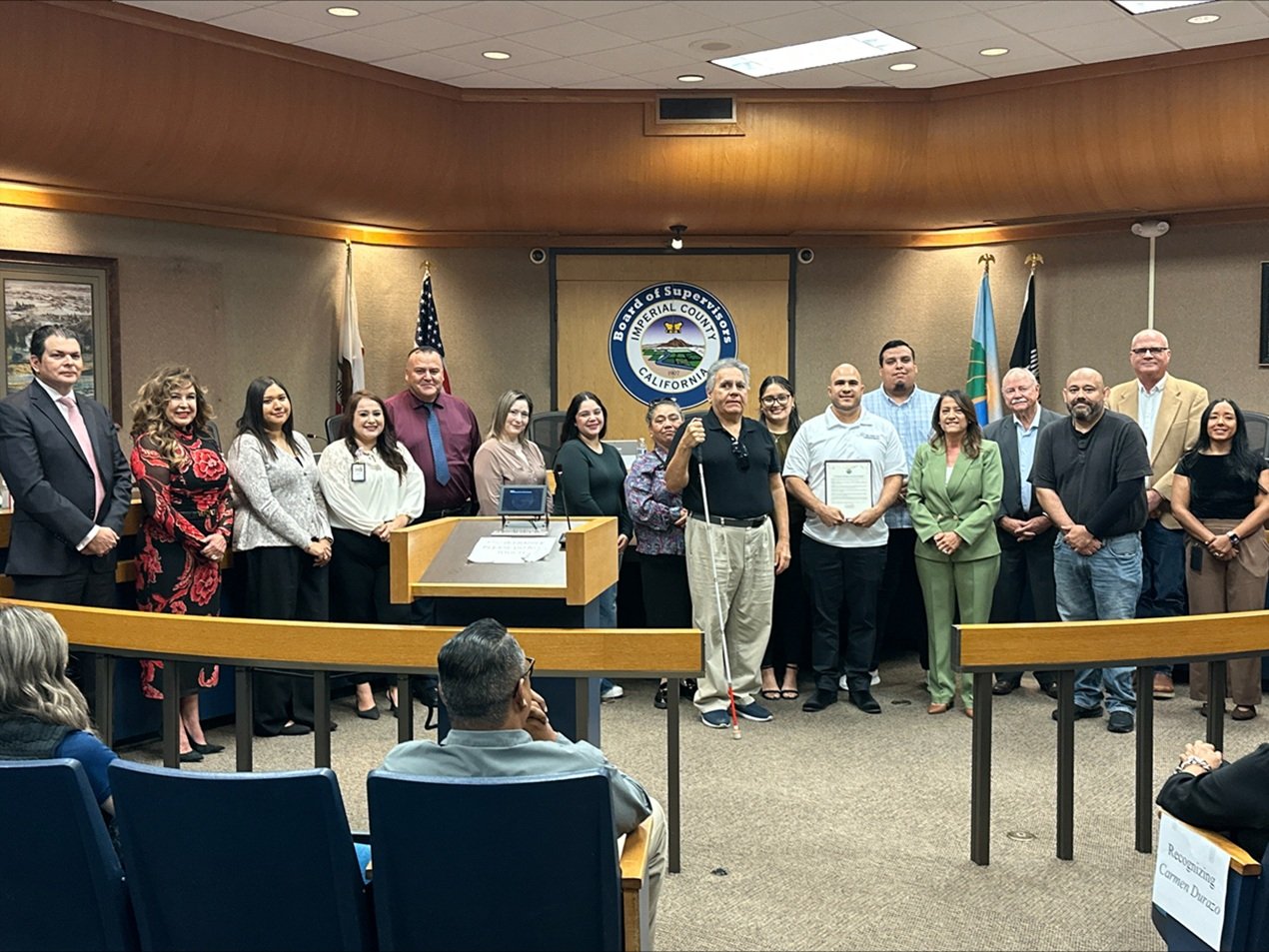
The Imperial County Board of Supervisors recognized individuals who are blind or visually impaired through a proclamation acknowledging their contributions to the community and emphasizing the need for greater accessibility, independent living resources, and support services throughout the county.
The proclamation recognizes residents with visual impairments as valued members of the community who contribute to Imperial County’s social, cultural, and economic life. It also stressed the importance of accessible transportation, assistive technology, education, employment opportunities, and community-based services in helping individuals maintain independence.
The recognition provided an opportunity for residents and representatives of Access to Independence, a nonprofit organization serving people with disabilities, to discuss challenges facing visually impaired individuals, including pedestrian safety, inadequate infrastructure and limited access to specialized training.
Kevin Gamino, an Imperial County resident who is legally blind, described the difficulties he encounters navigating public spaces and adapting to life after losing most of his vision.
“It is very difficult, especially when it comes to mobility, safety, and adequate accessibility, which is not always available,” Gamino said.
Gamino explained that he lost vision in his right eye after damage to his optic nerve and has limited vision in his other eye, allowing him to distinguish shapes but not detailed features.
He said his vision problems began in his 30s when he developed elevated intraocular pressure. His condition deteriorated significantly in late 2018, despite undergoing additional surgeries.
Before losing his vision, Gamino worked, drove, and carried out daily activities independently. The sudden deterioration required him to make significant adjustments to his personal and professional life.
“My entire life changed in an instant,” Gamino said. “I had to stop working, reading, and doing the activities I normally did. I had to adapt to a new life and a new way of living and thinking.”
Among the challenges he identified were deteriorating sidewalks, uneven pavement, missing traffic signs, and insufficient pedestrian safety measures.
Gamino said these conditions can make crossing streets particularly dangerous for people who rely on white canes or other mobility assistance.
He also emphasized the importance of public awareness, noting that some pedestrians and motorists do not recognize the significance of a white cane or the additional precautions visually impaired individuals may need when navigating public areas.
Gamino described tactile warning surfaces, commonly installed near sidewalk ramps and pedestrian crossings, as important tools for helping people with visual impairments identify changes in walking surfaces and potential hazards.
He said additional infrastructure improvements and greater public awareness could help reduce mobility barriers.
Gamino encouraged individuals experiencing vision loss to seek information, training and assistance rather than withdrawing from everyday activities.
During the COVID-19 pandemic, he said, the closure of a local training center for blind individuals limited his access to in-person instruction. He turned to online educational videos and resources to learn how to use a white cane, cook, organize household items, and perform other daily tasks.
“Life does not end when you lose your vision,” Gamino said. “We have to keep moving forward and find ways to continue with the resources we have.”
He also encouraged people experiencing vision loss to overcome any hesitation about requesting assistance.
Daniel Flores, manager of Access to Independence, said the proclamation provides an opportunity to increase awareness of the needs of visually impaired residents and strengthen cooperation among community organizations and local government agencies.
“We want to bring the community together,” Flores said. “There are still people in this community who are losing their vision and who want to contribute to the community.”
Flores said Access to Independence is working to connect residents with services that help them maintain independence, beginning with activities inside their homes and eventually expanding to greater participation in the community.
He identified independent living instruction as one of the most pressing needs for individuals adjusting to vision loss.
“We can begin with more assistance to teach people how to live independently in their own homes,” Flores said. “Once they learn to manage at home, we want to teach them how to go outside and contribute to the community.”
According to Flores, Access to Independence currently works with slightly more than 60 individuals experiencing vision loss in Imperial County. He said additional residents may need assistance but have not yet connected with the organization.
Flores also discussed efforts to restore specialized services that were previously available in the county, including the possibility of establishing another training center and developing a support group through Access to Independence.
He said the organization provides services without charging clients or requiring health insurance coverage.
Residents experiencing vision loss can contact Access to Independence for guidance, referrals, and information about available resources, he said.
“Life continues, even when you lose your sight,” Flores said. “It may become a little more difficult, but that is why organizations like ours exist, to help people learn how to face those challenges.”