



Trump Defends U.S. Military Actions, Warns Iran and Outlines ‘America First’ Agenda at UN
Share your love
 -Editorial
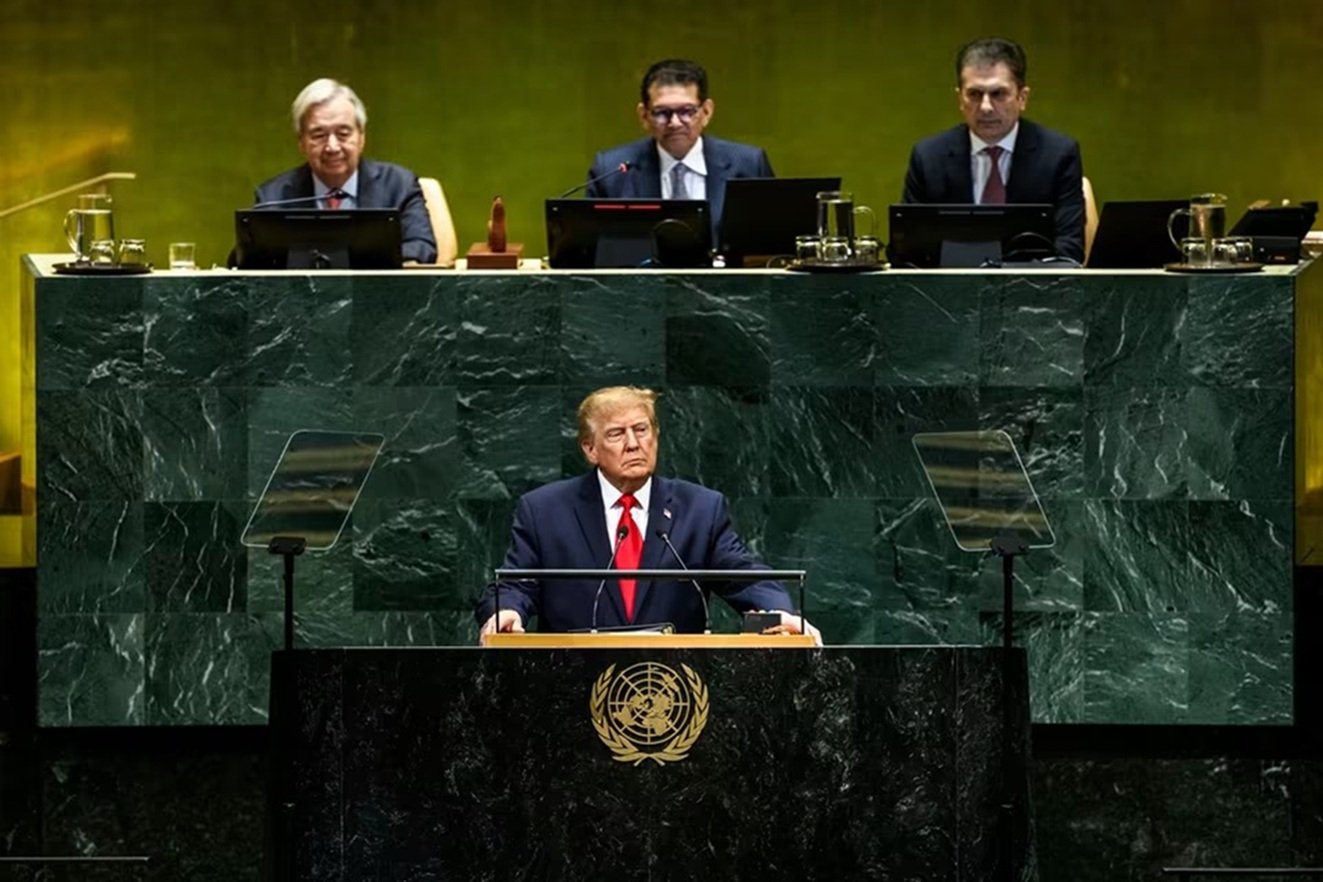
President Donald Trump defended his administration’s use of U.S. military power against Iran and in the Western Hemisphere, using a wide-ranging address to the United Nations General Assembly to promote his domestic record, criticize international institutions and outline his approach to conflicts and security threats around the world.
Trump spoke for about 37 minutes before world leaders gathered in New York for the 81st session of the General Assembly. Iran dominated much of the address, which also covered Venezuela, Mexico, Cuba, Greenland, Gaza, Ukraine, immigration, artificial intelligence and U.S. relations with the United Nations.
The president opened by portraying the United States as economically and militarily stronger since he returned to office in January 2025. He cited employment, poverty, household income, investment, crime, and border statistics as evidence of improvement, frequently contrasting his administration with that of former President Joe Biden.
Trump said his administration had reduced federal regulations and taxes while attracting trillions of dollars in investment commitments. He also credited his immigration policies with sharply reducing illegal border crossings and claimed violent crime had declined.
The president then turned to foreign policy, arguing that the United States should confront emerging threats rather than allow them to develop.
“While others have talked, I have acted,” Trump said.
Trump devoted a substantial portion of his speech to the conflict with Iran, defending U.S. military operations and reiterating his longstanding position that Tehran must not obtain a nuclear weapon.
Trump said his administration initially sought negotiations with Iran before turning to military action. He described U.S. attacks on Iranian nuclear and military infrastructure as necessary to prevent Tehran from developing nuclear weapons.
He also called on other countries to economically isolate Iran until its government ends attacks on commercial shipping, abandons what he described as its nuclear weapons ambitions, and stops supporting militant organizations.
Trump issued some of his strongest language while discussing the possibility of further military action, threatening to “annihilate” Iran if negotiations fail. At the same time, he predicted that an agreement could be reached after the November U.S. midterm elections.
Iran has disputed the U.S. characterization of its nuclear program and has maintained that its nuclear activities are for peaceful purposes. Its government has also accused Washington of undermining diplomacy through military action. Iran’s delegation walked out during Trump’s criticism of Tehran, according to The Associated Press.
Trump referenced the Sept. 11, 2001, terrorist attacks in the United States and the Hamas-led attack on Israel on Oct. 7, 2023, while accusing Iran of supporting terrorism and posing a broader threat to international security.
The president also defended U.S. military operations targeting Iranian naval, missile and drone capabilities. He said continued pressure would eventually produce an agreement or further weaken the Iranian government.
Trump pointed to the end of the Gaza war and the return of hostages as examples of his administration’s diplomatic record. He thanked countries that contributed money, personnel, or other assistance to stabilization and reconstruction efforts.
He also cited agreements involving several other international disputes while arguing that his personal relationships with foreign leaders, along with tariffs and economic pressure, had helped resolve conflicts.
Trump said his administration continued working with Russia and Ukraine toward ending their war. He described the number of soldiers being killed as unacceptable and said he wanted the fighting to stop.
The Russia-Ukraine war remained among the major conflicts confronting leaders gathering at the United Nations. U.N. Secretary-General António Guterres used his address Tuesday to call for an end to ongoing wars and greater international cooperation.
Trump also defended U.S. military intervention in Venezuela that resulted in the capture of Nicolás Maduro. He said the operation demonstrated that Washington would no longer tolerate what his administration considers security threats in the Western Hemisphere.
The administration has since worked with Venezuela’s interim leadership and recently announced a major oil agreement involving Venezuelan reserves. Trump said increased production could benefit both countries and help reduce global energy prices.
The president framed Venezuela as part of a broader effort to reassert U.S. influence in the Western Hemisphere.
“If necessary, we will use our unmatched military might to secure the vital national interests of the United States,” Trump said.
Trump also discussed drug cartels, comparing them to the Islamic State group and defending military strikes against vessels suspected of transporting narcotics.
He singled out Mexico as a center of cartel activity and said its government needed to regain control of territory affected by organized crime. Trump also said his administration maintains a good relationship with the Mexican government and that the two countries have made progress in combating cartels.
Trump described Cuba as a failing communist state and said Secretary of State Marco Rubio was involved in negotiations with Havana. He also accused the Cuban government of cultivating relationships with left-wing organizations in the United States.
Turning north, Trump discussed a new security agreement involving the United States, Denmark and Greenland that expands the American military presence on the strategically important Arctic island.
The agreement allows an expanded U.S. defense presence while Greenland remains a semiautonomous territory within the Kingdom of Denmark. The arrangement includes additional defense areas and comes after months of tensions generated by Trump’s previous effort to acquire Greenland.
Trump said the agreement would strengthen security in the Arctic and North Atlantic and help protect the United States and Europe.
Trump also used the speech to criticize parts of the international system, including the International Criminal Court and U.N. human rights institutions.
He urged countries participating in the ICC to withdraw, arguing that U.S. military personnel should not be subject to its jurisdiction. The United States is not a party to the Rome Statute that established the court.
Trump also criticized international approaches to immigration and transgender policies, arguing that individual countries should retain authority over their borders and domestic policies.
“There is no human right to illegal immigration, but there is a right to remain a sovereign nation,” Trump said.
His criticism reflected a broader theme throughout the address: opposition to international institutions or agreements that he believes constrain U.S. sovereignty.
Trump also addressed artificial intelligence, saying the United States should remain the global leader in the rapidly developing technology while resisting international regulatory systems that could restrict its development.
He proposed replacing the term “artificial intelligence” in U.S. government usage with “superintelligence,” arguing that the word “artificial” inaccurately suggests the technology is fake.
Trump said the administration would encourage technological development while using the Justice Department and other federal agencies to address potential problems.