


Sheinbaum Defends Mexico’s Sovereignty, Highlights Government Gains in Second Government Report
Share your love
 -Editorial
Mexican President Claudia Sheinbaum used her Second Government Report Tuesday to outline what her administration described as progress in the economy, security, infrastructure, health care and social programs, while emphasizing Mexico’s sovereignty and its continued cooperation with other countries.
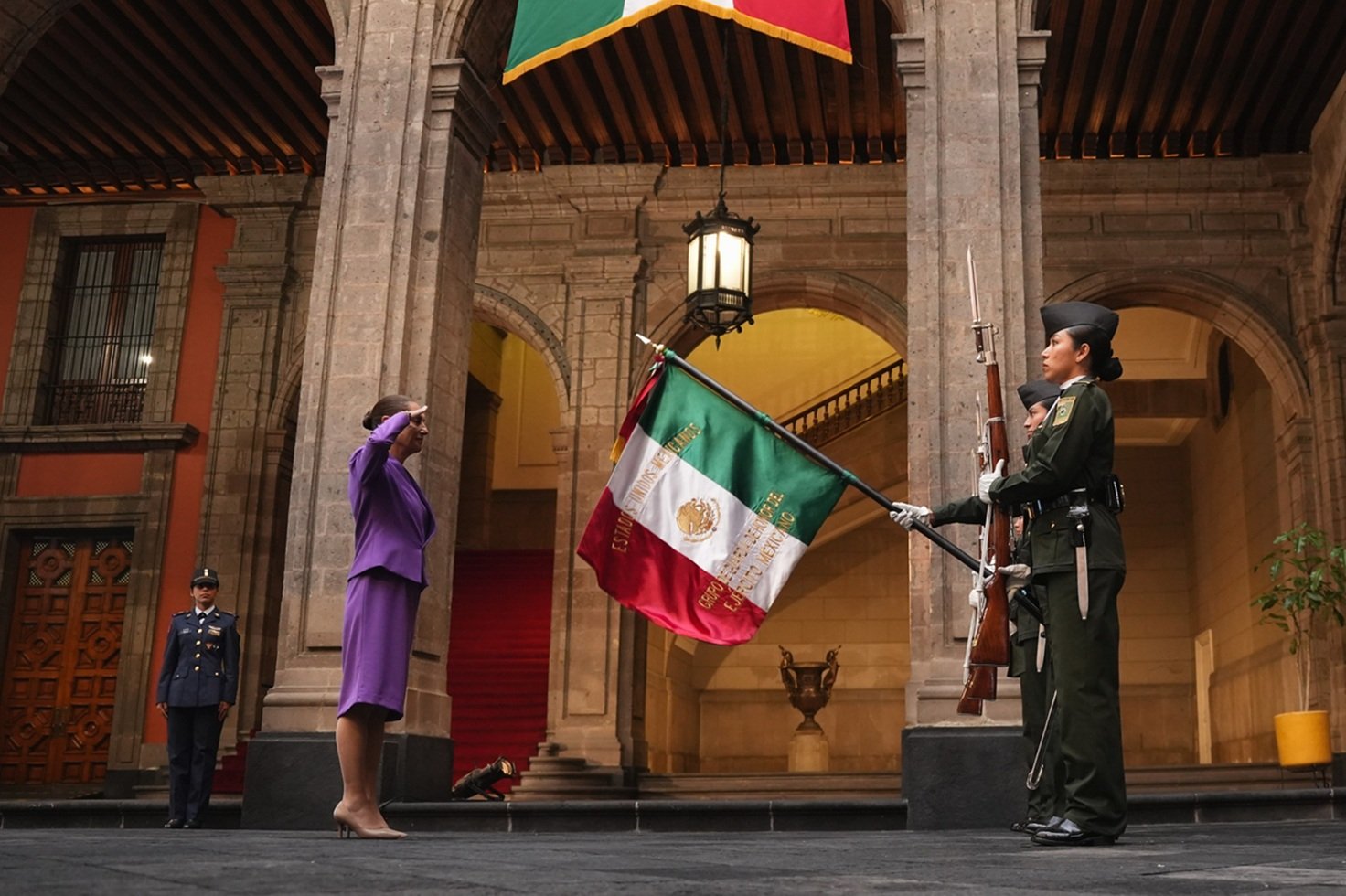
Speaking from the National Palace, Sheinbaum said Mexico is “better” and moving in a clear direction determined by its people. She also addressed the country’s relationship with the United States, stressing that her government intends to maintain dialogue and cooperation while protecting Mexico’s sovereignty and national principles.
“As long as I have the honor of serving as president of the republic, I will firmly defend our sovereignty, dignity and independence,” she said. “Mexico is a sovereign country, and sovereignty is not negotiated, surrendered or shared.”
Relations with the United States
The bilateral relationship with the United States was a central part of Sheinbaum’s message. She said cooperation between the two countries would continue, but not at the expense of Mexico’s sovereignty.
The framework she has outlined for the relationship is based on four principles: respect for sovereignty and territorial integrity; shared and differentiated responsibility; mutual respect and trust; and “cooperation without subordination.”
That approach calls for coordination on issues including security and trade while maintaining the relationship between equals. The president has repeatedly argued that a strong partnership with the United States does not require Mexico to abandon its principles or accept outside interference.
She said the two governments continue to hold discussions on trade and have reached agreements on security cooperation. Cooperation, she added, should not be interpreted as submission, just as friendship does not require Mexico to give up its principles.
Economy and Investment
Nearly 23 months into her administration, Sheinbaum said Mexico has undergone significant changes and rejected suggestions of divisions within the political project she inherited from former President Andrés Manuel López Obrador.
She reaffirmed her commitment to what the government calls the “Fourth Transformation,” the political movement associated with López Obrador’s administration and now continued under her leadership.
On the economy, the president presented several indicators that she said reflect continued stability. According to the figures cited in the report, Mexico attracted a record $35 billion in foreign direct investment, a 12% increase from 2024.
Gross domestic product grew 1.4% in the second quarter compared with the previous quarter and 1.9% compared with the same period in 2025, she said.
She also pointed to an exchange rate of approximately 17 pesos to the U.S. dollar and said Mexico recorded a positive trade balance for the second consecutive year.
Government figures presented during the address showed current spending had been reduced by 200 billion pesos compared with 2024, while federal revenues reached 6.046 trillion pesos. She also reported a 12% decline in the prices of 24 basic grocery products.
As part of the government’s Mexico Plan, the administration is developing industrial parks intended to attract investment and expand manufacturing. Sheinbaum said 25 of a planned 100 parks are already operating.
A presidential office created to promote investment also approved 19 projects valued at $3.76 billion during its first four months, according to the report.
Social Programs and Education
Social spending represented another major component of the address.
The government estimates that federal welfare programs will reach 42.86 million beneficiaries by the end of 2026, representing an investment of approximately 1 trillion pesos.
Education was also highlighted. Sheinbaum said scholarships are now reaching students in primary and high school and that more than 73,000 basic and upper-secondary schools received funding through the La Escuela Es Nuestra program in 2026.
More than 657,000 students graduated from the first generation of the National Baccalaureate, she said. The administration has also increased its six-year target for expanding higher education, with a goal of creating 400,000 additional places.
The government has eliminated high school entrance exams in 17 states and introduced the Mi Derecho, Mi Lugar system, which is intended to expand access to secondary education.
Security
On security, Sheinbaum pointed to a reported decline in homicides as one of the most significant indicators of progress.
She said the National Security Strategy has contributed to a 51% reduction in homicides over two years, a figure she characterized as equivalent to 44 fewer homicides per day.
Between October 2024 and July 2026, authorities arrested approximately 63,000 people, seized 32,824 firearms and 519 tons of drugs, and dismantled 2,725 clandestine laboratories, according to figures presented in the report.
The administration also reported holding 665 Peace Fairs and providing more than 1 million services through programs focused on addressing the social and economic causes associated with violence.
Health Care
Health care was another major area addressed during the report.
Sheinbaum said 33 hospitals operated by the Mexican Social Security Institute, the Institute for Social Security and Services for State Workers and IMSS-Bienestar were completed and opened during the first two years of her administration.
The government also reported the completion of 11 family medicine units, 36 health centers and clinics, and 650 modern operating rooms.
Over the course of the six-year administration, officials plan to build another 152 health facilities, adding approximately 9,000 hospital beds.
The Salud Casa por Casa program has also expanded. According to government figures, 20,000 health professionals have conducted approximately 23 million home visits.
Wages and Labor
On employment, Sheinbaum described the current period as a “labor spring,” pointing to rising wages and changes in labor protections.
The monthly minimum wage has increased from 2,800 pesos in 2018 to 9,582 pesos in 2026, a 154% increase, according to figures presented during the address. In the northern border region, the minimum wage has reached 13,409 pesos per month.
The administration also reported a record average formal-sector salary of 20,212 pesos per month, a historic low in labor poverty and approximately 60 million people employed. Sheinbaum said 86,765 jobs had been created through the end of August.
Recent labor legislation establishes a 40-hour workweek by 2030. App-based workers have also gained access to social security and profit-sharing under new rules.
Housing and Infrastructure
Housing remains another major component of the administration’s agenda. Sheinbaum said government housing programs are expected to benefit 12 million families during the six-year term.
The broader goal includes constructing 1.8 million homes. Of those, approximately 278,000 are currently under construction and 90,000 have already been assigned, according to the report.
The government also reported that 779,000 families have obtained mortgage loans through the Federal Mortgage Society, while another 717,000 have received loans or assistance for home improvements.
Infrastructure plans extend to roads and railways. Sheinbaum said 88% of the country’s 51,000 kilometers of toll-free federal highways have been repaved.
Among the projects cited were the Bavispe-Nuevo Casas Grandes highway, the Nichupté Bridge in Cancún and the Pátzcuaro-Uruapan highway.
The administration plans to invest 700 billion pesos in combined public and private funding to improve or expand approximately 5,000 kilometers of highways.
Passenger rail projects are also moving forward, including planned routes connecting Mexico City with Querétaro, Querétaro with Nuevo Laredo and Guadalajara, as well as projects in southern Mexico. The government is also advancing freight rail service connected to the Maya Train network.
Energy and Water
Energy policy featured prominently in the report. Sheinbaum said Petróleos Mexicanos has reduced its debt by $20 billion and that national oil production currently stands at 1.77 million barrels per day.
Natural gas production was reported at nearly 5 billion cubic feet per day, while the national refining system processes more than 1.5 million barrels per day.
The Olmeca refinery in Dos Bocas, Tabasco, was highlighted as part of the government’s strategy to strengthen domestic fuel production and address fuel prices and supply.
The administration has also built six combined-cycle power plants with a combined capacity of 3,000 megawatts and upgraded eight hydroelectric plants. The Federal Electricity Commission is implementing an investment plan exceeding 244 billion pesos to expand and modernize electricity transmission and distribution networks.
Water policy has also undergone changes. Sheinbaum said reforms to the National Waters Law have resulted in the recovery of more than 5 billion cubic meters of water from private concessions and the issuance of 12,346 concession titles.
The government is simultaneously working on cleanup efforts for the Atoyac, Lerma-Santiago and Tula rivers. Twenty-three water-treatment plants and 282 kilometers of collectors are being built or rehabilitated, according to the report.
Women and Indigenous Communities
The president also highlighted policies targeting women and Indigenous and Afro-Mexican communities.
More than 1,000 LIBRE Centers for women are expected to open this year, while 27 million booklets outlining women’s rights have been distributed, according to government figures.
Sheinbaum said 190,375 women have joined the Red de Tejedoras de la Patria network. Her administration has also promoted legislation addressing the prevention, investigation and punishment of femicide, as well as reparations for victims.
For Indigenous and Afro-Mexican communities, the government reported distributing 25 billion pesos to 19,000 communities and returning 13,000 hectares of land. Another 177,632 hectares are currently in process, according to the report.
Throughout her address, Sheinbaum presented the figures as evidence of progress under her administration while acknowledging that the government’s agenda remains tied to the broader political transformation launched under López Obrador.
The report ultimately returned to a theme that has become central to her presidency: that Mexico’s future should be determined domestically while maintaining constructive relationships abroad.
“Only with honesty are true results achieved,” Sheinbaum said. “We are doing better and we have a direction, because that direction is marked by the people.”