



Sheinbaum Announces Forums on Regulating Children’s Social Media Use
Share your love
 -Editorial
Mexican President Claudia Sheinbaum announced that her administration will hold a series of regional forums to develop a consensus-based proposal for regulating the use of digital platforms and social media by children and adolescents.
The proposal, which would be presented to Mexico’s Congress, is intended to address the impact of digital technologies on minors while incorporating input from educators, parents, researchers, students and other stakeholders, according to the federal government.
The remaining forums are scheduled for Aug. 19 in Nuevo León, Sept. 3 in Chiapas and Sept. 17 in Guerrero. Government officials said similar meetings have already been held in the metropolitan region, the Northwest and the Center-West of the country.
Speaking during her daily news conference, Sheinbaum said the objective is to develop the proposal through public discussion rather than imposing government regulations unilaterally. She said the forums will examine scientific research on issues such as excessive screen time, sleep disruption, digital addiction and the effects of technology on family interactions and child development.
Sheinbaum also noted that 16 Mexican states have already adopted measures restricting or prohibiting cellphone use in schools. She said the federal initiative seeks to promote the responsible use of technology while exploring whether additional national regulations are warranted.
The president announced that her administration’s Monday morning news conferences over the next month will focus on presenting scientific evidence and perspectives from experts and other sectors regarding technology use.
Education Secretary Mario Delgado said more than 70% of Mexico’s population age 6 and older uses the internet, with that figure rising to about 90% among adolescents. He cited United Nations data showing that people ages 15 to 24 are the world’s most connected age group, describing the regulation of digital technology and social media as a global issue.
Delgado said the forums will examine the role of technology in education and its effects on mental health while gathering input from parents, teachers, school administrators and families before drafting a legislative proposal.
Ricardo Villanueva Lomelí, Mexico’s undersecretary of higher education, said universities and higher education institutions from across the country are being invited to participate to ensure the discussions include perspectives from multiple academic disciplines. He said future discussions will also involve school communities and families and announced plans for a National Week of Traditional Mexican Games aimed at encouraging free play among children.
Andrés Morales Arciniegas, UNESCO’s representative in Mexico, said technological change has transformed education and communication while creating new challenges for children and young people. He cited UNESCO data indicating that one in three internet users worldwide is a child or adolescent and said 58% of countries, representing 114 education systems, had implemented some form of regulation on technology use in schools as of March 2026.
According to UNESCO, those measures include restrictions on cellphone use in elementary and secondary schools, limits on minors’ access to social media, screen time guidelines, educational campaigns promoting responsible technology use and school-level policies governing digital devices.
Morales said UNESCO recommends that any future regulations be accompanied by digital, media and algorithmic literacy programs, broader public discussions about emerging technologies such as artificial intelligence and neurotechnology, and additional research to support evidence-based policymaking.
Educational psychologist Cimenna Chao Rebolledo, speaking remotely from New York, presented research citing data from Mexico’s Education Ministry and the National Institute of Statistics and Geography showing that people age 16 and older spend an average of 7.32 hours online each day. She also said the findings indicate widespread use of generative artificial intelligence among students.
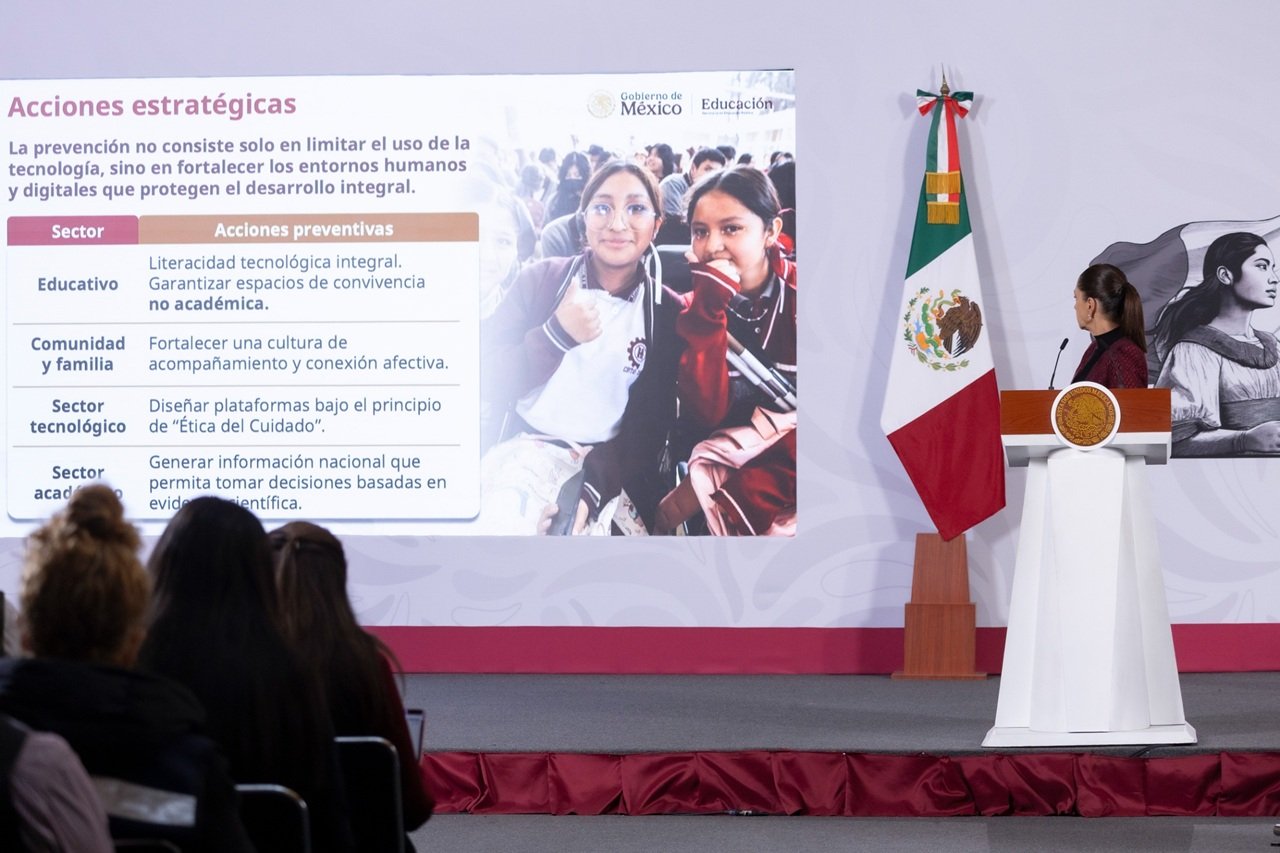
Chao said efforts should focus on strengthening educational, family and technological environments that support healthy development rather than relying solely on restrictions. She recommended expanding digital literacy, encouraging family dialogue about technology use, promoting online safety measures for minors and increasing research to inform future public policy.