


Imperial County Supervisors Approve Data Center Moratorium
Share your love
 -Editorial
After seven months of sustained public debate, community opposition, and ongoing discussion surrounding proposed data center development in the Imperial Valley—and following the adoption of similar moratoriums by several cities in the region—the Imperial County Board of Supervisors voted to approve a 45-day moratorium on new data center projects during its June 16 meeting.
The board also established an ad hoc committee tasked with reviewing the issue and providing recommendations regarding potential policies, regulations, and future development standards related to data center activity.
The ordinance was adopted under California Government Code Section 65858, which allows local governments to enact temporary land-use restrictions while reviewing potential zoning or planning changes.
Under the approved measure, the moratorium takes effect immediately and halts new data center entitlements while county officials evaluate possible updates to zoning regulations and land-use policies. The ordinance may be extended following a public hearing for up to 10 months and 15 days if the board determines additional study time is necessary.
The ad hoc committee will serve in an advisory capacity only, with final authority remaining with the Board of Supervisors. It is expected to include 19 members representing a broad range of stakeholders, including local governments, education, labor, business, nonprofit organizations, environmental interests, healthcare, and the energy sector, along with appointed supervisors and representatives from each incorporated city in the county.
County staff will open applications, coordinate appointments, and may retain technical consultants to assist in evaluating data center impacts and regulatory options.
The advisory committee is expected to examine a range of potential policy tools, including amendments to the county’s General Plan and zoning ordinance, the use of specific plans, and possible location or buffer requirements for data center facilities near residential neighborhoods, schools, and other sensitive land uses.
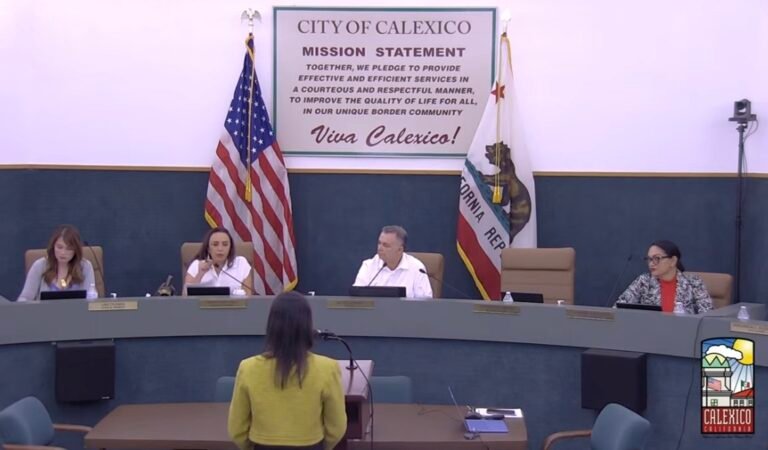
Resident Jake Tison delivered sharply critical remarks regarding data center development and the county’s decision to establish an ad hoc committee to study the issue.
Tison questioned the effectiveness of the committee structure, arguing that it would delay decisive action.
“The destructive stuff is still going to come in during the building process,” he said. “Forming a committee means you are not going to do the work yourselves. You’re going to have the no-accountability act again.”
He added, “It’s kind of like how you guys function around here. Let’s have somebody else take care of it.”
Tison further called for an outright ban on data centers in the Imperial Valley, stating they are not compatible with local conditions. He cited environmental and public health concerns, including extreme heat, strained water supplies, poor air quality, asthma rates, agricultural pressures, and increasing energy demand. He argued that large-scale data center development places additional burdens on existing infrastructure and resources.
“They call it innovation, they call it progress, they call it economic development,” Tison said, “but what kind of progress threatens our air, our water, our homes, our health, and our peace?”
Referencing constitutional language, Tison also questioned whether current development trends align with community well-being.
“The American promise is supposed to include life, liberty, and the pursuit of happiness,” he said. “But how can families pursue happiness when industrial-scale data centers are placed near neighborhoods?”
He continued, saying that children’s health and quality of life could be affected by increased industrial activity. He argued that essential resources such as water and energy should prioritize residents, agriculture, schools, hospitals, and small businesses.
Tison added that the pursuit of happiness is not merely a phrase; it includes the right to live in peace, raise a family without industrial harm at one’s doorstep, breathe clean air, sleep at night, and trust that elected leaders are protecting the public rather than sacrificing it.
“It’s obvious there is a lack of leadership in this room,” he said.
He concluded by urging supervisors to take a firm stance against future development of large data center facilities in the county.
“This is not Data Center Alley; this is the Imperial Valley,” Tison said. “The Imperial Valley is our home, and we refuse to continue being an industrialized sacrifice zone. Ban these data centers in the Imperial Valley, protect the people, protect our water, protect our health, and protect our American pursuit of happiness.”
Gina Brister Snow spoke in support of the proposed moratorium on data center development while also raising concerns about transparency, governance structure, and the role of the newly formed ad hoc committee.
“I support the moratorium because residents deserve a pause, but residents also deserve a real cause,” she said.
Brister Snow argued that if existing rules are significant enough to justify pausing development, then they should also be strong enough to prevent ongoing exemptions or modifications during the review process.
“If these rules are important enough to pause and study, they are important enough to stop accepting modifications under them,” she said.
She added that the purpose of the moratorium should be to protect public confidence, not preserve uncertainty for future projects.
“What is being preserved is not the public’s confidence; it is the county’s objective,” she said, adding that when government is considering whether stronger protections are necessary, “the benefit of that uncertainty should belong to the public, not future projects, not pending projects, and certainly not projects that remain exempt from the very protections this board is now suggesting are necessary.”
Brister Snow questioned the need for a large-scale advisory process, arguing that the creation of a committee suggested either delayed recognition of public concerns or an unnecessary response to issues that should have already been addressed.
“You do not pause a process that needs no corrections. You do not pause a framework that needs no improvements, and you do not appoint a 19-member committee to investigate concerns that never existed,” she said.
She outlined two possible interpretations of the county’s actions.
“Either the public spent months raising legitimate concerns that were dismissed until they became politically impossible to ignore, or this board is proposing a moratorium, an advisory committee, and potential future amendments to solve a problem that never existed,” she said. “I think the public is smart enough to determine which explanation is more likely.”
While Brister Snow said she supports the formation of the committee, she emphasized concerns about how it is structured and whether it can maintain public trust.
“What I do not support is asking the public to place its trust in a committee appointed by the same governing structure that spent months giving them reasons not to,” she said, adding that “the real issue here is not the committee. The real issue is control.”
She said residents have repeatedly pushed for greater inclusion in discussions surrounding data center development.
“The public has spent months demanding a seat at the table. This resolution offers them an application for one,” she said.
Brister Snow also questioned whether the process meaningfully reflects public participation or simply formalizes limited input.
“After months of residents forcing this conversation, forcing this moratorium, and forcing this board to confront concerns it spent months defending against, the public is still expected to ask permission to participate in what comes next.”
She added that the structure of the committee risks appearing self-referential rather than independent.
“I do not think this board should be surprised that many residents are struggling to tell the difference between an objective review and the government grading its own homework,” she said.
Brister Snow called for greater transparency and public access to the committee’s work.
“The public should be able to see the committee’s work. The public should be able to review its recommendations, and the public should be able to weigh in before these recommendations return to this board for action,” she said.
She concluded by emphasizing that public confidence is tied to shared decision-making and openness.
“Confidence is not restored when government appoints a committee to advise government. Confidence is restored when government is willing to surrender enough control to prove it is actually listening,” she said.
“The public brought you to this conversation, to this moratorium, and to the reality that the concerns residents were criticized for raising were never the problem. Ignoring them was.”
Tom Dubose of DuBose Design Group said during public comment that he supports forming an ad hoc committee but opposes the proposed moratorium on data centers, arguing that the ordinance contains drafting issues.
He said the county should ensure economic development representation on the committee and pointed to Imperial County’s industrial and energy assets as opportunities for local job creation and revenue retention.
Dubose referenced past county development tied to defense industry facilities, saying those projects demonstrated both challenges and potential for growth.
He added that while Imperial County produces significant renewable energy, much of it is used outside the region. Future projects, he said, could help retain energy resources, jobs, and tax benefits locally.