


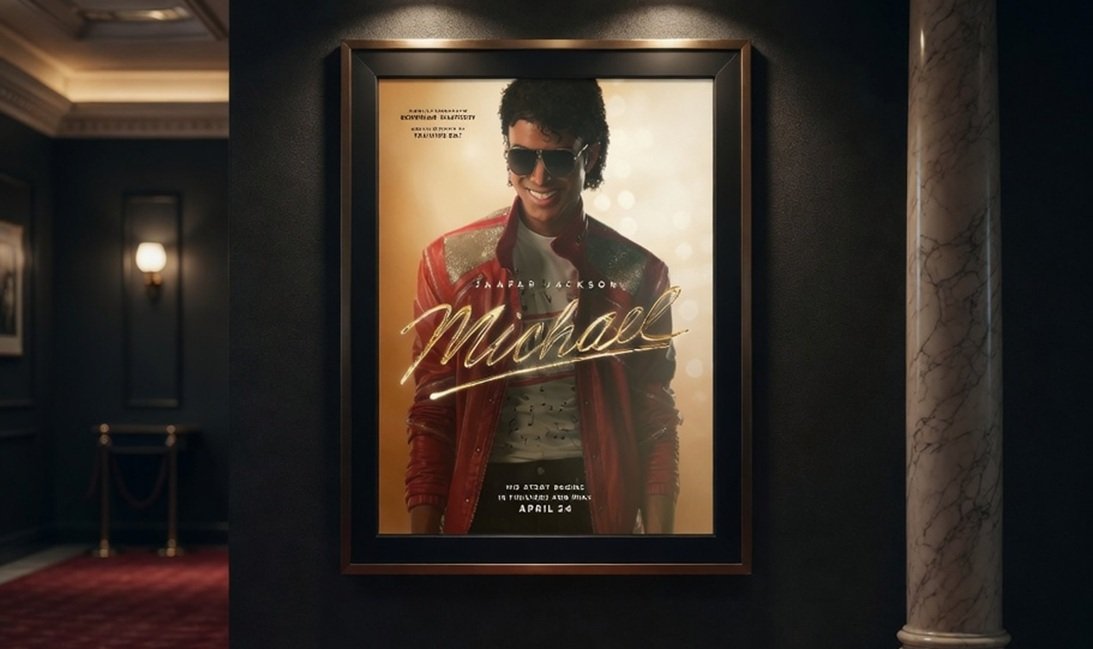

“Michael”: The King of Pop Reimagined on Screen
Share your love
 By: Ellie Burgueño, Journalist and Writer.
There are names that don’t need introductions. “Michael Jackson” is one of them. The moment you hear it, it doesn’t feel like you’re thinking about a person so much as a cultural force—an echo that has moved through generations, stages, headlines, and living rooms around the world. So when news broke of a new biographical film simply titled Michael, it was almost inevitable that audiences would be drawn in with curiosity, nostalgia, and expectation.
I went to see it on a Sunday, not alone, but with both of my daughters. They’re at that age where music is still discovery and emotion at the same time. They watch, listen, and absorb everything without the filters adults tend to build. From the very first scenes, both of them were immediately captivated by Jaafar Jackson’s performance. There was no need for explanation or context in that moment—just recognition that something on screen carried presence, rhythm, and familiarity.
For me, Michael Jackson was never just history. As the youngest of nine siblings, raised in a home where music was always present in the background, I inherited sound before I fully understood it. There was a nearly ten-year gap between me and my closest sibling, which meant I grew up inside a household layered with different eras of music and influence. Somewhere in that mix was an old disc player, slightly worn records, and Michael Jackson’s voice cutting through everything else.
I remember watching his videos as a child—“Thriller,” “Billie Jean”—not fully grasping their cultural magnitude, but instinctively understanding that what I was witnessing was something different. The precision, the movement, the silence between beats. Even then, he didn’t feel like just a performer. He felt like someone rewriting the language of performance itself.
By the time I was six, I was already singing in church choir. Music existed in my life, but more as devotion than ambition. In my upbringing, shaped by strong Christian values, secular music was admired from a distance rather than embraced as a path. Still, it lived in me quietly, as it does in many people who never fully pursue it but never truly leave it behind either.
That emotional backdrop followed me into Michael, the 2026 biographical film directed by Antoine Fuqua and produced with the cooperation of the Jackson estate. The film arrives with significant anticipation and has performed strongly at the box office in its early run, drawing large international audiences even as critical reception remains divided.
At the center of the film is Jaafar Jackson—Michael Jackson’s nephew—whose performance has become one of the most discussed elements of the production. His portrayal does not rely solely on imitation; it leans into embodiment. He captures not just the choreography and vocal cadence, but also a studied emotional stillness that many viewers associate with Michael Jackson’s stage presence. For both of my daughters, that presence was enough. They didn’t analyze it—they simply watched, engaged, and stayed with it.
The film traces Jackson’s journey from childhood performer in The Jackson 5 to global superstardom, revisiting the creative peaks that reshaped music videos and live performance. It gives space to the construction of iconic moments—stage design, choreography, and the cultural impact of songs that became global reference points.
But Michael also touches, at least partially, on a more complicated emotional terrain. The film reflects aspects of Jackson’s own long-stated accounts of his childhood, particularly his descriptions of an intense and often controlling upbringing under his father, Joe Jackson. Historically, Michael Jackson spoke publicly about experiencing strict discipline and emotional strain during his early years in the music industry—an upbringing that he said came at the cost of a normal childhood. The film integrates fragments of that tension, suggesting how early fame and familial pressure shaped both his discipline and his sense of loss.
 These elements sit alongside the broader, unavoidable complexity of Jackson’s legacy. His life has been extensively documented, celebrated, and scrutinized. He was acquitted in a 2005 criminal trial and consistently denied allegations made against him during his lifetime, yet public debate around his legacy continues across documentaries, biographies, and cultural discourse. The film does not attempt to resolve those tensions, but it does choose where to place its emotional focus, leaning more heavily toward artistry, internal conflict, and formative experience.
Watching it, I found myself less focused on interpretation and more on observation—on how a life so publicly dissected is translated into cinematic language. Biopics rarely provide closure when the subject remains as globally debated as Michael Jackson. Instead, they offer perspective fragments: memory shaped into narrative, performance shaped into history.
What stayed with me most was not a single scene, but the experience of watching my daughters react to the music. They didn’t see headlines or legacy debates. They saw rhythm, movement, emotion, and a performer who seemed to command space and time. For a brief moment, I recognized that same kind of discovery I once had as a child—before context, before critique, before everything music later becomes.
That, perhaps, is the enduring paradox of Michael Jackson. He is both universally known and endlessly interpreted. A figure whose artistry continues to inspire and whose life continues to be examined from every possible angle.
As the credits rolled, I didn’t leave with conclusions. I left with contrast—between memory and reinterpretation, between history and storytelling, between the public figure and the private experience of music itself.
And maybe that is what Michael ultimately offers: not resolution, but reflection.